CARE
Safeguards, Standards and Safeguard Information Systems
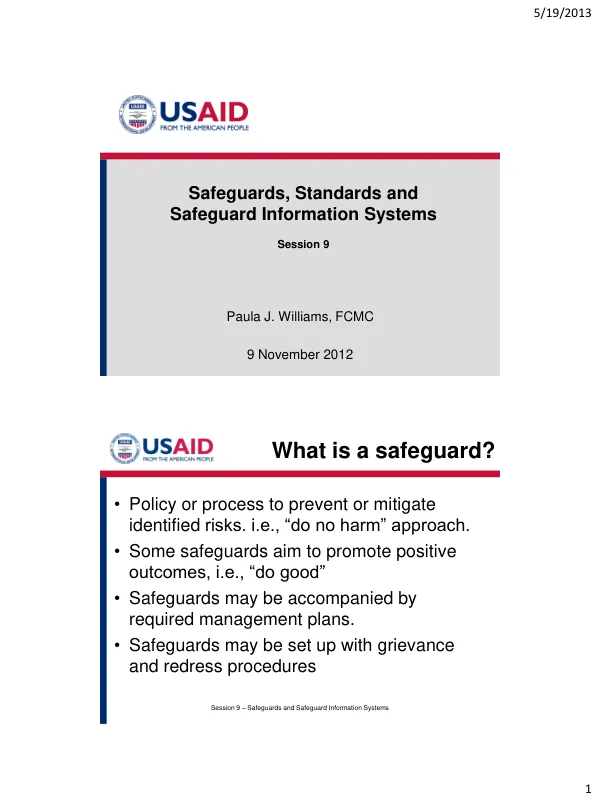
Safeguards are policies or processes designed to prevent or mitigate identified risks, often adopting a "do no harm" approach.
2013 · 12 pages
Sign in to readA free account is required to download.
Abstract
Some safeguards aim to promote positive outcomes, known as the "do good" approach. These measures may be accompanied by required management plans and grievance and redress procedures. Types of safeguards include measures to protect against or minimize social and environmental damage or harm. Different types of safeguards focus on policies to minimize harm and/or increase benefits, monitoring for compliance with safeguards and grievance procedures, and specifying criteria or standards to be met. Safeguards may be separate, such as social safeguards, environmental safeguards, or integrated (social and environmental). Standards are defined and measurable levels of performance that must be achieved in relation to a particular criterion. Standards are often structured into hierarchical principles, criteria, and indicators that aim to demonstrate positive performance. They may be enforced through audits and are used in various contexts, including climate, community, and biodiversity initiatives. The Climate, Community, and Biodiversity Alliance (CCBA) has developed CCB Standards for project-level initiatives, while the REDD+ SES Standards are used for government-led REDD+ programs. Certification standards for various commodities, such as forest certification, biofuels, palm oil, and soybeans, also exist. The 7 UNFCCC REDD+ Safeguards, agreed in Cancun in 2010, are the internationally-agreed minimum requirements. These safeguards include actions consistent with national forest programs, transparent and effective national forest governance structures, respect for indigenous peoples' and local communities' knowledge and rights, and full and effective participation of relevant stakeholders. The UNFCCC Cancun Safeguards have been categorized as Governance Safeguards, Social Safeguards, Environmental Safeguards, and Carbon Safeguards. However, these categories overlap, and the UNFCCC text also refers to the importance of gender issues, land tenure, and other social and environmental issues. Other safeguards and standards systems exist, including those developed by the World Bank, UN-REDD, and multilateral REDD+ support partners. These systems address various social and environmental issues, such as property rights, stakeholder participation, indigenous peoples' rights, and gender. A comparative analysis of these systems reveals that no existing system covers the full range of social issues in REDD+, and there is a need for consolidation and simplification. Ongoing work is being done on environmental and biodiversity safeguards, particularly in relation to the Convention on Biological Diversity (CBD). Building on national safeguards and other processes, such as national Environment Impact Assessment requirements, is also underway. Reporting guidelines on Safeguard Information Systems (SIS) are still under discussion by the UNFCCC, with possible provision of information linked to national reporting to the UNFCCC.
Related documents