USAID DEC
Sahel Resilience Learning Project (SAREL) Fact Sheet
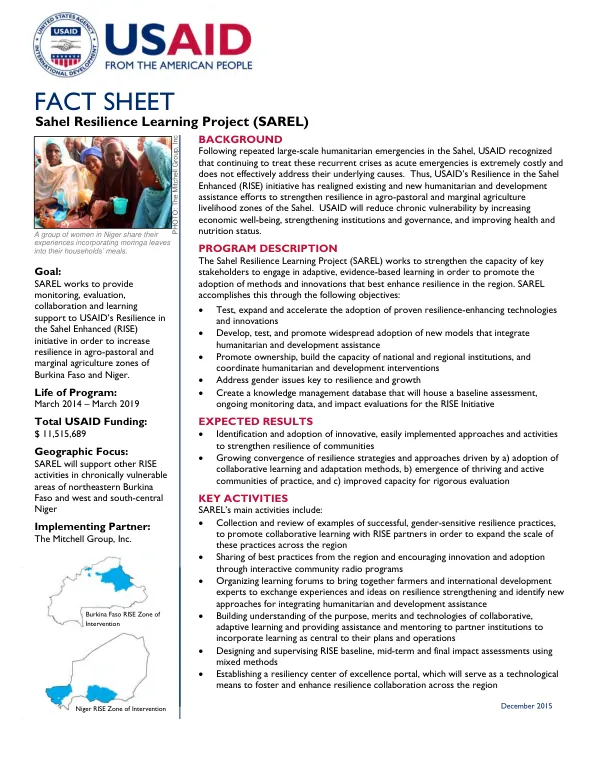
The Sahel Resilience Learning Project (SAREL) aims to increase resilience in agro-pastoral and marginal agriculture zones of Burkina Faso and Niger.
2016 · 1 pages
Sign in to readA free account is required to download.
Abstract
SAREL works to provide monitoring, evaluation, collaboration, and learning support to USAID's Resilience in the Sahel Enhanced (RISE) initiative. The project's goal is to strengthen the capacity of key stakeholders to engage in adaptive, evidence-based learning and promote the adoption of methods and innovations that enhance resilience in the region. SAREL's objectives include testing, expanding, and accelerating the adoption of proven resilience-enhancing technologies and innovations, developing and promoting new models that integrate humanitarian and development assistance, and promoting ownership and building the capacity of national and regional institutions. The project also aims to address gender issues key to resilience and growth, and create a knowledge management database to house baseline assessments, monitoring data, and impact evaluations for the RISE Initiative. The project's expected results include the identification and adoption of innovative approaches and activities to strengthen community resilience, growing convergence of resilience strategies and approaches, and improved capacity for rigorous evaluation. SAREL's main activities include collecting and reviewing examples of successful, gender-sensitive resilience practices, sharing best practices through interactive community radio programs, and organizing learning forums to bring together farmers and international development experts. SAREL's geographic focus is on chronically vulnerable areas of northeastern Burkina Faso and west and south-central Niger. The project's life span is from March 2014 to March 2019, with a total USAID funding of $11,515,689. The implementing partner is The Mitchell Group, Inc. SAREL's work is part of USAID's broader effort to strengthen resilience in the Sahel, which aims to reduce chronic vulnerability by increasing economic well-being, strengthening institutions and governance, and improving health and nutrition status. The project's approach to promoting resilience is centered on collaborative learning and adaptation methods, with a focus on building the capacity of national and regional institutions and coordinating humanitarian and development interventions. SAREL's activities are designed to promote the adoption of innovative, easily implemented approaches and activities to strengthen community resilience, and to create a knowledge management database that will house a baseline assessment, ongoing monitoring data, and impact evaluations for the RISE Initiative.
Related documents