USAID DEC
Groundswell International: Building Resilience and Improving Nutrition in the Sahel
Groundswell International has been working to build the resilience and improve nutrition of communities in the Sahel's ecologically fragile dry lands.
2020 · 2 pages
Sign in to readA free account is required to download.
Abstract
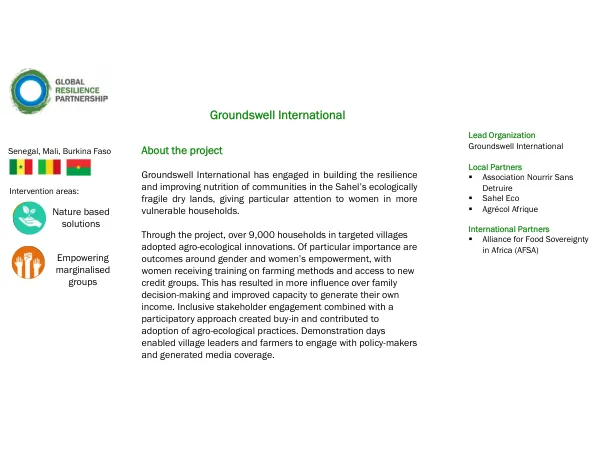
The organization has given particular attention to women in more vulnerable households, recognizing their critical role in food security and household decision-making. Through the project, over 9,000 households in targeted villages adopted agro-ecological innovations, with a focus on empowering women through training on farming methods and access to new credit groups. This empowerment has resulted in women having more influence over family decision-making and improved capacity to generate their own income. The project's inclusive stakeholder engagement and participatory approach have created buy-in and contributed to the adoption of agro-ecological practices. Demonstration days have enabled village leaders and farmers to engage with policy-makers, generating media coverage and raising awareness about the importance of sustainable agriculture practices. The project has achieved significant results, with 60,021 people in 148 villages across Mali, Senegal, and Burkina Faso benefiting from the Groundswell Resilience Project (GRP). A total of 10,102 farmers applied 13 technology or practices, including farmer-managed natural regeneration, rapid compost, and contour rock bunds. Additionally, 231 organizations received agricultural or food security-related organizational development assistance through the project. Local governance strengthening has enabled the modification of 5-year communal development plans and budgets in Mali and Burkina Faso. The project has also produced policy briefs and case studies, which are available on the Groundswell website. Furthermore, Groundswell and Marchmont have published op-eds highlighting the project's achievements and lessons learned. Groundswell International has gained valuable insights from the project, including the importance of clear communication methods in policy and advocacy work. The organization has also recognized the need to "network-ride" or build on existing networks, which has a greater amplification effect than working alone. Additionally, Groundswell has learned the importance of understanding staff capability and capacity when developing project plans.