FEWS NET
Sahel – Food Insecurity and Complex Emergency Fact Sheet #2, Fiscal Year (FY) 2014
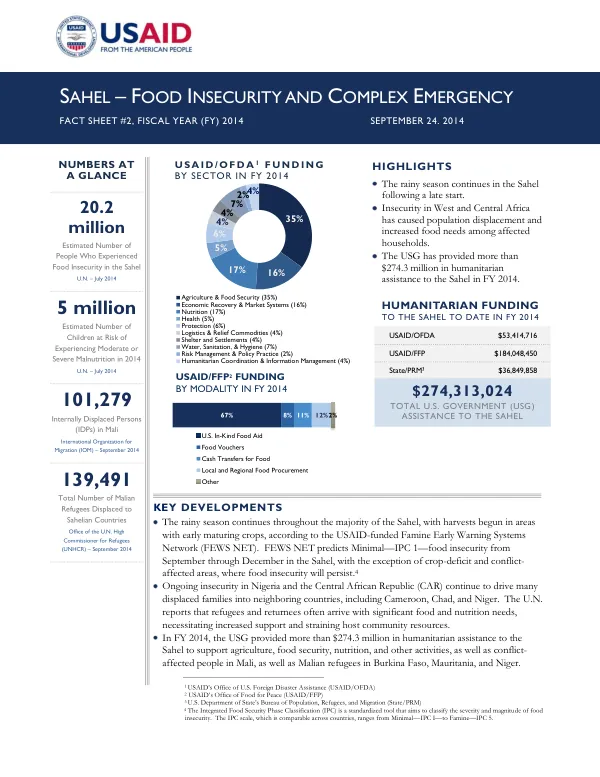
The Sahel region in West Africa experienced significant food insecurity and complex emergency conditions in FY 2014.
2014 · 12 pages
Sign in to readA free account is required to download.
Abstract
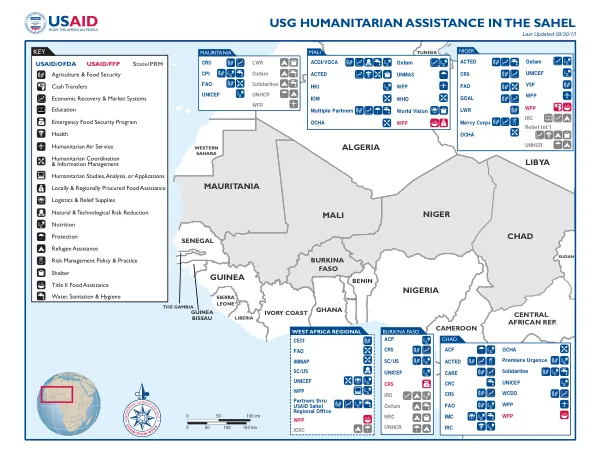
The region's population of 20.2 million people faced food insecurity, with 5 million children at risk of moderate or severe malnutrition. Insecurity in Nigeria and the Central African Republic drove population displacement, increasing food needs among affected households. The USG provided more than $274.3 million in humanitarian assistance to the Sahel in FY 2014, with USAID/OFDA contributing $53.4 million, USAID/FFP providing $184 million, and State/PRM committing nearly $36.8 million. The funding supported agriculture, food security, nutrition, and other activities, as well as conflict-affected people in Mali and Malian refugees in Burkina Faso, Mauritania, and Niger. The Sahel's rainy season continued throughout FY 2014, with harvests begun in areas with early maturing crops. However, insecurity in West and Central Africa caused population displacement and increased food needs among affected households. FEWS NET predicted Minimal—IPC 1—food insecurity from September through December in the Sahel, with the exception of crop-deficit and conflict-affected areas. In Burkina Faso, the U.N. projected a reduction in the number of food-insecure and malnourished individuals in 2014, attributed to the efforts of the Government of Burkina Faso and complementary support from humanitarian actors. However, vulnerable families in northern Burkina Faso continued to face Stressed—IPC 2—levels of food insecurity due to decreasing livestock sale prices and increased costs for staple food products. In Chad, FEWS NET reported improved food security among households in southern Chad, noting increased rainfall, milk availability, and income. However, southern Bahr el Ghazal and Wadi Fira regions remained in Crisis—IPC 3—food insecurity, facing a deficit likely to continue through September. USAID/OFDA provided nearly $13.7 million to humanitarian partners in Chad in FY 2014, working to increase food security and nutritional status of vulnerable Chadians. The humanitarian funding to the Sahel in FY 2014 was allocated as follows: USAID/OFDA ($53.4 million), USAID/FFP ($184 million), and State/PRM ($36.8 million). The funding supported various activities, including emergency food assistance, nutrition treatments, and feeding services, as well as protection, livelihoods assistance, education, shelter, and health support for refugees and displaced populations.
Related documents