CHEMONICS
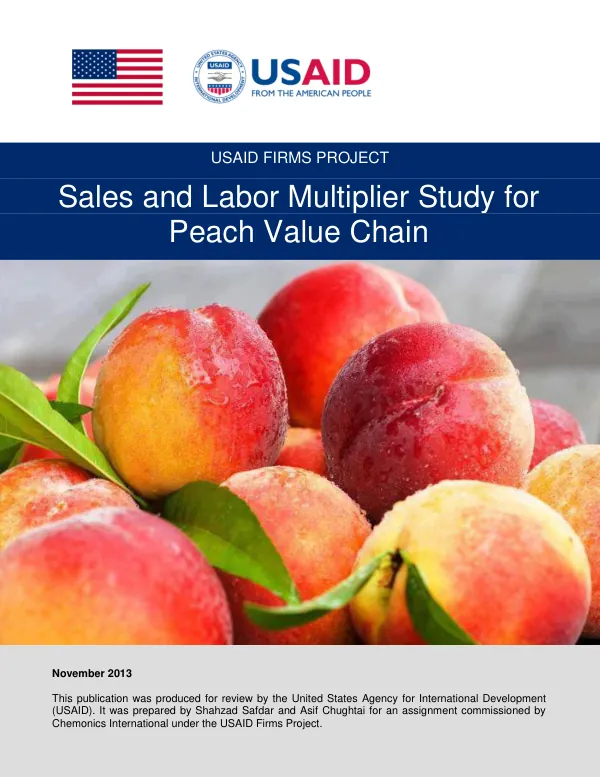
Sales and Labor Multiplier Study for Peach Value Chain
The USAID Firms Project Sales and Labor Multiplier Study for Peach Value Chain was conducted in November 2013.
2013 · 74 pages
Sign in to readA free account is required to download.
Abstract
The study aimed to develop a model to estimate the economic impact of interventions throughout the entire peach value chain sector in Pakistan. The study collected and analyzed data from different stakeholders in the peach value chain to calculate a multiplier for the change in sales and jobs. The study was commissioned by the USAID Firms Project with the objective of providing a level of confidence for attribution to its investments. The study focused on the peach value chain in Swat, Khyber Pukhtunkhwa (KP), Pakistan. The study collected data from different stakeholders, including producers, traders, and consumers, to understand the peach value chain and its dynamics. The study identified several constraints and challenges in the peach sector, including limited access to markets, lack of infrastructure, and limited availability of inputs such as irrigation and fertilizers. The study also highlighted the importance of the peach value chain in generating employment and income for rural communities in Swat. The study used a multiplier approach to estimate the economic impact of interventions in the peach value chain. The multiplier approach takes into account the ripple effects of changes in sales and employment on other sectors of the economy. The study calculated a multiplier of 1.27, which means that for every unit of sales increase, there is a corresponding increase of 1.27 units in employment. The study also identified several key actors in the peach value chain, including producers, traders, and consumers. The study highlighted the importance of these actors in shaping the dynamics of the peach value chain. The study also identified several characteristics of the peach market, including the presence of intermediaries, the importance of seasonality, and the limited availability of information. The study concluded that the peach value chain in Swat, KP, Pakistan, has significant potential for growth and development. The study recommended several interventions to improve the efficiency and productivity of the peach value chain, including the development of infrastructure, the provision of inputs such as irrigation and fertilizers, and the improvement of market access. The study also highlighted the importance of monitoring and evaluation (M&E) in the peach value chain. The study recommended the establishment of a M&E system to track the progress of interventions and to identify areas for improvement. The study also recommended the development of a performance management plan (PMP) to ensure that interventions are aligned with the goals and objectives of the USAID Firms Project. Overall, the study provided valuable insights into the peach value chain in Swat, KP, Pakistan, and highlighted the potential for growth and development in this sector. The study's recommendations provide a framework for future interventions to improve the efficiency and productivity of the peach value chain.