PATH
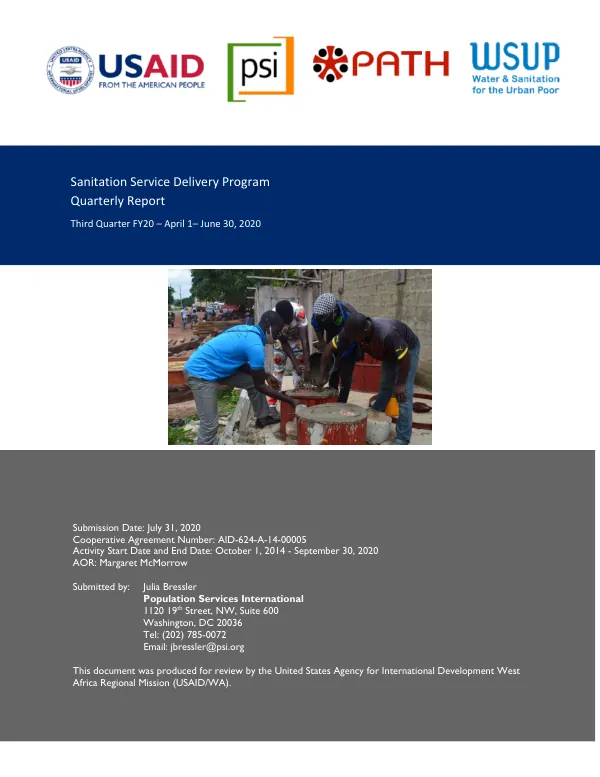
Sanitation Service Delivery (SSD) Program Quarterly Report
Sanitation Service Delivery is a USAID/West Africa regional urban sanitation project implemented by Population Services International (PSI), in collaboration with PATH and Water and Sanitation for the Urban Poor (WSUP).
2015 · 20 pages
Sign in to readA free account is required to download.
Abstract
The project aims to improve sanitation outcomes in Ghana, Côte d'Ivoire, and Benin by developing and testing scalable business models that engage private sector service providers and by contributing to the creation of a strong enabling environment for sanitation in West Africa. The project's goal is to create a thriving sanitation marketplace with increased capacity to deliver products and services to low-income consumers in a sustainable manner. In the process, the project will learn and share findings, models, and tools regionally that facilitate rapid expansion of successful approaches and position the project as a regional leader in the sector. Field visits were conducted in May to Kumasi and Benin, where a group consisting of Dan Nover, USAID AOR, John Sauer, Senior Technical Advisor at PSI/W, and Dana Ward, COP, met with donors, government officials, NGOs, private companies, and visited urban slums. The group observed a lack of affordable sanitation options on the markets in both countries, as well as a lack of aggregators to tie together parts of the sanitation value chain. There is significant government and donor interest in sanitation in Benin, and in Ghana, the group attended the launch of a Euro 6.3 million fund supported by the Dutch Government to provide low-interest loans to sanitation businesses and consumers. The project also organized a reception for sanitation partners in April, which was attended by key players, including WSUP, IRC, Global Communities, and private sector companies, including Duraplast, a manufacturer of septic tanks. The reception was an opportunity to introduce SSD to the wider sanitation community in the country. In Dakar, several members of the SSD team visited various sanitation partners, including the local water authority, ONAS, which is implementing an innovative project to transform fecal sludge management. The project is creating better linkages between local vacuum truck operators and consumers, to improve the quality and lower cost of FSM services. The SSD team also met with Chuck Henry, the inventor of the Earth Auger, an innovative low-cost urine diversion toilet designed for low-income countries. The project participated in the AfricaSan 4 conference, which was hosted by the Government of Senegal, and sponsored the participation of a member of the Kumasi Metropolitan Assembly in Kumasi, Ghana, Mr. Tony Mensah. Mr. Mensah is a champion of private sector participation in sanitation and took part in the USAID presentation at the conference. The project is also collaborating with the African Water Association (AfWA) and SuSanA, a global network of organizations and individuals working for the development of improved sanitation solutions. AfWA provides a forum for knowledge sharing and capacity building in the water and sanitation sector, and SSD will partner with AfWA in knowledge management and communication. SuSanA expressed a particular need for French language material, particularly in content from local sanitation practitioners and organizations, which SSD will be able to provide through its presence in Côte d'Ivoire and Benin. The project conducted extensive desk research across six key areas, including technology, business operations and models, behavior change, sanitation financing, sanitation governance, and urban sanitation. PATH prepared a literature review and produced a series of briefs, which were incorporated into a composite report. The report includes information on key players in global sanitation, as well as market opportunities and constraints. Information from the secondary research informed the design of the landscape study. The landscape study aims to gather insights into the formal and informal, local and national rules and regulations that apply to sanitation and FSM. The study will understand rule setting, identify regulatory barriers, and potential levers to success in the sanitation and FSM markets. In collaboration with project partners, PSI finalized research briefs and data collection tools for the market landscape study.
Related documents