USAID DEC
Saving Mothers, Giving Life: An Evaluation of the Saving Mothers, Giving Life Initiative
Sign inUSAID DEC
Saving Mothers, Giving Life: An Evaluation of the Saving Mothers, Giving Life Initiative
Maternal mortality is a complex challenge in Zambia, where the maternal mortality ratio is 440 per 100,000 live births.
2013 · 2 pages
Sign in to readA free account is required to download.
Abstract
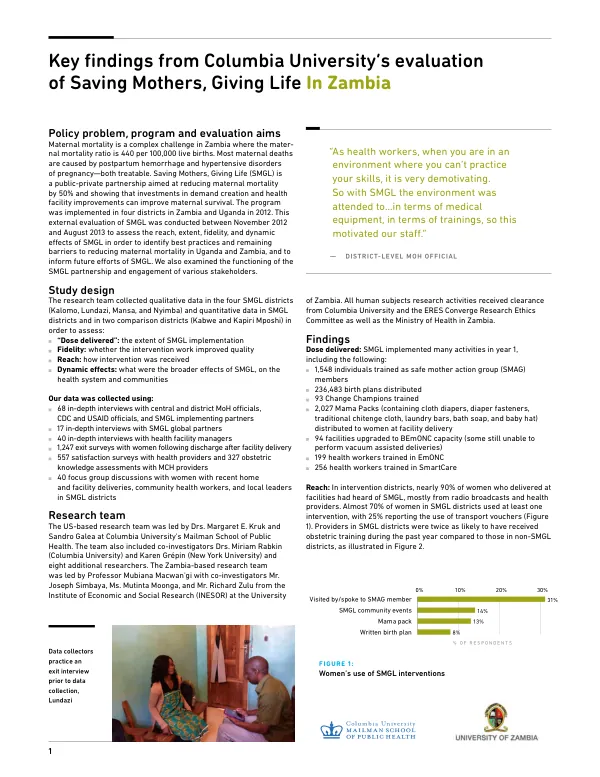
Most maternal deaths are caused by postpartum hemorrhage and hypertensive disorders of pregnancy, both of which are treatable. The Saving Mothers, Giving Life (SMGL) program is a public-private partnership aimed at reducing maternal mortality by 50% and demonstrating that investments in demand creation and health facility improvements can improve maternal survival. SMGL was implemented in four districts in Zambia and Uganda in 2012. The program's external evaluation was conducted between November 2012 and August 2013 to assess the reach, extent, fidelity, and dynamic effects of SMGL. The evaluation aimed to identify best practices and remaining barriers to reducing maternal mortality in Uganda and Zambia and to inform future efforts of SMGL. The study design involved collecting qualitative data in the four SMGL districts and quantitative data in SMGL districts and two comparison districts. The research team collected data through 68 in-depth interviews with central and district MoH officials, CDC and USAID officials, and SMGL implementing partners, as well as 17 in-depth interviews with SMGL global partners. Additionally, the team conducted 40 in-depth interviews with health facility managers, 1,247 exit surveys with women following discharge after facility delivery, 557 satisfaction surveys with health providers, and 327 obstetric knowledge assessments with MCH providers. The team also conducted 40 focus group discussions with women with recent home and facility deliveries, community health workers, and local leaders in SMGL districts. The evaluation found that SMGL implemented many activities in year 1, including training 1,548 individuals as safe mother action group (SMAG) members, distributing 236,483 birth plans, and upgrading 94 facilities to BEmONC capacity. The evaluation also found that nearly 90% of women who delivered at facilities in intervention districts had heard of SMGL, mostly from radio broadcasts and health providers. Almost 70% of women in SMGL districts used at least one intervention, with 25% reporting the use of transport vouchers. The evaluation also found that SMGL raised awareness of maternal mortality within and beyond focus districts and had mostly positive "spillover" effects on the broader health system. Women in the community were enthusiastic about SMGL, specifically the work of the SMAGs. However, women reported social pressure to deliver in facilities, and some who delivered at home felt stigmatized. Based on the evaluation findings, several recommendations were made to improve the effectiveness of SMGL. These recommendations include committing to a minimum of five years of implementation with a clear transition plan, thinking in terms of health system packages rather than isolated interventions, and considering cost-effective models for improving care quality. The evaluation also recommended focusing on "last mile" women, clarifying the SMGL governance structure, and testing future intervention packages using rigorous evaluation methods.
Related documents