PEPFAR
Family Planning/HIV Integration Quality Assurance Tool
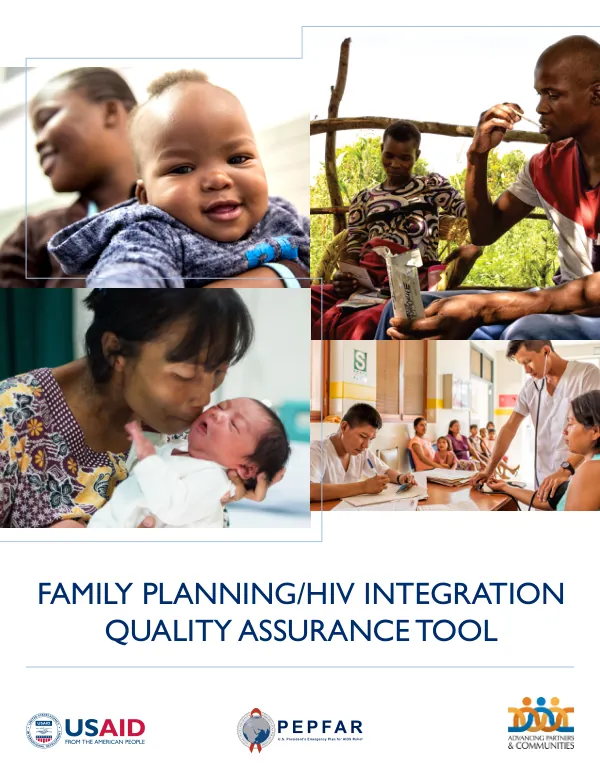
The FP/HIV Integration Quality Assurance Tool is designed to assess the extent to which facilities offering integrated family planning (FP) and HIV services are meeting basic minimum standards for the provision of quality FP services.
2017 · 30 pages
Sign in to readA free account is required to download.
Abstract
This tool is intended to be used in HIV service delivery settings that have integrated family planning into the constellation of HIV services they provide. Facilities that offer FP education and screening, counseling for specific FP methods, and provision of FP methods or a referral for FP methods not available on-site or on the same day are considered integrated FP/HIV service delivery sites. The tool is designed to assess the quality of FP services in these settings, identify any gaps in the provision of integrated services, and serve as a starting point for improving FP service delivery. The tool is intended to be used by a wide range of stakeholders, including facility managers, health providers, program or project managers, implementing agencies, community-based organizations, donors, and Ministry of Health (MOH) staff. The tool can be used either as a stand-alone monitoring system or in conjunction with other systems. The importance of quality of care in reproductive health and FP programs was brought to the forefront of public health dialogue in the 1990s with the Bruce/Jain framework, which outlined six elements of FP programs that collectively define quality of care: choice of methods, information given to clients, technical competence, interpersonal relations, follow-up mechanisms, and appropriate constellation of services. High-quality FP services can lead to increased uptake of contraceptive methods, improved continuation rates, and an overall increase in contraceptive prevalence and satisfaction. Performing routine quality assurance assessments followed by targeted quality improvement efforts will help ensure that programmatic weaknesses are addressed in an effective and realistic manner, while also helping to identify and maintain any programmatic elements that are functioning well. This tool can help facilities understand in greater detail why a site may not be performing up to standard and assist them in identifying actionable steps they can take to make lasting improvements. The tool provides a comprehensive dashboard and element-specific score that will show users how well they performed overall and in specific areas. For areas that need improvement, there is an option to develop an action plan that helps the user identify next steps, benchmarks, and a time frame for quality improvement. The process of completing this tool and identifying specific actions to improve quality can also serve as a starting point for broader discussions with stakeholders and/or partners interested in improving quality of FP services. The tool can be used in conjunction with other monitoring systems, such as the Site Improvement through Monitoring System (SIMS), which aims to assess adherence to PEPFAR standards of care and service delivery and track certain aspects of FP service delivery. However, SIMS is not meant to help users assess the quality of FP services or the strengths and weaknesses of programs.
Related documents