USAID DEC
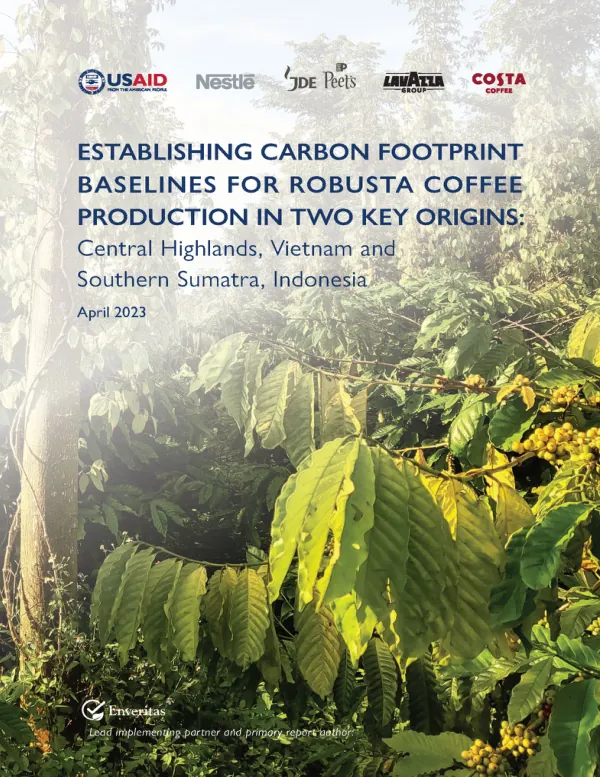
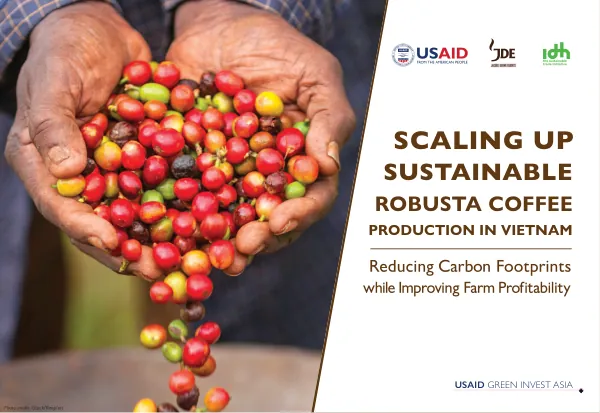
Scaling up Sustainable Robusta Coffee Production in Vietnam
Vietnam is the world's largest producer of Robusta coffee, accounting for approximately 40% of the global production.
2021 · 27 pages
Sign in to readA free account is required to download.
Abstract
The country's Central Highlands region is the most intensive and concentrated area of coffee production, with around 565,000 hectares dedicated to coffee cultivation. Small-scale farmers, numbering over half a million, produce coffee on farms averaging just over 1 hectare in size. These farmers are among the most productive worldwide, but their yields depend heavily on high amounts of inputs like inorganic fertilizers. The use of chemical fertilizers and associated greenhouse gas (GHG) emissions has been decreasing over the last five years, but more than 70% of farmers surveyed still apply excessive amounts of fertilizer, leading to high input costs and lower farm profitability. A second carbon emissions mitigation strategy is diversification of monoculture coffee farms through intercropping, which involves planting multiple crops together at the same time. The study estimated how these farms' emissions compared to monocrop farms and found that diversification can lead to a lower carbon footprint. The carbon footprint of Vietnamese coffee farms is typically lower in more diversified farms. Coffee farms can be carbon neutral or have a negative carbon footprint, where sequestration exceeds emissions. The data showed that diversified farms captured more carbon than monoculture farms, but this gain did not always correlate with increased profitability. Relationships between carbon footprint and profitability are complex, and a more detailed understanding of intercropping production models is needed. The study analyzed data from almost 15,000 farmers, including data from the Global Coffee Platform, and found that interventions that optimize fertilizer use will best lower the carbon footprint of Robusta coffee production in Vietnam's Central Highlands. The study also estimated that total net emissions of approximately 800,000 tons carbon dioxide equivalent (CO2e) per year can be attributed to the Robusta coffee production sector in Vietnam's Central Highlands. Strategies to reduce emissions and improve the environmental and financial performance of Vietnam's coffee production should focus on both fertilizer/nutrient use efficiency and intercropping. Vietnam's coffee production is concentrated in the Central Highlands provinces of Dak Lak, Lam Dong, Gia Lai, and Dak Nong, where around 90% of coffee is produced. The country's coffee farmers are among the most productive worldwide, but their yields depend heavily on high amounts of inputs like inorganic fertilizers. The study's findings suggest that optimizing fertilizer use and diversification of monoculture coffee farms through intercropping can lead to a lower carbon footprint and improved profitability for coffee farmers in Vietnam.
Related documents