USAID DEC
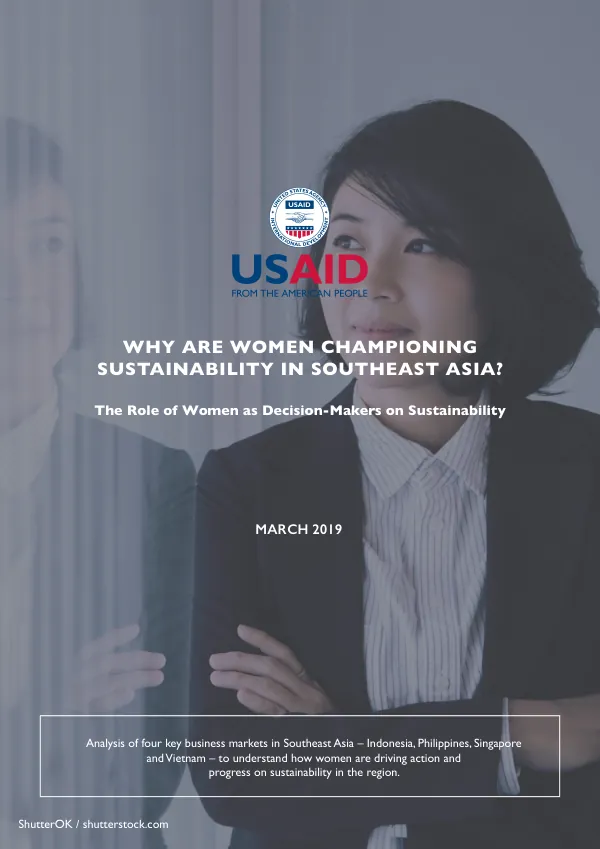
The Role of Women as Decision-Makers on Sustainability
Women's priorities and practices regarding sustainable business in Southeast Asia are a key focus of the analysis conducted by USAID Green Invest Asia and Moxie Future.
2019 · 24 pages
Sign in to readA free account is required to download.
Abstract
The study aimed to understand how women are driving action and progress on sustainability in the region, with a particular emphasis on the four key business markets in Southeast Asia – Indonesia, Philippines, Singapore, and Vietnam. The analysis found that women are a significant force behind households' responsible consumption and investment decisions, with 80 percent of household consumption purchases globally influenced by women. In the four countries studied, women expressed concern about similar issues, including access to education, access to healthcare, and air pollution. However, women reported a higher degree of concern than men, which in turn influences how they consume and invest. Women's priorities for sustainability are centered around three key areas: economic, environmental, and social. As consumers, women are motivated to act on sustainability concerns, particularly with regards to climate change and pollution. They are more likely to be sustainable consumers, buying eco-labelled or organic food, recycling, and placing more value on energy efficiency than men. The study found that women are willing to pay a premium for sustainably certified basic food products, with up to 30 percent of women paying more for such products. As investors, 85 percent of women want to invest in responsible companies but many also want better guidance on how to do so. Close to half of the women surveyed said there are too few female financial advisors. Women's priorities for sustainability are reflected in their purchasing decisions, with the majority of women purchasing from companies that market themselves as environmentally and socially conscious. In Vietnam, 65 percent of female consumers are "active" consumers, purchasing from companies that market themselves as environmentally and socially conscious. Some consumers, as many as 23 percent of women in Vietnam and 16 percent in Singapore, avoid purchasing specific products or from companies that raise concern. The study highlights the importance of providing women with trusted, clear, and comprehensive information on companies' sustainability efforts and responsible investment products. Women are motivated to act on sustainability concerns and priorities, but they are held back by a lack of information. The study recommends that businesses and firms with a sustainability profile focus on serving the female market, which represents a significant opportunity for growth and development. In terms of specific priorities, women in the four countries consistently chose the same top concerns, with nuances by location. For example, food safety is a major concern in Vietnam, while access to education is a top concern in Indonesia and the Philippines. Women are motivated to act on sustainability concerns, particularly with regards to climate change and pollution, and are more likely to be sustainable consumers, buying eco-labelled or organic food, recycling, and placing more value on energy efficiency than men. In conclusion, the analysis conducted by USAID Green Invest Asia and Moxie Future highlights the significant role that women play in driving action and progress on sustainability in Southeast Asia. Women's priorities and practices regarding sustainable business are centered around three key areas: economic, environmental, and social. The study recommends that businesses and firms with a sustainability profile focus on serving the female market, which represents a significant opportunity for growth and development.
Related documents