USAID DEC
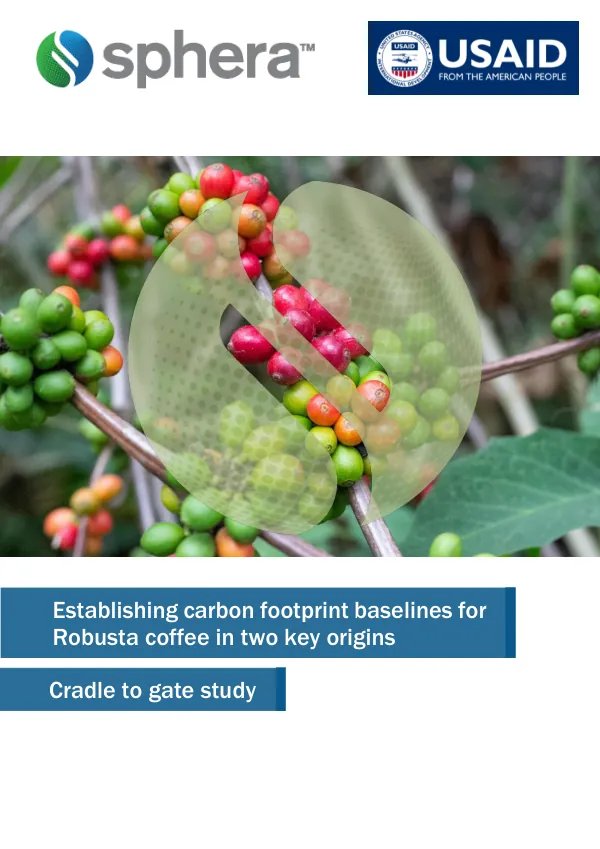
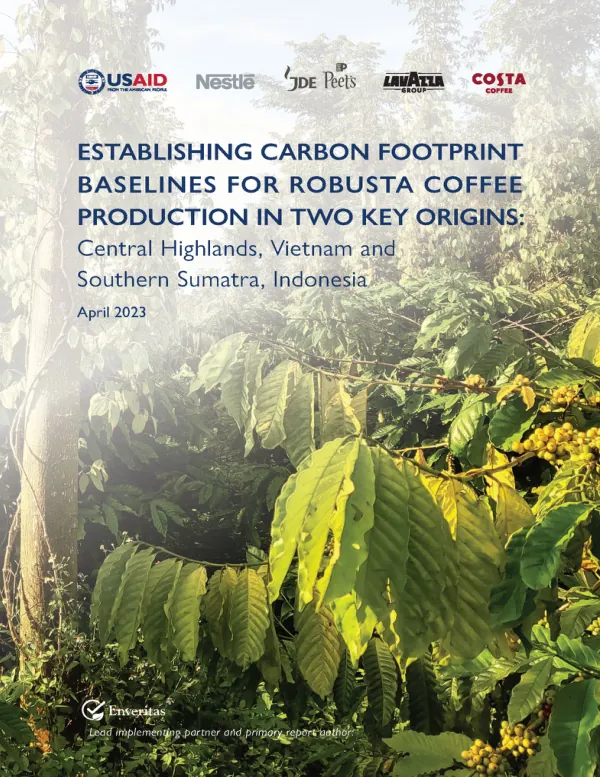
Establishing carbon footprint baselines for Robusta coffee production in two key origins: Central Highlands, Vietnam & Southern Sumatra, Indonesia
Sign inPACT
Establishing carbon footprint baselines for Robusta coffee production in two key origins: Central Highlands, Vietnam & Southern Sumatra, Indonesia
The Central Highlands in Vietnam and Southern Sumatra in Indonesia are two key origins of Robusta coffee production, accounting for approximately 20 percent of worldwide coffee production.
2023 · 101 pages
Sign in to readA free account is required to download.
Abstract
The region's annual trade value exceeds $4 billion, with over 1 million hectares of land dedicated to coffee farming by smallholder farmers. Establishing carbon footprint baselines for Robusta coffee production in these regions is a critical step towards Net Zero and informs collaborative climate action. A consortium of 25 private sector and technical partners collaborated on an industry-led initiative to develop carbon footprint baselines for Robusta coffee production in the two key producing regions. The initiative included a core group of 11 participating supplier partners, with co-investment from USAID Green Invest Asia, Nestlé, JDE-Peet’s, Lavazza Group, and Costa Coffee. The lead technical partner, Enveritas, developed a farmer survey plan and trained agronomists and field staff to survey 4,920 farmers in Vietnam and Indonesia. The survey collected inputs required for the Cool Farm Tool, which served as the primary framework for carbon footprint estimations. Enveritas then collated, cleaned, and analyzed the gathered data with the Cool Farm Tool to generate the carbon footprint estimates and findings presented in this report. Additional technical partners analyzed the same datasets using other carbon footprinting models and tools, including Sphera, 4C, Meo Carbon Solutions, and Lavazza Group. The carbon footprint of agricultural commodities is highly technical and new to most industries, with multiple tools, calculators, and approaches available. Estimating the carbon footprint of agricultural commodities is critical for companies and organizations to mitigate their climate impacts and honor climate commitments. Establishing a robust carbon footprint baseline provides an important starting point and reference for monitoring improvements, particularly in agricultural supply chains where 70-90 percent of emissions typically come from the commodity's production at the farm level. The initiative aims to help move the sector toward a low-carbon future, while continually improving farmer livelihoods, productivity, and nature conservation. The model of corporate pre-competitive collaboration and co-investment is expected to accelerate climate action and transform coffee origins, along with other agricultural supply chains. The Central Highlands in Vietnam and Southern Sumatra in Indonesia are characterized by diverse geography and climate conditions, with the majority of Robusta coffee production concentrated in the highlands. The region's coffee farms are primarily smallholder-owned, with limited access to resources and technology. The Initiative's findings highlight the importance of understanding the main emission sources associated with Robusta coffee production, including fertilizer production and use, energy for irrigation, residue management, land use change, and transportation. The results of the Initiative provide a benchmark for comparison across origins and within specific supply chains, informing low-emission strategies for land use management. Improved metrics enable targeted investments and interventions to address the main emissions sources and monitor change over time. The Initiative's model of collaboration and co-investment is expected to accelerate climate action and transform the coffee sector, while continually improving farmer livelihoods, productivity, and nature conservation.
Related documents