ACDI/VOCA
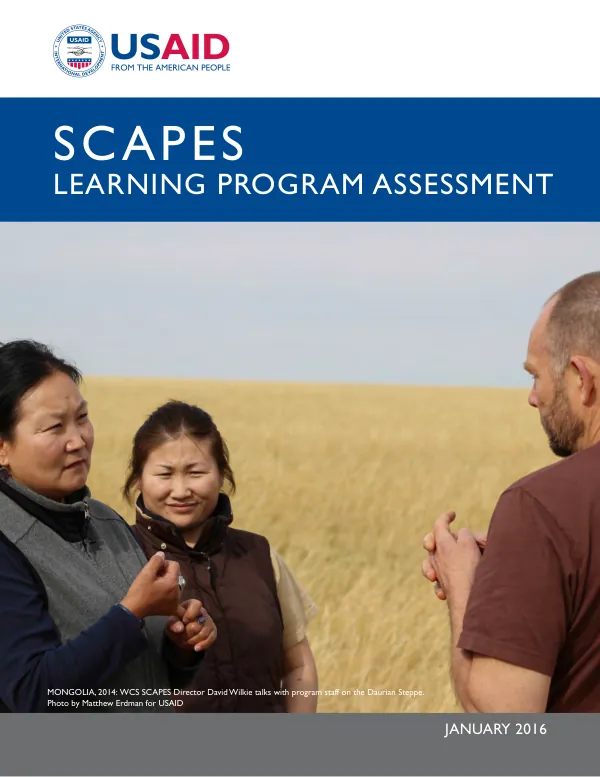
SCAPES LEARNING PROGRAM ASSESSMENT
The Sustainable Conservation Approaches in Priority Ecosystems (SCAPES) project was a global conservation initiative launched by USAID in 2010.
2016 · 17 pages
Sign in to readA free account is required to download.
Abstract
The project aimed to conserve globally important biodiversity and provide leadership in developing, documenting, and sharing state-of-the-art conservation practices. SCAPES was a partnership between USAID and four non-governmental organizations: African Wildlife Foundation, Wildlife Conservation Society, World Wildlife Fund, and a consortium led by Pact, Inc. The project implemented nine transboundary landscape and policy initiatives in 19 countries, with a focus on innovative and tested methodologies to achieve conservation and development goals. One of the core objectives for the SCAPES program was to "scale-up knowledge and impact to increase conservation success at sites, across the partnership, and among the global conservation community." A hallmark of the SCAPES program was the intentional focus on partner-driven learning throughout the life of the program. The project set aside dedicated time and resources for learning activities, including four annual meetings, two partner-driven learning programs (governance and climate change adaptation), and the implementation of a limiting factors analysis applied across the life of the project. The SCAPES learning program was designed to facilitate peer-to-peer learning among project staff and partners. The program included four annual meetings in the United States, each with a specific theme: sustainability, conservation and development, monitoring and evaluation, and innovation and reflection. These meetings provided a platform for participants to share best practices, collaborate on planning agendas, and develop innovative products, such as a governance tool and a climate change adaptation tool. The SCAPES learning program also supported specific learning programs focused on governance and climate change adaptation. These programs were championed by partner organizations, who studied existing research, documented lessons learned from SCAPES, reviewed frameworks, and offered recommendations for harmonization. The limiting factors analysis (LFA) was another key component of the SCAPES learning program. The LFA is a survey-based tool that assesses the degree to which a project uses best practices, such as written management objectives and performance metrics. The LFA also helps to determine which factors limited landscape conservation prior to and during SCAPES support. An independent evaluator was asked to assess the performance of the SCAPES learning program in 2014. The evaluation identified several key recommendations for improvement, including better accommodating and involving field staff, providing more opportunities for field staff to participate in learning activities, and improving the distribution of tools and lessons learned to USAID missions, government agencies, and the development community. The evaluation also highlighted the importance of cross-institutional learning, which was a key aspect of the SCAPES program. Project staff suggested that cross-institutional learning could be enhanced through exchange opportunities with other project sites, greater support for communications and knowledge management among SCAPES partner organizations, and improved distribution of tools and lessons learned. Overall, the SCAPES learning program was designed to facilitate peer-to-peer learning, support partner-driven learning activities, and promote the sharing of best practices and innovative products. The program's focus on governance, climate change adaptation, and limiting factors analysis was intended to help project staff and partners address the complex challenges of landscape-level conservation.
Related documents
Documents in this collection
 2014
2014USAID DEC
FY 2014 Semi-annual Report: Conservation and Adaptation in Asia’s High Mountain Landscapes and Communities
Open record 2011
2011USAID DEC
Finding Optimal Trade-offs Between Food Security and Conservation in Africa: A Review of Tools and Presentation of Case Studies from Zambezi and Ituri Landscapes
Open record