PACT
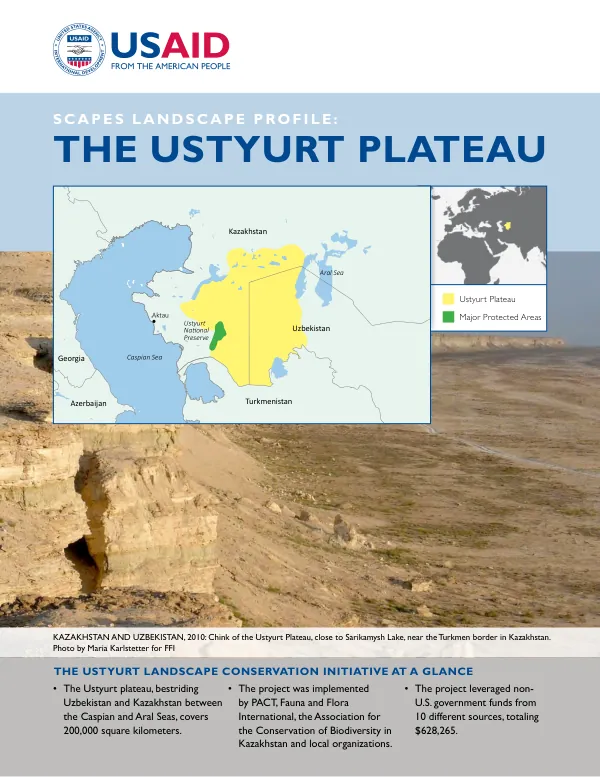
SCAPES LANDSCAPE PROFILE: THE USTYURT PLATEAU
The Ustyurt Plateau, spanning 200,000 square kilometers across Kazakhstan and Uzbekistan, is a vast and harsh temperate region.
2016 · 4 pages
Sign in to readA free account is required to download.
Abstract
Its eroded hills, shallow basins, and extensive escarpments feature no permanent streams or open freshwater sources. The plateau's age and isolation have blessed it with a spartan beauty, supporting a diverse range of endemic species. Approximately 300 vertebrate species, including 30 reptiles and amphibians, 45 mammals, and 50 breeding birds, call the Ustyurt home. The region also hosts at least 724 species of vascular plants. Historically, nomadic cattle-breeders were among the few people to populate the region. Their traditions managed to survive the collectivized agriculture of the Soviet era, but they are now threatened by industrial activity, such as oil and gas extraction and infrastructure development. The construction of roads, rail, and pipelines has brought economic growth, but not enough to generate widespread employment in rural areas, where poverty remains high. This has driven people to hunt the saiga antelope for its meat and its highly valued horns, which fetch up to $100 per kilogram on the black market. The environmental impact of this damage is severe. Animals depend on the integrity of the environment, and the saiga, an endangered species, is particularly vulnerable. As its habitat becomes damaged and fragmented, the saiga suffers from disease and poaching increases, reducing its chances of survival. The saiga's population has declined by 95% in 20 years, from 250,000 in the mid-1990s to fewer than 2,000 today, making it one of the most rapid and drastic deteriorations of a mammal ever recorded. Protecting the saiga is a priority, as it is a keystone species in the Ustyurt's complex food web, providing food sources for animals such as the desert lynx, wolf, and eagles. Of the 35 endangered species in the Ustyurt, the saiga is the most threatened. The Ustyurt Landscape Conservation Initiative was a transboundary landscape-scale project under USAID's Sustainable Approaches in Priority Ecosystems (SCAPES) project. The initiative identified the main environmental threats to the Ustyurt as human impact on saiga mortality, lack of environmental knowledge, and lack of development. The Ustyurt Landscape Conservation Initiative implemented several strategies to address these threats. One was the creation of the Mobile Resource Center, a yurt that traveled to five communities in the northeast edge of the Ustyurt, providing low-interest agricultural loans, skills training, and information on environmental issues. The resource center also functioned as an information hub, inviting experts to help the community understand the importance of a healthy ecosystem and livelihoods. In addition, the project conducted media campaigns to raise awareness of conservation issues, including a video for television broadcast, posters, and billboards. The project also established eco-clubs for youth, which were mentored by rangers. The eco-clubs received books on wildlife identification, binoculars, and applied lessons on the saiga, facilitated by a well-known Kazakh illustrator. The project also trained rangers in map-reading and GPS use, equipped them with equipment such as spotting scopes, digital cameras, and off-road vehicles, and supported them in monitoring saiga migration patterns. The Ustyurt Landscape Conservation Initiative also partnered with a dog-training center in Kazakhstan to detect wildlife trafficking. Four pre-trained drug-detection dogs were taught to detect saiga horn, working with law enforcement and customs teams trained in wildlife trafficking laws and conventions. This led to the first seizures of saiga horn at border crossings in 15 years. The project faced challenges due to harsh conditions, including extreme winters, which made field research and visits difficult. The project required extensive logistical planning, and building constituencies took time. The Ustyurt had a thin history of conservation activity, and the Ustyurt Landscape Conservation Initiative was the first project to specifically target the saiga. The project had to gather basic data in lieu of providing services, and local staff sometimes lacked skills in international standards. Drawing on local pride was essential to promoting saiga conservation. Citizens were engaged through education, which they valued, as well as resources to bolster the local economy and adapt to climate change. These steps are small but significant, contributing to more robust civil society engagement in the region.
Related documents
Documents in this collection
 2021
2021USAID DEC
LEGISLATIVE REVIEW OF GROUP CERTIFICATION OF SMALL AND MEDIUM-SIZED ORGANIC FARMERS IN CENTRAL ASIA
Open record 2012
2012USAID DEC