CREATIVE ASSOCIATES INTERNATIONAL INC.
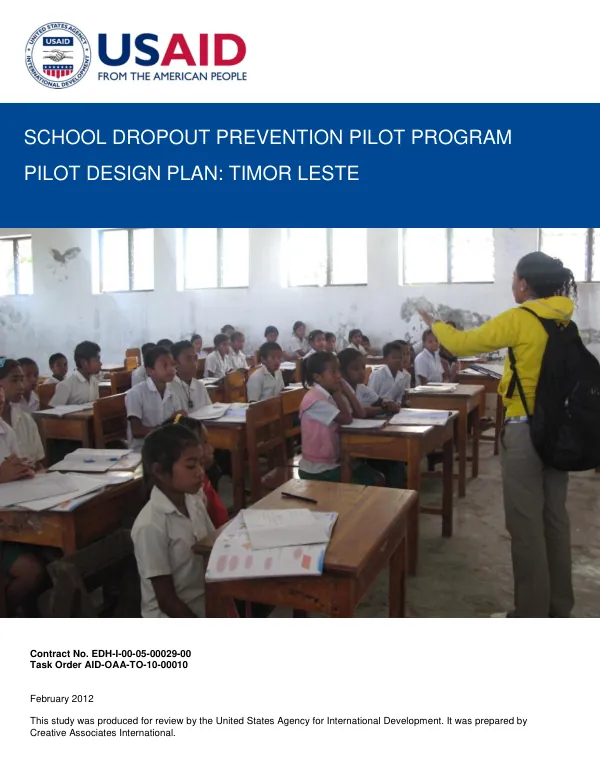
School Dropout Prevention Pilot Program Pilot Design Plan: Timor Leste
The School Dropout Prevention Pilot Program in Timor Leste is a three-year multi-country program funded by the US Agency for International Development (USAID).
2012 · 29 pages
Sign in to readA free account is required to download.
Abstract
The program aims to mitigate school dropout from primary and secondary school by piloting and testing the effectiveness of dropout prevention interventions in four target countries: Cambodia, India, Tajikistan, and Timor Leste. The program will advance knowledge on dropout prevention through an applied research approach, identifying best practices in dropout prevention in the US and developing countries, analyzing dropout trends in each country, and designing, implementing, and rigorously assessing interventions to keep at-risk students in schools. The pilot design plan for Timor Leste focuses on Grades 4, 5, and 6 students in five target districts: Bobonaro, Ermera, Liquica, Manatuto, and Viqueque. The intervention proposed is the Dropout Mitigation Program, comprising two components: an Early Warning and Response System (EWS) and a Pupil Social Support program. The EWS aims to identify pupils who are at risk of dropping out and allow educators to intervene and positively interact with the student and their family. The Pupil Social Support program provides support to at-risk pupils through supervised non-academic high-interest activities. The intervention selection and design are based on evidence from the SDPP Situational Analysis, which indicates that the top causes of student dropout among pupils in Grades 4-6 in the target districts are economic. Over half of the at-risk students, dropout, and parent/guardian respondents cited inability to pay for school-related expenses as a factor leading to school dropout. High absenteeism was a major factor influencing low academic performance, which was identified as one of the five top causes of school dropout. Schools fail to adequately track and provide timely support to at-risk pupils, with attendance records kept sporadically and performance only monitored twice a year. The situation for at-risk pupils is especially difficult in rural areas, which may also suffer from poor teacher attendance, low levels of training on motivational and interactional approaches to pupils, and difficult access to school. Despite high absenteeism among at-risk pupils, school interventions are limited, coupled with little attention by parents of their child's school attendance. The Dropout Mitigation Program aims to reduce Grades 4, 5, and 6 student in-grade dropout and between-grade dropout and increase attendance in treatment schools in the target districts. The program will be implemented in 100 treatment schools in the target districts, with the EWS and Pupil Social Support program components. The program will be designed and operationalized up to the point that it will be introduced in the schools, with a detailed work plan organized by task, activity, expected products/outputs, and timeline. The program will be implemented in a three-stage process, with the first stage focusing on identifying best practices in dropout prevention in the US and developing countries. The second stage will involve analyzing dropout trends in each country to identify those groups, grades, and/or geographic areas most severely affected by dropout and conducting a situational analysis of the target group to understand the risk factors and conditions affecting dropout. The third stage will involve designing, implementing, and rigorously assessing interventions to keep at-risk students in schools in the most acutely affected areas. The program will be evaluated through a randomized control trial (RCT) design, with a control group and an intervention group. The RCT will allow for the evaluation of the effectiveness of the Dropout Mitigation Program in reducing school dropout and increasing attendance among at-risk pupils. The program will also be evaluated through a process evaluation, which will assess the implementation of the program and identify any challenges or barriers to implementation. The Dropout Mitigation Program is expected to have a positive impact on reducing school dropout and increasing attendance among at-risk pupils in Timor Leste. The program will provide evidence-based programming guidance to USAID missions and countries in Asia and the Middle East on student dropout prevention, and will contribute to the advancement of knowledge on dropout prevention through an applied research approach.
Related documents