MINISTRY OF EDUCATION
Performance Progress Report SF-PPR
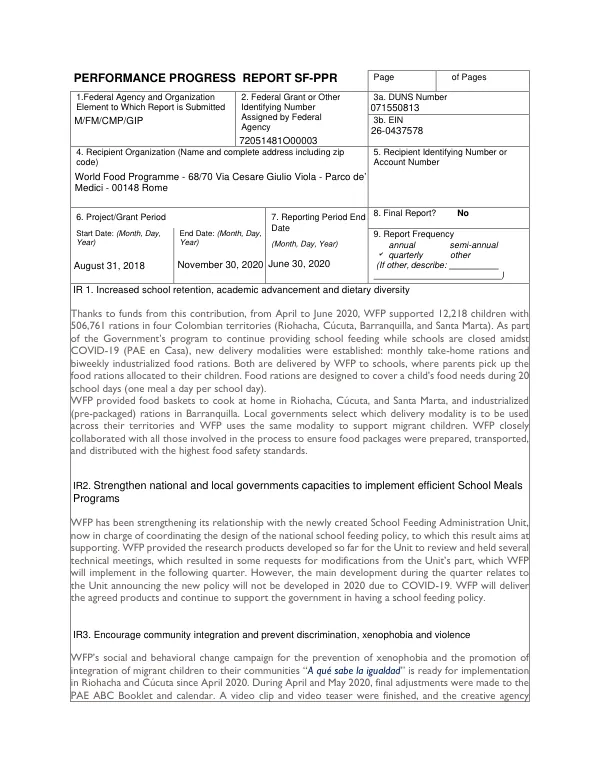
The World Food Programme (WFP) implemented the NUTRITIOUS SCHOOL MEALS FOR EXCLUDED MIGRANT CHILDREN project in Colombia, with the goal of providing nutritious meals to migrant children.
2020 · 2 pages
Sign in to readA free account is required to download.
Abstract
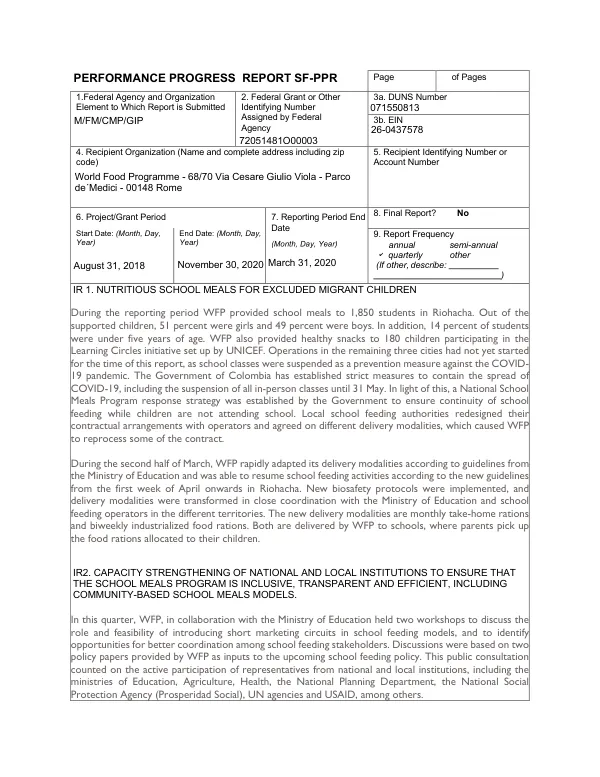
During the reporting period, WFP provided school meals to 1,850 students in Riohacha, with 51 percent of the supported children being girls and 49 percent being boys. Additionally, 14 percent of the students were under five years of age. WFP also provided healthy snacks to 180 children participating in the Learning Circles initiative set up by UNICEF. Operations in the remaining three cities had not yet started due to the COVID-19 pandemic, which led to the suspension of all in-person classes. However, the Government of Colombia established a National School Meals Program response strategy to ensure the continuity of school feeding while children were not attending school. WFP rapidly adapted its delivery modalities according to guidelines from the Ministry of Education and was able to resume school feeding activities in Riohacha. New biosafety protocols were implemented, and delivery modalities were transformed in close coordination with the Ministry of Education and school feeding operators. The new delivery modalities included monthly take-home rations and biweekly industrialized food rations, which were delivered by WFP to schools where parents picked up the food rations allocated to their children. WFP also collaborated with the Ministry of Education to hold two workshops to discuss the role and feasibility of introducing short marketing circuits in school feeding models. The workshops aimed to identify opportunities for better coordination among school feeding stakeholders and to promote the inclusion of smallholder farmers and local food businesses in the school feeding cycle and policy. The main conclusions from the workshops pointed to the inclusion of smallholder farmers and local food businesses in the school feeding cycle and policy, which is expected to have a positive impact on local development. WFP also refined the details of its social and behavioral change campaign for the prevention of xenophobia and the promotion of integration of migrant children to their communities. The campaign was internally approved by WFP and presented to USAID's Agreement Officer Responsible and to local school feeding authorities and participating schools. The campaign strategy was adapted to the other two cities where WFP supports migrant children with this contribution, Barranquilla and Santa Marta, and the contracting process for the creative agency is ongoing. The project's goal is to ensure that the school meals program is inclusive, transparent, and efficient, including community-based school meals models. The project's implementation is ongoing, and WFP continues to work with the Ministry of Education and other stakeholders to achieve its objectives.