GOVERNMENT OF COLOMBIA
School Feeding Response Activity (SFRA) Q1-FY2 Report
The school feeding response activity (SFRA) in Colombia aims to provide nutritional food sources for vulnerable Venezuelan children, Colombian returnee children, and host communities through a school feeding strategy.
2020 · 25 pages
Sign in to readA free account is required to download.
Abstract
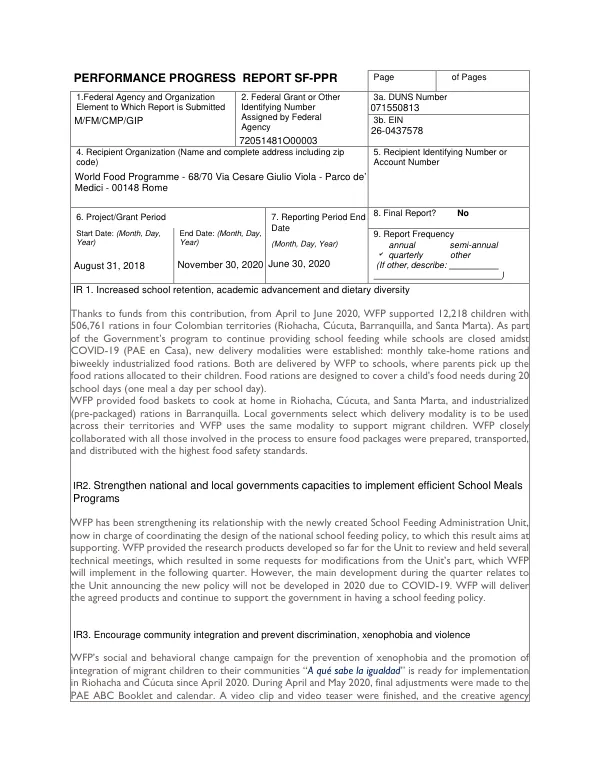
The activity is implemented by the World Food Programme (WFP) in collaboration with the Government of Colombia and other partners. During the reporting period from October 1 to December 31, 2019, WFP provided school meals to 8,030 students in four Colombian cities: Barranquilla, Cúcuta, Santa Marta, and Ríohacha. The program supported 50% girls and 50% boys, with 10% of students under five years of age. In addition, WFP provided healthy snacks to 351 children participating in the Learning Circles initiative, set up by UNICEF to support integration of migrant children to their host communities. The school feeding program guarantees a balanced diet while at school and incentivizes sustained school attendance. WFP's monitoring indicates that in 2019, 92% of the students who started the school year in WFP-supported schools finished it. According to results of a perception survey carried out by WFP, school feeding supports children to stay at school as it improves their academic performance, contributes to family income, provides meals that might not be available at home, and represents an important part of total caloric intake for some students. The provision of school feeding finished on December 6, 2019, together with the school year and is scheduled to restart in February 2020. WFP continued advancing in the production of evidence to support the national school feeding policy. Out of the nine research studies planned, four were reviewed by the Ministry of Education in the reporting period. The Ministry recognized the value these documents can provide for public policy design and recommended some topics to be added to the analyses. WFP also strengthened capacities of local institutions during this quarter. In this quarter, WFP trained 871 members of the school communities on good nutrition and healthy eating habits through the Nutrifami app, a platform developed by WFP Colombia to provide better nutritional education to vulnerable communities across Colombia. Those trained include members of the Ministry of Education's delegated territorial authorities (ETCs), food handlers, and school coordinators, who will act as multipliers of this knowledge. Besides providing healthy food to children, WFP is working to prevent xenophobia and promote the full integration of children to their host communities through a Social and Behavioural Change Communications activity (SBCC) funded by this project. A baseline study commissioned to the University of Atlántico in schools of Barranquilla, Cúcuta, Ríohacha, and Santa Marta has been conducted during this quarter and will feed into the abovementioned strategy. The study reviewed perceptions of schoolchildren and parents on issues of xenophobia, violence, and discrimination, as well as their overall opinion about the school feeding program. Results indicate that overall, there is an attitude of inclusion towards Venezuelan migrants in all four cities, however, there is presence of general violence in schools, and over 40% of Venezuelan and Colombian children reported having suffered some kind of aggression, with 26% of migrant children saying they had witnessed aggression due to nationality. Barranquilla and Cúcuta were the cities where students reported a higher number of violent actions in school, while Santa Marta was the city with more aggressions due to nationality, according to the surveyed children. Based on these findings, a creative agency has developed a SBCC campaign, to be implemented over the next quarter. Creative workshops were held in Cúcuta and Ríohacha where over 230 schoolchildren and parents participated. Conclusions derived from these workshops provided the agency with a deeper understanding of the needs and perceptions of the target audience, which will inform the development of the SBCC campaign. The SFRA activity has made significant progress in increasing school retention, academic advancement, and dietary diversity. WFP has also strengthened capacities of local institutions and encouraged community integration and prevented discrimination, xenophobia, and violence. The activity has been implemented in four Colombian cities, and the program has supported over 8,000 students with nutritious meals. The activity has also contributed to the development of evidence to support the national school feeding policy and has strengthened capacities of local institutions.