CDM SMITH INTERNATIONAL INC.
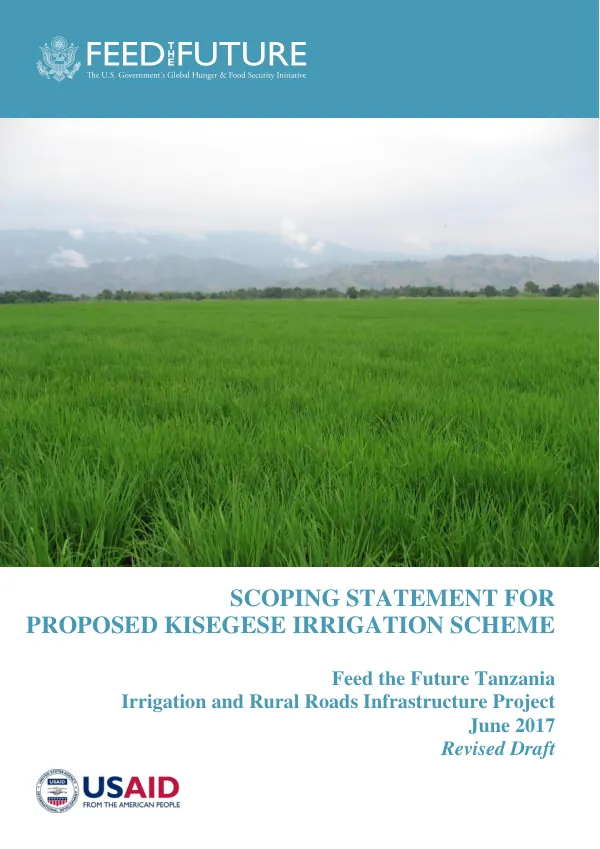
Scoping Statement for Proposed Kisegese Irrigation Scheme
The Feed the Future Tanzania Irrigation and Rural Roads Infrastructure Project (IRRIP2) aims to support the Government of Tanzania in improving the productivity of the agricultural sector, particularly for irrigated rice, through the rehabilitation of existing irrigation infrastructure and the development of new irrigation schemes.
2017 · 64 pages
Sign in to readA free account is required to download.
Abstract
The project is implemented through USAID/Tanzania's IRRIP2, which is funded by the United States Agency for International Development (USAID) under the Feed the Future initiative. The proposed Kisegese Irrigation Scheme is one of four irrigation schemes identified for further study in the feasibility study (FS) conducted by IRRIP2. The scheme is located in the Kilombero Valley of the Morogoro Region, which is part of the Southern Agricultural Growth Corridor of Tanzania (SAGCOT). The project aims to deliver increased productivity of staple crops in the region, contributing to economic growth. The Environmental Assessment (EA) process for the Kisegese Irrigation Scheme is required due to the potential for significant environmental impacts. The EA will build on the previous analysis conducted in the draft Program Environmental Assessment (PEA) prepared in 2013, which assessed general impacts of irrigated agriculture within the Kilombero Valley. The FS process has significantly revised the scope of the projects evaluated in the PEA and has developed additional information on existing conditions through environmental flow analysis (EFA) studies. The project-specific EA for the Kisegese scheme will focus on the following key areas: 1. Environmental procedures: The EA will follow the procedures outlined in Regulation 216, which encourages a participatory approach to determine the scope of the issues to be addressed in the follow-on EA. 2. Previous scoping and stakeholder involvement: The EA will build on the previous analysis conducted in the PEA and will involve stakeholders in the scoping process to ensure that all potentially significant issues are identified. 3. Affected environment: The EA will assess the potential impacts of the proposed action on the environment, including air, water, land, biodiversity, and biodiversity. 4. Alternatives to be analyzed in the EA: The EA will analyze the potential impacts of different alternatives, including sprinkler irrigation and drip irrigation. 5. Issues to be addressed in the EA: The EA will address the following issues: * Soil erosion * Water quality * Biodiversity * Human health * Climate change 6. Environmental assessment format: The EA will follow the format outlined in Regulation 216, which includes a scoping statement, a description of the proposed action, an analysis of the potential impacts, and a determination of the scope of the issues to be addressed. 7. Environmental assessment team and schedule: The EA will be conducted by a team of experts, including environmental planners, environmental scientists, and other specialists. The schedule for the EA will be developed in consultation with stakeholders and will be based on the complexity of the issues to be addressed. The EA will be conducted in accordance with Regulation 216, which requires that the EA be conducted in a participatory manner and that the scope of the issues to be addressed be determined through a scoping process. The EA will provide a comprehensive analysis of the potential impacts of the proposed action and will inform the decision-making process for the project. The proposed Kisegese Irrigation Scheme is expected to have significant environmental impacts, including impacts on air, water, land, biodiversity, and biodiversity. The EA will assess the potential impacts of the scheme and will identify measures to mitigate or avoid these impacts. The EA will also assess the potential impacts of different alternatives, including sprinkler irrigation and drip irrigation. The EA will provide a comprehensive analysis of the potential impacts of these alternatives and will inform the decision-making process for the project. The EA will be conducted by a team of experts, including environmental planners, environmental scientists, and other specialists. The schedule for the EA