FHI 360
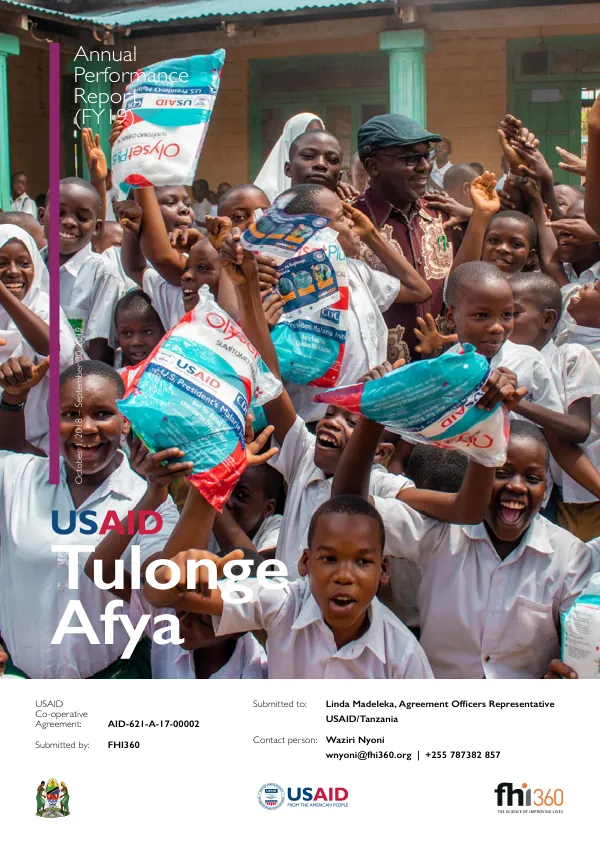
USAID TULONGE AFYA ANNUAL REPORT | OCT 2018 - SEP 2019
The project USAID Tulonge Afya, in collaboration with the Health Promotion Section (HPS), launched the NAWEZA and SITETEREKI platforms in FY19.
2019 · 50 pages
Sign in to readA free account is required to download.
Abstract
The platforms were introduced through zonal introduction events held in Mwanza, Tabora, and Iringa, accompanied by strategic radio, print, and out-of-home promotional activities to generate interest and awareness of the brands. Under NAWEZA, the social and behavior change (SBC) package for the prevention of mother-to-child transmission of HIV was rolled out, with 9,000 radio spots aired on national and regional radio stations and 276,235 individuals reached through small-group dialogues. For SITETEREKI, small-group activities promoting modern contraceptive method use for young women and condom use for young men were implemented across 29 Enhanced Districts, reaching 172,864 individuals aged 15-24. The NAWEZA anchor show, a 12-episode series, was launched on three national radio stations, reaching an estimated 4.8 million listeners. The show aimed to reinforce community-based SBC activities by promoting integrated maternal, newborn, and child health, family planning, and HIV priority behaviors, while addressing their determinants. Over 900 trailers were aired to promote the show, with tie-ins on social media platforms such as Facebook, Instagram, and Twitter, where NAWEZA content was viewed 4.6 million times. In the 29 Enhanced Districts, over 1,800 community volunteers were trained and supported to implement multi-session small-group discussions using the NAWEZA and SITETEREKI platforms. Collectively, they conducted activities that reached over 600,000 individuals, with 83.2% of enrolled participants completing all sessions. The project developed and deployed an electronic monitoring and evaluation (M&E) system, allowing for the collection, analysis, and analysis of project data to facilitate decision-making. The system can be accessed by partners, civil society organizations, and government with different levels of access for decision-making. The project continued to deliver technical assistance across various SBC needs, responding to the needs of implementing partners (IPs) and the Government of Tanzania. Examples of this support include the development and Government of Tanzania endorsement of SBC materials and messages, such as Furaha Yangu, to address key Country Operating Plan '19 priorities and Government priorities such as index testing, treatment adherence, viral load testing, and isoniazid preventative therapy for TB uptake. The project also provided technical assistance and support to the United States Government (USG) IPs, including AIDS, Kizires, and Sauti, to drive voluntary medical male circumcision, gender-based violence prevention, and violence against children prevention. Additionally, the project provided surge support to USAID Boresha Afya Southern Zone partners to drive HIV testing services among men and adolescents at high risk for HIV, via the development and deployment of regionalized and targeted radio spots, volunteer training, and provision of Furaha Yangu community dialogue toolkits. The project also provided technical support to the Government of Tanzania to develop the National Policy Guidelines on Health, the National Health Strategy, and the National Guidelines for the Development and Approval of Health Communication Materials. Furthermore, the project built the skills of Health Coordinators and civil society organizations at the district level to use co-delivery approaches and create a culture of participation and engagement within their communities. The project faced several challenges in FY19, including slow Ministry of Health, Community Development, Elderly, and Children (MoHCDG) approvals of materials, which delayed the roll-out of activities. The project has strengthened its working relationship with the HPS by supporting the development of standard operating procedures to guide a more streamlined approval process and bolstering coordination with key HPS officials with a dedicated, project-supported consultant within the unit. The project also faced challenges in the family planning policy environment, including the need for a more supportive policy environment to promote the use of modern contraceptive methods. The project worked with the Government of Tanzania to address these challenges and strengthen the policy environment to promote family planning. The project has made significant progress in FY19, with notable achievements including the launch of the NAWEZA and SITETEREKI platforms, the roll-out of the social and behavior change package for the prevention of mother-to-child transmission of HIV, and the implementation of small-group activities promoting modern contraceptive method use for young women and condom use for young men. The project has also developed and deployed an electronic M&E system and provided technical assistance across various SBC needs. The project will continue to work with partners, the Government of Tanzania, and the United States Government to address the challenges faced in FY19 and strengthen the policy environment to promote family planning. The project will also continue to deliver technical assistance across various SBC needs and build the skills of Health Coordinators and civil society organizations at the district level to use co-delivery approaches and create a culture of participation and engagement within their communities.