USAID DEC
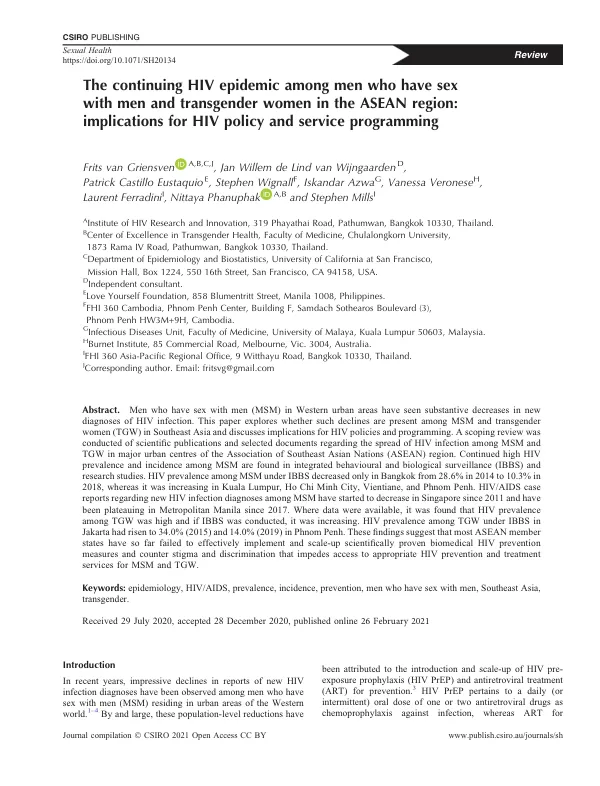
The continuing HIV epidemic among men who have sex with men and transgender women in the ASEAN region: implications for HIV policy and service programming
Sign inBURNET INSTITUTE
The continuing HIV epidemic among men who have sex with men and transgender women in the ASEAN region: implications for HIV policy and service programming
The HIV epidemic among men who have sex with men (MSM) and transgender women (TGW) in the ASEAN region remains a significant public health concern.
2021 · 10 pages
Sign in to readA free account is required to download.
Abstract
HIV prevalence among MSM in integrated behavioural and biological surveillance (IBBS) studies has been found to be high in several major urban centres in the region. In Bangkok, HIV prevalence among MSM decreased from 28.6% in 2014 to 10.3% in 2018, while it increased in Kuala Lumpur, Ho Chi Minh City, Vientiane, and Phnom Penh. HIV/AIDS case reports in Singapore have shown a decrease in new HIV infection diagnoses among MSM since 2011, with a plateau observed in Metropolitan Manila since 2017. HIV prevalence among TGW has been found to be high in several cities, including Jakarta and Phnom Penh. In Jakarta, HIV prevalence among TGW increased from 34.0% in 2015 to 14.0% in 2019, while in Phnom Penh, it increased from 14.0% in 2015 to 6.1% in 2019. These findings suggest that most ASEAN member states have failed to effectively implement and scale-up scientifically proven biomedical HIV prevention measures and counter stigma and discrimination that impedes access to appropriate HIV prevention and treatment services for MSM and TGW. The introduction and scale-up of HIV pre-exposure prophylaxis (HIV PrEP) and antiretroviral treatment (ART) for prevention have been attributed to the decline in new HIV infection diagnoses among MSM in Western urban areas. However, the efficacy of these interventions in the ASEAN region remains uncertain. A scoping review of scientific publications and selected documents regarding the spread of HIV infection among MSM and TGW in major urban centres in the ASEAN region was conducted to provide an overview of available data and discuss implications for HIV policy and service programming. The review included 634 publications, of which 18 reported HIV prevalence or incidence data among MSM residing in ASEAN major urban centres, five reported such data among TGW, and six reported them for both MSM and TGW. In addition, eight IBBS reports and two city-specific HIV/AIDS case reporting systems were identified. The results of the review highlight the need for effective implementation and scale-up of scientifically proven biomedical HIV prevention measures and counter stigma and discrimination to improve access to HIV prevention and treatment services for MSM and TGW in the ASEAN region. The HIV epidemic among MSM and TGW in the ASEAN region is characterized by high HIV prevalence and incidence rates in several major urban centres. The introduction and scale-up of HIV PrEP and ART for prevention have been attributed to the decline in new HIV infection diagnoses among MSM in Western urban areas, but their efficacy in the ASEAN region remains uncertain. The review highlights the need for effective implementation and scale-up of scientifically proven biomedical HIV prevention measures and counter stigma and discrimination to improve access to HIV prevention and treatment services for MSM and TGW in the ASEAN region. The ASEAN region has made progress in reducing HIV/AIDS-related deaths and increasing access to antiretroviral therapy (ART) for people living with HIV. However, the region still faces significant challenges in addressing the HIV epidemic among MSM and TGW. The review highlights the need for continued efforts to improve access to HIV prevention and treatment services, including HIV PrEP and ART, and to address stigma and discrimination that impedes access to these services. The HIV epidemic among MSM and TGW in the ASEAN region is a complex issue that requires a comprehensive and multi-faceted approach to address. The review highlights the need for continued research and evaluation to better understand the epidemiology of HIV among MSM and TGW in the region and to inform effective HIV prevention and treatment strategies.
Related documents