TETRA TECH
Second Annual Work Plan (FY21)
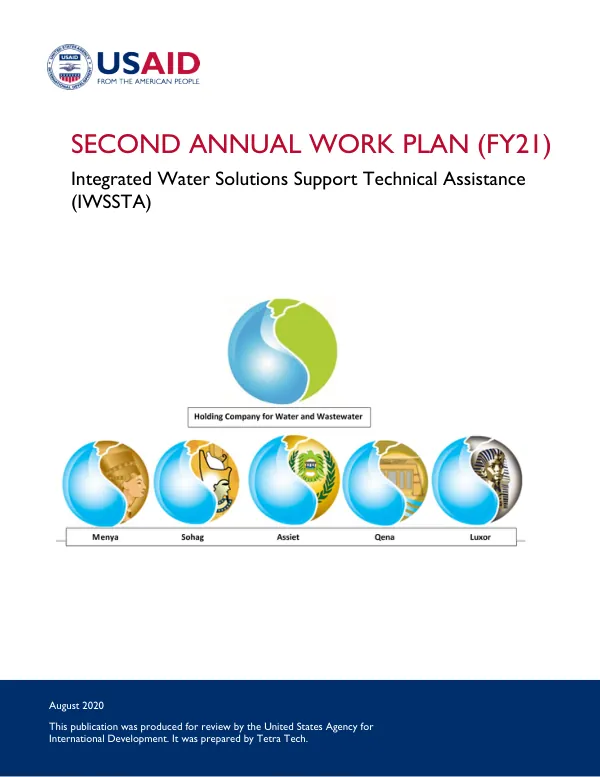
The Integrated Water Solutions Support Technical Assistance (IWSSTA) project in Egypt aims to improve the efficiency and effectiveness of water services in five governorates: Assiut, Minia, Sohag, Qena, and Luxor.
2020 · 211 pages
Sign in to readA free account is required to download.
Abstract
The project is implemented by Tetra Tech, with funding from the United States Agency for International Development (USAID). The project's strategic approach is based on addressing the challenges of water scarcity, inadequate infrastructure, and limited institutional capacity. The theory of change underlying the project is that improved water services will lead to increased access to safe drinking water, reduced water-borne diseases, and enhanced economic opportunities. The project's overall approach to achieving its objectives is based on four core principles: (1) improving water infrastructure, (2) enhancing institutional capacity, (3) promoting water conservation, and (4) fostering community engagement. The project will also employ a monitoring, evaluation, and learning (MEL) plan to track progress, identify challenges, and inform decision-making. The MEL plan includes a project logic model, which outlines the expected outcomes and outputs of the project. The plan also includes a monitoring framework, which will track progress against key performance indicators (KPIs) such as water production, water quality, and customer satisfaction. The IWSSTA work plan for FY21 is divided into two main components: Year 1 and Year 2. The work plan for Year 1 focuses on establishing the project's institutional framework, conducting a comprehensive assessment of the water sector in the five governorates, and developing a detailed plan for improving water services. The work plan for Year 2 builds on the progress made in Year 1 and focuses on implementing the project's interventions, including improving water infrastructure, enhancing institutional capacity, promoting water conservation, and fostering community engagement. The work plan also includes a detailed schedule of tasks, milestones, and deadlines. The project will be implemented by a team of experts from Tetra Tech, in collaboration with local implementing partners. The project's management structure will include a project manager, a deputy project manager, and a team of technical specialists. The project's risk mitigation strategy includes measures to address potential risks such as changes in government policies, funding constraints, and technical challenges. The project will also establish a system for reporting progress, tracking expenses, and monitoring risks. Overall, the IWSSTA project aims to improve the efficiency and effectiveness of water services in Egypt, with a focus on enhancing access to safe drinking water, reducing water-borne diseases, and promoting economic opportunities. The project's work plan for FY21 outlines a comprehensive approach to achieving its objectives, including improving water infrastructure, enhancing institutional capacity, promoting water conservation, and fostering community engagement.
Related documents