THE ASIA FOUNDATION
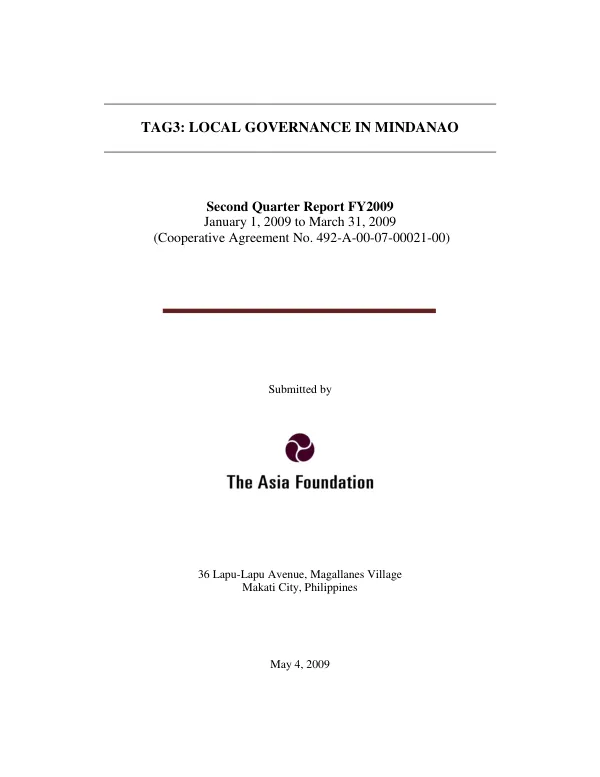
Second Quarter Report FY2009: Local Governance in Mindanao
The TAG3: Local Governance in Mindanao project aims to strengthen local governance and mechanisms for conflict resolution, and local economic development in Mindanao cities and municipalities.
2009 · 71 pages
Sign in to readA free account is required to download.
Abstract
The project is supported by the United States Agency for International Development (USAID) under Cooperative Agreement No. 492-A-00-07-00021-00 and runs from October 1, 2007, through September 30, 2009. The project is composed of five broad components, including Technical Assistance to Nine Mindanao Cities, Development of service standards for business registration and real property tax administration, Technical Assistance to 30 Conflict-Affected Municipalities in Mindanao, Public-Private Partnerships through the City Coalitions for Transparent Accountable Governance, and Four COPS to Improve the Delivery of Health Products and Services in Asipulo, Ifugao. Technical Assistance to Nine Mindanao Cities is one of the project's components, which aims to improve the overall business environment and increase the competitiveness of Mindanao cities through better governance. The technical assistance to cities has three components: local policy reforms, human resource development, and procedural reforms. Local policy reforms examine the city governments' regulations, policies, and priorities that directly affect businesses and have an impact on the competitiveness of the cities as well as the vibrancy of the local economy. Five cities have enrolled in the policy reform component of the project. Human Resource Management (HRM) is another key area of focus for the project. The HRM component helps cities improve the programs and processes related to the capacity building of city government personnel, and looks into programs related to the employment skills of city residents and their readiness to supply the human resource requirement of investors. This component specifically looks into the city governments' staffing, training and development of personnel, employee welfare, recruitment, selection and promotion, and performance evaluation. Implementation of the project's activities has been challenging due to the prevailing social, political, and security situation in Mindanao. In several instances, progress of project activities was put on hold due to breakdown of the security situation and heavy fighting. In some cases, natural disasters like flood made the municipalities inaccessible. In others, political bickering between the executive and the legislative caused setbacks in implementation. Despite these challenges, the project has made progress in several areas. Five cities have enrolled in the policy reform component of the project, and the HRM component has helped cities improve their programs and processes related to the capacity building of city government personnel. The project has also introduced improvements in selected city government systems and services deemed crucial in providing support to businesses and investors.