USAID DEC
Sector Reform and Utility Commercialization Support Project: USAID Energy Toolkit Development
Sign inDELOITTE CONSULTING, LLP
Sector Reform and Utility Commercialization Support Project: USAID Energy Toolkit Development
The Sector Reform and Utility Commercialization Support Project (SRUC) aims to promote utility commercialization and equitable, effective reforms that will enhance the financial viability and long-term sustainability of developing countries' electricity systems.
2018 · 3 pages
Sign in to readA free account is required to download.
Abstract
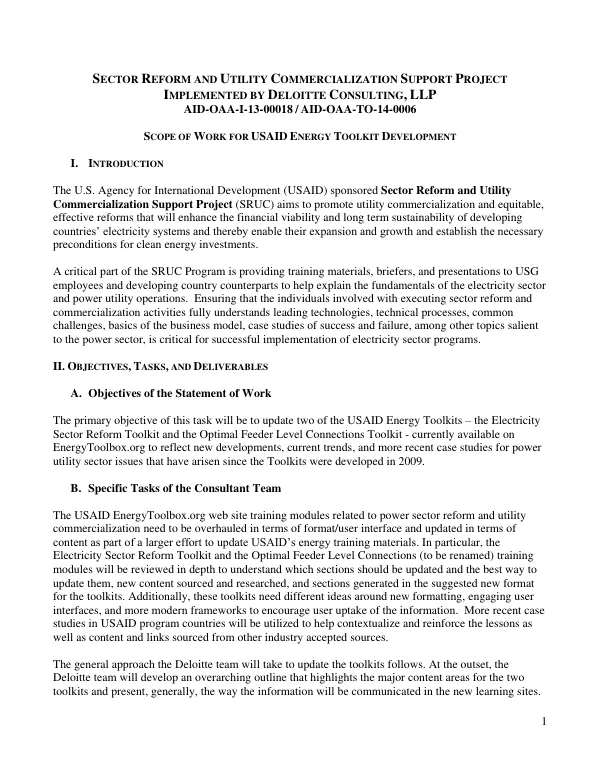
This project is implemented by Deloitte Consulting, LLP, and is sponsored by the U.S. Agency for International Development (USAID). The primary objective of the SRUC Program is to provide training materials, briefers, and presentations to USG employees and developing country counterparts to help explain the fundamentals of the electricity sector and power utility operations. Ensuring that individuals involved in executing sector reform and commercialization activities fully understand leading technologies, technical processes, common challenges, and basics of the business model is critical for successful implementation of electricity sector programs. The SRUC Program involves updating two of the USAID Energy Toolkits – the Electricity Sector Reform Toolkit and the Optimal Feeder Level Connections Toolkit – to reflect new developments, current trends, and more recent case studies for power utility sector issues that have arisen since the Toolkits were developed in 2009. The Deloitte team will overhaul the USAID EnergyToolbox.org web site training modules related to power sector reform and utility commercialization, updating the content and format to make it more engaging and user-friendly. The Deloitte team will source and research new content for each learning site, pulling from the latest case studies, technical innovations, and industry-accepted standard sources. This new content will include information on smart grid technology, anti-theft technology and strategies, advanced metering case studies, low-income and slum electrification approaches, technical and non-technical loss best practices, and other power sector issues that reflect agency priorities on these subjects. The primary audience for the Toolkits will be agency staff and other development professionals as well as electricity sector stakeholders, such as power utility and regulator staff, in developing countries. The final product will be narrative content developed by Deloitte SMEs regarding electricity sector reform and electricity sector losses. The Deloitte team will align the narrative with graphical content and interactive features designed to engage the user. Upon USAID's approval, Deloitte will deliver the finished narrative content to the ESTLP team for final assembly into a learning module for peer review and dissemination among development professionals. The Deloitte team will deliver several key milestones, including a short work plan, outlines of the general layout and high-level content for both toolkits, storyboards/wireframes for the Optimal Feeder Level Connections learning site and Electricity Sector Reform learning site, and narrative scripts annotated with graphics and other interactive features. The team will also provide quality control and oversight to ensure that the final deliverable meets the required standards. The project timeline is as follows: a short work plan was delivered on January 6, outlines of the general layout and high-level content were delivered on February 16, and storyboards/wireframes were also delivered on February 16. The final narrative scripts and graphical content are due on April 24. The project team includes several Deloitte SMEs, including a Chief of Party, Renewables SME/Team Lead, Technical & Engagement Coordinator, Sector Reform SME, Loss Reduction SME, and Feeder/Distribution SME.