USAID DEC
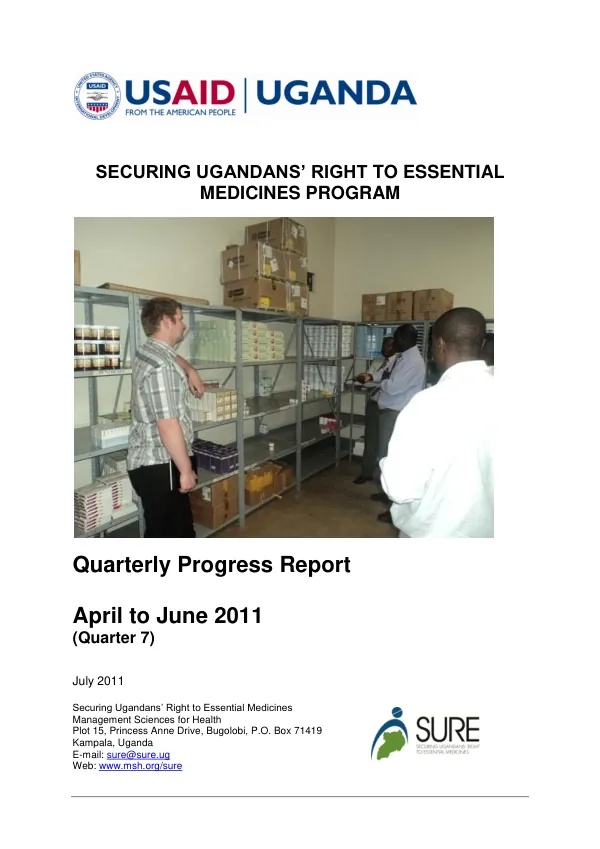
Securing Ugandans' Right to Essential Medicines Program: Quarterly Progress Report April to June 2011
Sign inMANAGEMENT SCIENCES FOR HEALTH
Securing Ugandans' Right to Essential Medicines Program: Quarterly Progress Report April to June 2011
The Securing Ugandans' Right to Essential Medicines program, funded by the US Agency for International Development (USAID), aims to strengthen the national pharmaceutical supply system in Uganda.
2011 · 46 pages
Sign in to readA free account is required to download.
Abstract
The program, implemented by Management Sciences for Health, has a five-year cooperative agreement worth $39 million. The program's objectives include improving Uganda's policy, legal, and regulatory framework for pharmaceutical supply chain stability and sustainability, improving the capacity and performance of central government entities in supply chain management, and improving the capacity and performance of districts and implementing partners in supply chain management. The program has made significant progress in achieving its objectives. The Government of Uganda has demonstrated commitment to improving health commodities financing, and the legal, regulatory, and policy framework has been revised to promote cost-effective, efficient, and equitable use of available funds and health commodities. The National Medical Stores (NMS) has improved its capacity to procure, store, and distribute essential medicines and health supplies (EMHS), and the Ministry of Health (MoH) program managers and technical staff have improved their capacity to plan and monitor national EMHS. The program has also focused on improving the capacity and performance of targeted districts and health facilities in planning, distribution, managing, and monitoring EMHS. The capacity of target districts and health facilities has been improved in planning, distribution, managing, and monitoring EMHS, and the capacity of selected implementing partners has been improved in quantifying, managing, and monitoring EMHS. Overall access to EMHS has been improved through innovative district-level interventions. The program has also made progress in monitoring and evaluation, with the performance monitoring plan (PMP) indicators reported for the April-June 2011 period. The program has also improved its capacity for monitoring and evaluation for key stakeholders, and has implemented a district support package in SURE districts. The program has also made progress in program management, program implementation, staffing, and finances. The appointment of a new Minister for Health and internal changes in the Ministry of Health's senior management have had an impact on the program's progress. However, the program has been able to re-establish its visibility among the new appointees and continue making progress towards its objectives. The program's progress has been characterized by the improvement of the policy, legal, and regulatory framework, the improvement of the capacity and performance of central government entities, and the improvement of the capacity and performance of districts and implementing partners. The program's achievements have been significant, with the Government of Uganda demonstrating commitment to improving health commodities financing, and the legal, regulatory, and policy framework revised to promote cost-effective, efficient, and equitable use of available funds and health commodities. The program has also improved the capacity of NMS to procure, store, and distribute EMHS, and the capacity of MoH program managers and technical staff to plan and monitor national EMHS. The program has also improved the capacity of target districts and health facilities in planning, distribution, managing, and monitoring EMHS, and overall access to EMHS has been improved through innovative district-level interventions.