USAID DEC
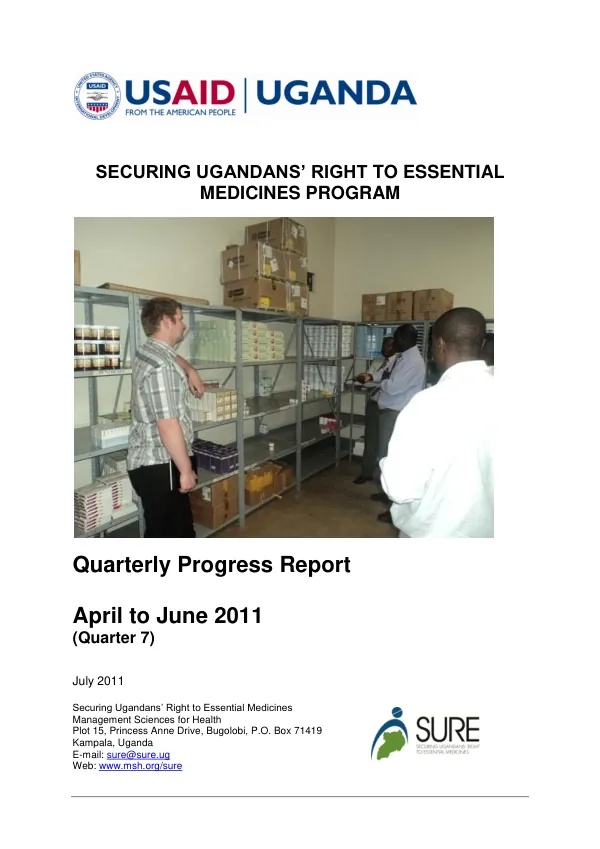
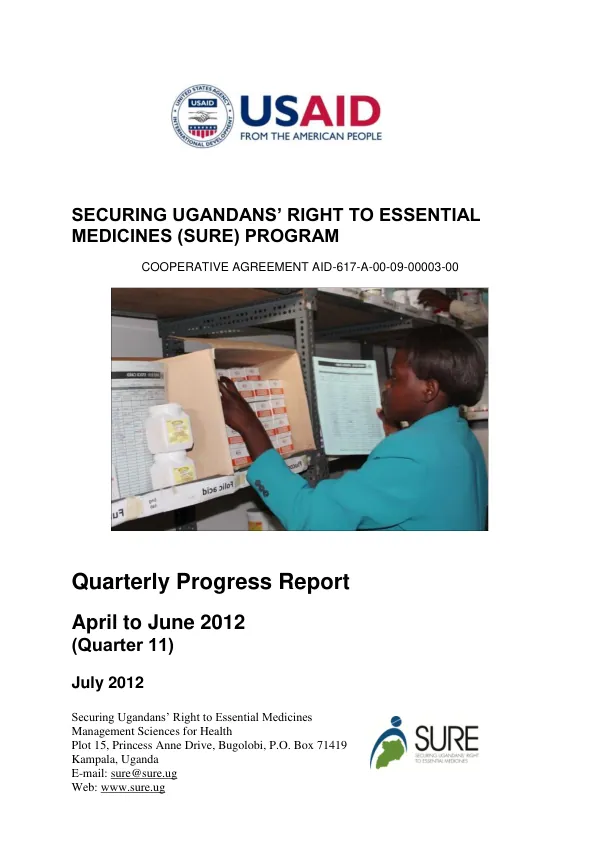
Securing Ugandans' Right to Essential Medicines (SURE) Program Quarterly Progress Report
Sign inMANAGEMENT SCIENCES FOR HEALTH
Securing Ugandans' Right to Essential Medicines (SURE) Program Quarterly Progress Report
The Securing Ugandans' Right to Essential Medicines (SURE) program is a five-year initiative funded by the US Agency for International Development (USAID) with a budget of $39 million.
2012 · 55 pages
Sign in to readA free account is required to download.
Abstract
The program aims to strengthen Uganda's national pharmaceutical supply system, ensuring that the population has access to good quality essential medicines and health supplies. Management Sciences for Health is the lead implementing partner, collaborating with the Euro Health Group, Fuel Group/Pharmaceutical Healthcare Distributors-RTT, Makerere University, and the Infectious Disease Institute. The SURE program focuses on improving Uganda's policy, legal, and regulatory framework to produce pharmaceutical supply chain stability and sustainability. This involves improving the capacity and performance of central government entities, districts, and implementing partners in their supply chain management roles and responsibilities. The program also aims to improve the capacity and performance of target districts and health facilities in planning, distribution, managing, and monitoring essential medicines and health supplies. Key activities under the SURE program include developing an information system for tracking financing and essential medicines and health supplies funding, conducting financial assessments of EMHS utilization, and prioritizing resources for greater health impact. The program also supports the development of a functional supply chain system serving Uganda's central and local healthcare levels with the necessary tools, approaches, skills, and coordinating mechanisms. The SURE program has made significant progress in Quarter 11, with notable achievements in the areas of government commitment to improving health commodities financing, legal, regulatory, and policy framework revision, and improved capacity and performance of central government entities in their supply chain management roles and responsibilities. The program has also supported the development of a district- and facility-level support package, implemented the Supervision, Performance Assessment, and Recognition Strategy (SPARS), and introduced new district communication and technology. In terms of monitoring and evaluation, the SURE program has established a robust system to track progress against planned activities, including the use of the District Health Information Management Software Version-2 (DHIS2) and the Financial and Commodity Tracking System (FACTS). The program has also conducted regular monitoring and evaluation activities, including site visits and data analysis, to assess progress and identify areas for improvement. Overall, the SURE program is making significant strides in improving Uganda's pharmaceutical supply system, with a focus on strengthening the capacity and performance of central government entities, districts, and implementing partners. The program's achievements in Quarter 11 demonstrate its commitment to improving access to essential medicines and health supplies for the people of Uganda.
Related documents