USAID DEC
Select Gender-Based Violence Literature Reviews: Corporal Punishment in Schools in Low-Income Countries
Sign inUSAID DEC
Select Gender-Based Violence Literature Reviews: Corporal Punishment in Schools in Low-Income Countries
Corporal punishment in schools is a widespread issue in low-income countries, with significant consequences for child development and well-being.
2021 · 3 pages
Sign in to readA free account is required to download.
Abstract
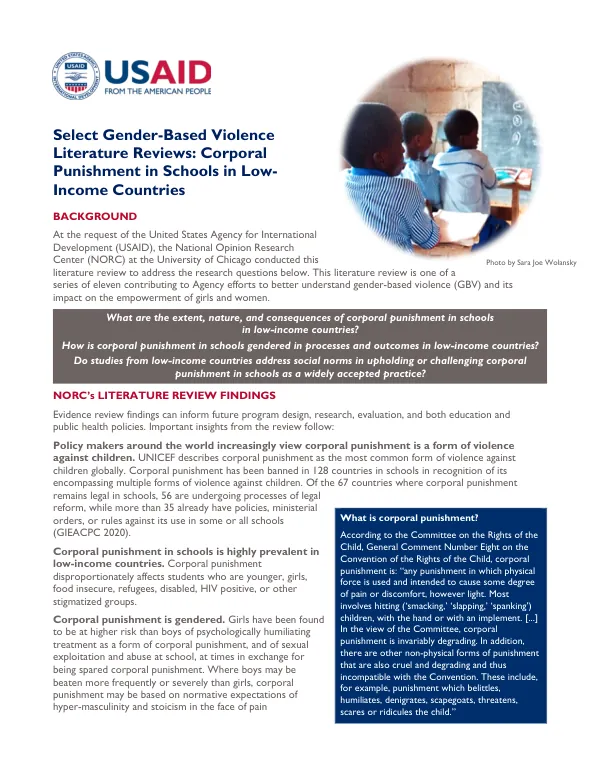
According to the United Nations Children's Fund (UNICEF), corporal punishment is the most common form of violence against children globally, with 128 countries having banned its use in schools. However, in 67 countries where corporal punishment remains legal, 56 are undergoing legal reform, and more than 35 have policies or rules against its use in some or all schools. Corporal punishment disproportionately affects vulnerable students, including those who are younger, girls, food insecure, refugees, disabled, HIV positive, or other stigmatized groups. Girls are at higher risk of psychologically humiliating treatment and sexual exploitation and abuse at school, often in exchange for being spared corporal punishment. Boys, on the other hand, may be beaten more frequently or severely, with corporal punishment based on normative expectations of hyper-masculinity and stoicism in the face of pain. Corporal punishment is defined as any punishment in which physical force is used and intended to cause some degree of pain or discomfort, however light. According to the Committee on the Rights of the Child, corporal punishment is invariably degrading and can take many forms, including hitting, belittling, humiliating, denigrating, scapegoating, threatening, scaring, or ridiculing the child. Research has shown that corporal punishment has multiple harmful effects on child development, including injuries and mortality, poor behavioral regulation, impaired cognitive development, and negative mental and physical health. Attitudes, beliefs, and norms underpin both the upholding and challenging of corporal punishment in schools. Many adults hold contradictory beliefs and practices concerning violence against children, struggling to clearly delineate what constitutes acceptable "discipline" or "punishment" versus violence. However, evaluation results show that corporal punishment is preventable, and non-violent, positive discipline alternatives, supportive teacher-student relationships, and a safer school climate can contribute to reducing students' risks of poor academic performance, dropout, poor mental and physical health, and other compounded problems affecting child development. To address the issue of corporal punishment in schools, combined whole-of-school and whole-of-community programs are needed, coordinated within and across education, health, and child protection sectors. Intervention development through careful co-design with evaluation and implementation partners can help maximize and measure interlinked education and child development outcomes. Longer-term gender norm change community-wide is required for cultivating safe, supportive, stable, and nurturing schools and homes that value girls and boys equally and use alternative, positive, non-violent discipline methods with students of all genders.