USAID DEC
Select Gender-Based Violence Literature Reviews: VSLAs and Intimate Partner Violence
Sign inNORC AT THE UNIVERSITY OF CHICAGO
Select Gender-Based Violence Literature Reviews: VSLAs and Intimate Partner Violence
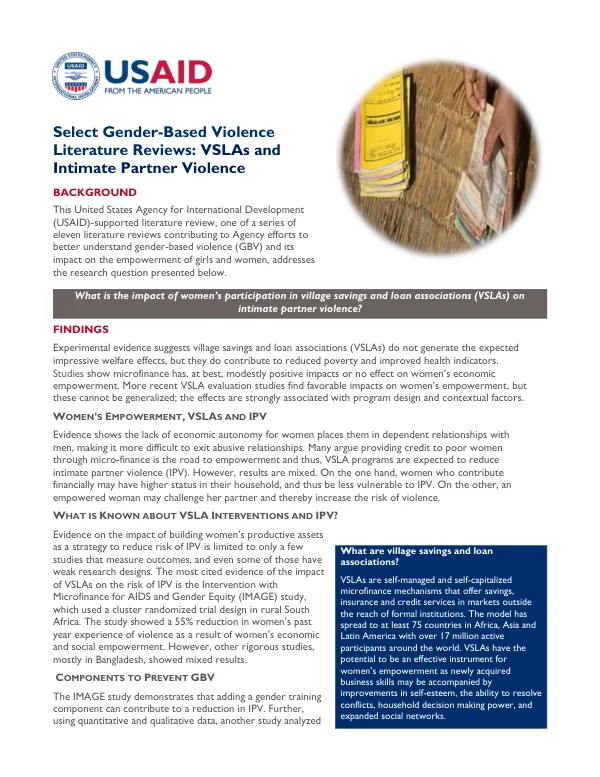
The literature review on the impact of women's participation in village savings and loan associations (VSLAs) on intimate partner violence (IPV) suggests that VSLAs do not produce the expected significant positive effects on women's economic empowerment.
2021 · 2 pages
Sign in to readA free account is required to download.
Abstract
However, studies indicate that VSLAs can contribute to reduced poverty and improved health indicators. Experimental evidence suggests that VSLAs can have modestly positive impacts or no effect on women's economic empowerment. However, recent VSLA evaluation studies show favorable impacts on women's empowerment, but these effects are associated with program design and contextual factors. The literature review highlights the importance of women's economic empowerment in reducing IPV. Women who contribute financially may have higher status in their household, making them less vulnerable to IPV. However, an empowered woman may also challenge her partner, potentially increasing the risk of violence. The evidence on the impact of building women's productive assets as a strategy to reduce IPV is limited, with only a few studies measuring outcomes. The most cited evidence of the impact of VSLAs on IPV is the Intervention with Microfinance for AIDS and Gender Equity (IMAGE) study, which used a cluster randomized trial design in rural South Africa. The study showed a 55% reduction in women's past year experience of violence as a result of women's economic and social empowerment. The IMAGE study demonstrates that adding a gender training component can contribute to a reduction in IPV. The study analyzed the mechanisms underlying the significant reduction in IPV and found that women were able to challenge the acceptability of violence, expect and receive better treatment from partners, leave abusive relationships, and raise public awareness about IPV. However, a recent impact evaluation of the short-term Sumaq Warmi program in rural Peru showed disappointing results, with no significant changes in social norms and only small effects on violence. The study also found that the effects disappeared by the end line. Other studies have found similar results, suggesting that short-lived programs are not sufficient to reduce exposure to violence. The literature review highlights the importance of involving men in training and changing underlying social and cultural norms. The WINGS intervention in Côte d'Ivoire, which included a "Gender Dialogue Group" for women participants and their male partners, showed reduced physical violence among those who attended groups regularly. The study suggests that programs should address underlying social and cultural norms, such as decision-making dynamics, household power relations, and social sanctions and/or stigma related to specific behaviors. Additionally, programs should involve men and boys in training components, and consider the duration and intensity of components aimed at reducing IPV.