USAID DEC
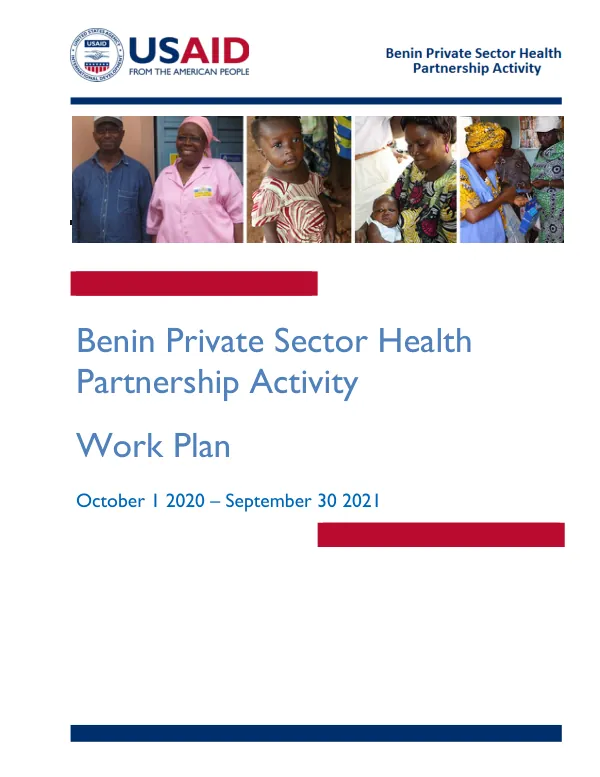
USAID Benin Private Sector Health Partnership Activity Work Plan: October 1 2020 – September 30 2021
Sign inABT ASSOCIATES
USAID Benin Private Sector Health Partnership Activity Work Plan: October 1 2020 – September 30 2021
The USAID Benin Private Sector Health Partnership Activity is a five-year project (2018-2023) with a budget of 9.8 million dollars in Benin.
2020 · 55 pages
Sign in to readA free account is required to download.
Abstract
The project aims to increase the use of high-impact health services and products of reproductive, maternal, newborn, and child health (RMNCH) provided by the private sector. The activity is linked to the sub-intermediate result (IR) I.I of the USAID/Benin result frame "Improvement of access to high-impact health services." The project has four intermediate results (IRs), including: - IR 1: Increase the volume of RMNCH high-impact quality services provided by private sector providers. - IR 2: Increase the availability of affordable and quality products through private sector channels. - IR 3: Strengthen public-private engagement for universal results of RMNCH services. - IR 4: Identify, manage, and apply innovative and successful private sector models recognizing four possible models. The project is implemented by Abt Associates in collaboration with MCDI, EnCompass, IQVIA, PSSP, and CEBAC-STP. The project's organizational chart is presented in Figure 2, and the list of acronyms is provided on page vi. The project's introduction and context highlight the substandard health indicators in Benin, including high maternal, newborn, and child mortality rates. Despite progress made in recent years, achieving the Sustainable Development Goals (SDG) will remain a challenge unless the present improvement trend is strongly accelerated. The private sector in Benin offers opportunities to increase employment, reduce poverty, empower women and youth, strengthen community resilience, and possibly improve life. The project's implementation plan includes activities to achieve the four intermediate results. For IR 1, the project aims to increase the volume of RMNCH high-impact quality services provided by private sector providers. This will be achieved through training and capacity-building programs for private sector providers, as well as the establishment of a quality assurance system. For IR 2, the project aims to increase the availability of affordable and quality products through private sector channels. This will be achieved through the establishment of a logistics management information system (LMIS) and the provision of technical assistance to private sector providers. For IR 3, the project aims to strengthen public-private engagement for universal results of RMNCH services. This will be achieved through the establishment of a public-private partnership (PPP) framework and the provision of technical assistance to public and private sector stakeholders. For IR 4, the project aims to identify, manage, and apply innovative and successful private sector models recognizing four possible models. This will be achieved through the conduct of a private sector assessment and the provision of technical assistance to private sector providers. The project's implementation plan also includes cross-cutting activities, such as program management, human resources, environmental mitigation and monitoring, and financial reporting. The project's budget is presented in Table 2, and the results framework is presented in Figure 1.