USAID DEC
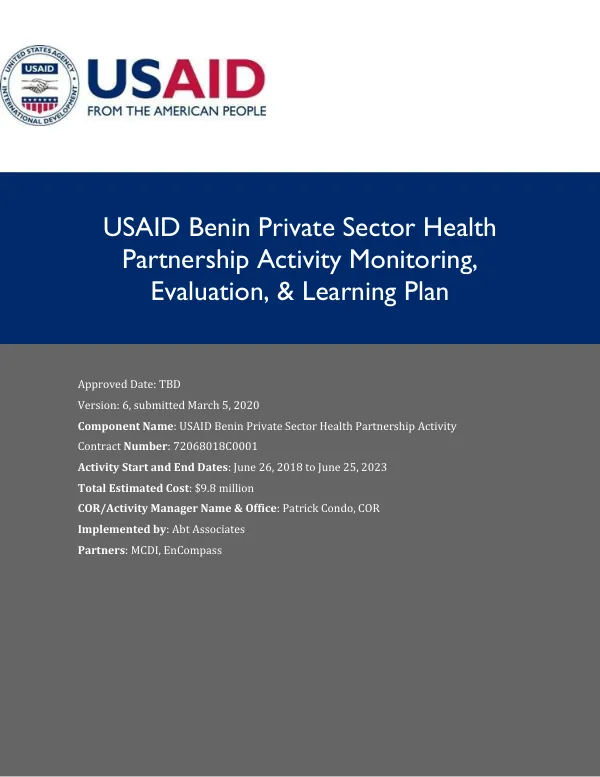
USAID Benin Private Sector Health Partnership Activity Monitoring, Evaluation, & Learning Plan
Sign inABT ASSOCIATES
USAID Benin Private Sector Health Partnership Activity Monitoring, Evaluation, & Learning Plan
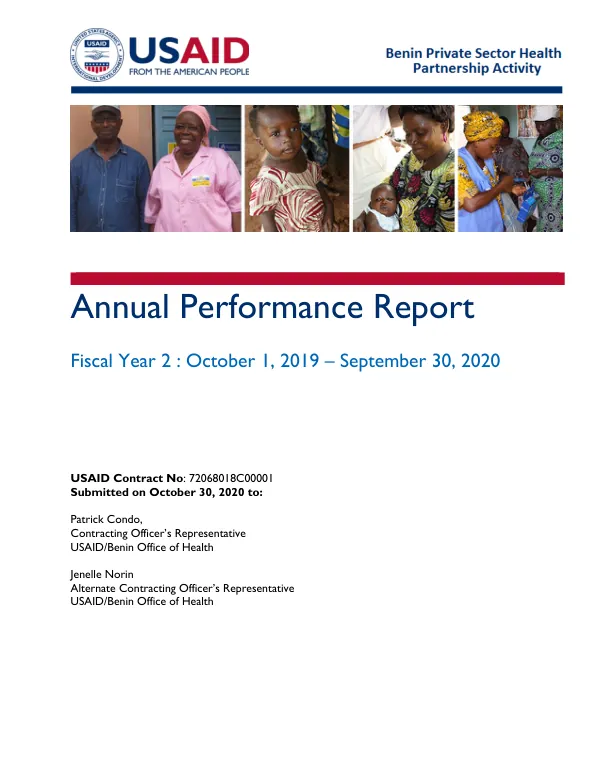
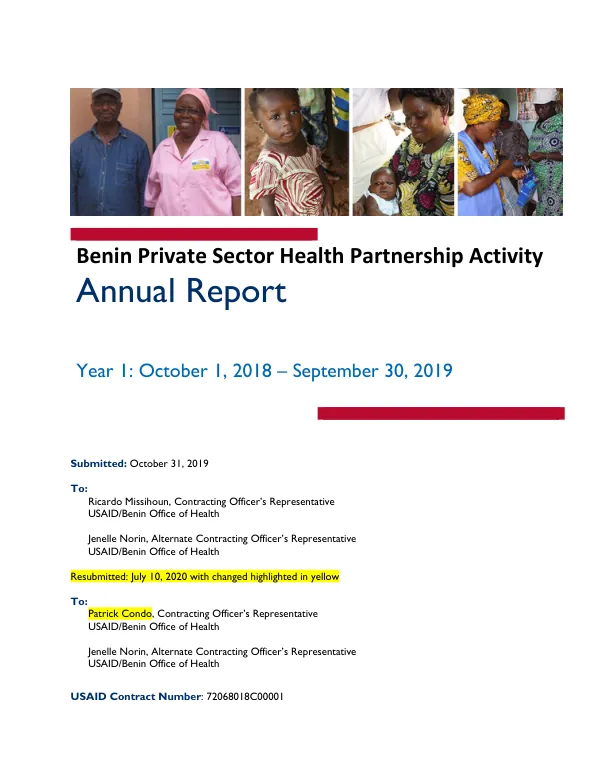
The Private Sector Health Partnership Activity (PSHPA) Monitoring, Evaluation, and Learning Plan (AMELP) serves to guide the implementation of the PSHPA project, which aims to empower the Government of Benin to be a market-driven steward of the health system with increased engagement and oversight of the private sector.
2020 · 55 pages
Sign in to readA free account is required to download.
Abstract
The project seeks to increase the use of high-impact Reproductive, Maternal, Newborn, and Child Health (RMNCH) services and products delivered by the private sector nationwide. The PSHPA Theory of Change posits that empowering the Government of Benin to be a market-driven steward of the health system, streamlining regulations and standards, scaling up promising private sector approaches, and strengthening the capacity of the Plateforme du Secteur Sanitaire Privé (PSSP) will increase the use of high-impact RMNCH products and services delivered by the private sector. This will contribute to the reduction of preventable deaths, including deaths among traditionally underserved, vulnerable populations, and improve health outcomes for the Beninese population. The PSHPA Results Framework integrates the Theory of Change elements into an actionable framework that guides all project activities. The overall purpose of PSHPA is to increase the use of high-impact RMNCH services and products delivered by the private sector nationwide. There are four results: Expanded volume of quality RMNCH services and products delivered by the private sector; Increased use of high-impact RMNCH services and products by the private sector; Improved health outcomes for the Beninese population; and Strengthened capacity of the PSSP to lead quality assurance and advocacy. The PSHPA project will achieve these results through several key interventions, including streamlining private sector registration and RMNCH accreditation, supporting the private sector to scale up services, strengthening the PSSP's ability to lead quality assurance and advocacy, and strengthening coverage, timeliness, and quality of private sector reporting. The project will also focus on learning, aiming to make use of monitoring, evaluation, and learning findings to inform project design, make programmatic adjustments as possible, and systematically generate knowledge. The PSHPA project will be implemented over a five-year period, from June 26, 2018, to June 25, 2023, with a total estimated cost of $9.8 million. The project will be implemented by Abt Associates, with partners including MCDI and EnCompass. The project will be monitored and evaluated through a variety of mechanisms, including performance monitoring, context monitoring, and strategic evaluation and learning. The PSHPA project will also focus on data management, including data collection, data quality assurance, data storage and security, and data analysis and use and dissemination. The project will establish a learning agenda, which will guide the project's approach to learning and adaptation. The project will also establish guidelines for the collection, management, quality assurance, storage, analysis, and use of data, and define responsibilities from the point of collection through use. The PSHPA project will be implemented in Benin, with a focus on increasing the use of high-impact RMNCH services and products delivered by the private sector nationwide. The project will aim to improve health outcomes for the Beninese population, particularly among traditionally underserved, vulnerable populations. The project will also focus on strengthening the capacity of the PSSP to lead quality assurance and advocacy, and will aim to make use of monitoring, evaluation, and learning findings to inform project design, make programmatic adjustments as possible, and systematically generate knowledge.