USAID DEC
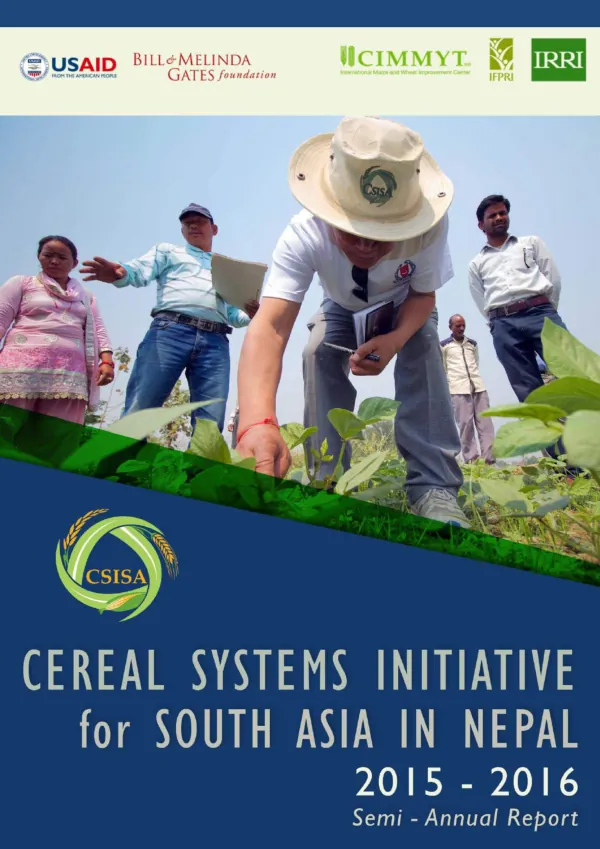
Semi-Annual Report 2015: Cereal Systems Initiative for South Asia in Nepal
The Cereal Systems Initiative for South Asia in Nepal (CSISA-NP) is a project implemented by the International Maize and Wheat Improvement Center (CIMMYT) with funding from the United States Agency for International Development (USAID).
2015 · 21 pages
Sign in to readA free account is required to download.
Abstract
The project aims to improve the productivity and sustainability of cereal-based cropping systems in Nepal, with a focus on rice, lentil, and maize. The project's research focus in Nepal is aligned with the staple crop mandates of Feed the Future (FtF), which includes sustainable intensification (SI) technologies for rice, lentil, and maize-based cropping systems. CSISA stages its work in the Mid and Far West development regions from offices in Nepalgunj, Surkhet, Dadeldhura, and Dhangadhi. In response to the threat of drought and variable monsoon conditions, CSISA has started to devise and evaluate simple agronomic practices that may build resilience to drought. Preliminary results indicate that increasing planting density from 20 cm x 20 cm to 15 cm x 15 cm increased yield by about 1.5 t/ha, a 50% gain in yield with very little cost to farmers. CSISA also conducted a household survey (N=98) to understand farmers' perception of various coping strategies for drought. Farmers perceived the value of planting short-duration varieties (32%) and expanding irrigation availability and use (28%). The project has also explored the use of laser land leveling (LLL) as a means of operational land consolidation. Many farmers in the mid and far-western Terai split larger plots into multiple small plots by constructing temporary bunds, which are reformed each season. However, this practice is labor-intensive and costly, and area taken up by the bunds cannot be cultivated, resulting in economic losses. LLL is performed by a four-wheel tractor-drawn laser-guided land leveling attachment, which not only improves water distribution but also increases plot size by reducing the bund. In the Terai region, CSISA has introduced different machinery for seeding spring maize, including a zero-tillage (ZT) planter. The project has also conducted field demonstrations and agricultural fairs to promote the use of improved technologies and practices among farmers. Additionally, CSISA has been working with service providers to train them on the use of new technologies and practices, with the goal of achieving scale and increasing the adoption of improved technologies among farmers. The project has also focused on business development initiatives, including business mentoring for local seed enterprises and pathways to improve the availability of registered hybrid maize seeds. Furthermore, CSISA has been working on a mungbean promotion initiative to improve the productivity and profitability of mungbean production among farmers. Overall, the CSISA-NP project is working to improve the productivity and sustainability of cereal-based cropping systems in Nepal, with a focus on rice, lentil, and maize. The project's research and development activities are aimed at building resilience to drought and variable monsoon conditions, improving water distribution and use, and increasing the adoption of improved technologies and practices among farmers.