USAID
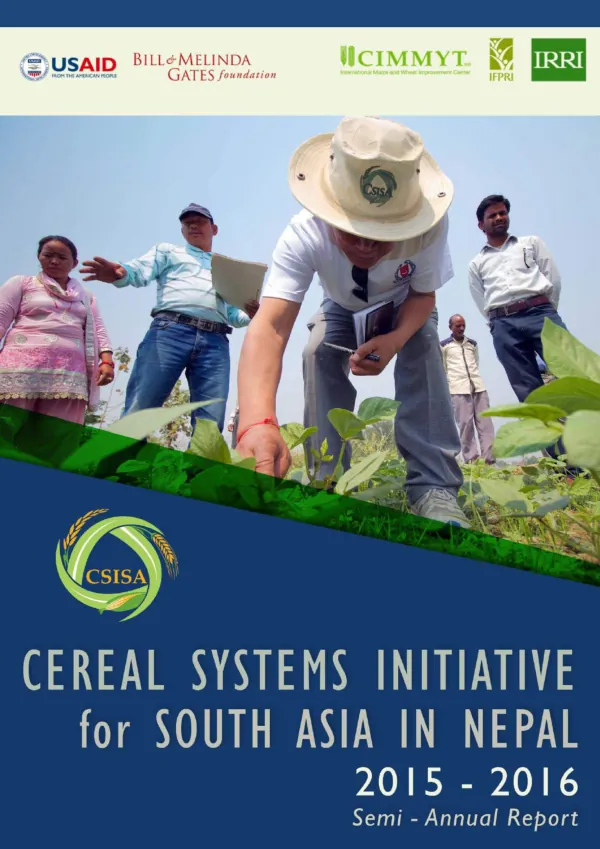
Semi-Annual Report: Cereal Systems Initiative for South Asia in Nepal (CSISA-NP)
Cereal and pulse yields in Nepal fall well below regional averages and present rates of increase won't meet long-term domestic requirements.
2016 · 56 pages
Sign in to readA free account is required to download.
Abstract
Factors contributing to low staple crop performance in Nepal include scarce farm labor, poor knowledge of best agricultural management practices, lack of irrigation and mechanization, and farmers' inability to take risks and invest in new technologies. Innovative applied research has long been underfunded, and research benefits have rarely reached farmers. Nepal's Mid and Far West development regions are most acutely affected by these constraints, with the highest poverty rates and lowest private sector investment. The Government of Nepal's new 20-year Agriculture Development Strategy recognizes the need for new science-led innovations, crop diversification options for income generation, strengthened input systems for seed and fertilizer, mechanization to cope with outmigration and an aging agricultural workforce, and enterprise development to create new jobs and extend essential support services to large numbers of farmers. In support of these priorities, the Cereal Systems Initiative for South Asia (CSISA) works with partners to rapidly and broadly increase the adoption of sustainable intensification technologies at scale. CSISA's 'Scaling Seed and Sustainable Intensification Technologies in Nepal' project pursues several objectives, including pulse (lentil and mung bean) intensification and diversification, cropping system-based approaches for sustainably intensifying wheat and minimizing terminal heat stress, facilitation of efficient and low-risk strategies for the precise and productive use of nutrients, robust seed systems, and scale-appropriate mechanization and irrigation. These activities are part of a four-year program funded jointly by USAID Washington and USAID India. AGRONOMY AND SEED SYSTEMS SCALING is a key component of CSISA's work in Nepal. Wheat is a major focus area, with CSISA conducting on-station experiments to test three wheat varieties of different maturation classes, seeded on three different dates at two different seed rates. Results indicate that early-seeded, long-duration wheat varieties fare better than late-seeded ones, particularly in the Terai region where terminal heat frequently lowers yields. CSISA also conducted on-farm evaluation trials in six farmers' fields in Surkhet to evaluate the performance of rainfed wheat under different seeding times in the hills. Results show that early planting of wheat in the hills helps the crop take advantage of residual soil moisture from late monsoon rains, thus avoiding drought-like conditions. In addition to wheat, CSISA is also working on lentil and mungbean. Realizing the importance of suitable genotypes for lentil, CSISA collaborated with the Agronomy Division of NARC, National Grain Legume Program, and ICARDA to evaluate 100 lentil genotypes from the Mediterranean region for drought and high moisture resistant genotypes. Current field observations show that some lines may be resistant to drought, evidenced this year as it is extremely dry. CSISA also conducted a household survey of 600 farm households in its working districts in 2014-15 to understand lentil productivity trends under farmer management. Results suggest that high rainfall was the major predictor of low lentil yields during the study year. Mungbean is another key focus area for CSISA, with seed companies evaluating the performance, yield, and economic benefits of mungbean under four different cropping systems: rice-mustard-mungbean, rice-vegetable-mungbean, rice-lentil-mungbean, and rice-wheat-mungbean. CSISA is also launching collaborative research with the National Grain Legume Program and a private seed company for both on-farm and on-station evaluations of pipeline mungbean varieties. Data generated will be helpful for the registration of potential varieties and to make available seed to farmers as seed companies participate in evaluating varieties.