GLOBAL COMMUNITIES
Semi-Annual Report: Barrio Mio Scale Up Program (BMSU)
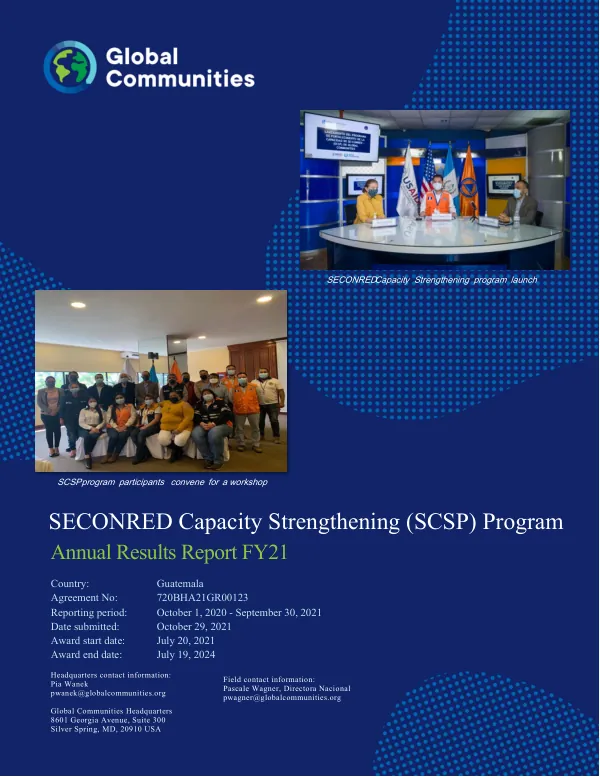
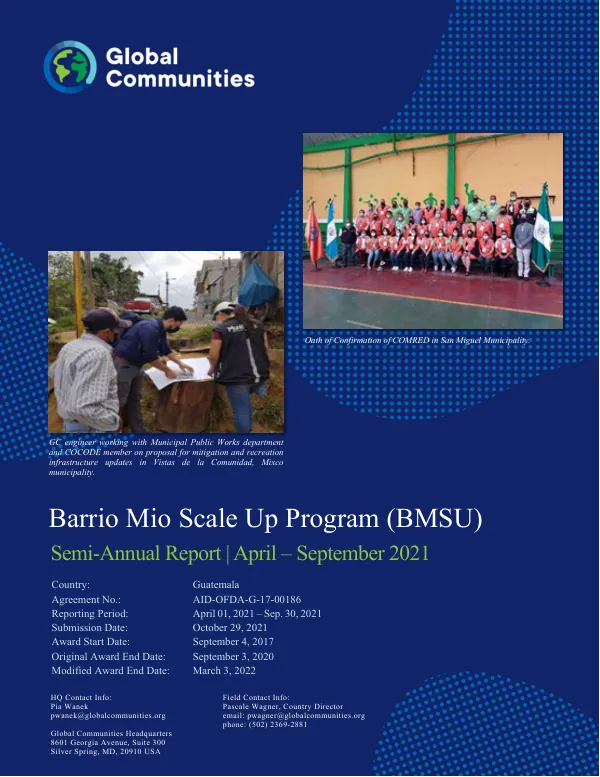
The Barrio Mio Scale Up Program (BMSU) is a 42-month initiative implemented by Global Communities (GC) in Guatemala, with funding from the United States Agency for International Development (USAID).
2021 · 15 pages
Sign in to readA free account is required to download.
Abstract
The program aims to support Barrio Mio partners in making Guatemala a global model in urban disaster response and upgrading of disaster-prone urban informal settlements into safer, healthier, and more prosperous neighborhoods. The BMSU program targets 2,178 direct beneficiaries and indirectly benefits 296,439 individuals. Despite ongoing challenges related to the COVID-19 pandemic, the program made progress towards achieving key milestones and targets across all three sectors: Risk Management Policy and Practice, Shelter and Settlements, and Economic Recovery and Market Systems. In the Risk Management Policy and Practice sector, the program launched a diploma course in "Public investment in development projects with a focus on sustainability and risk management," which included 1,388 participants nationwide. The program also continued progress in training and transferring the MIB Kit to INFOM staff responsible for scaling up and replicating the system to municipalities across the country. Additionally, nine out of ten tools of the MIB Kit were validated and adopted in the municipality of Mixco, and four out of nine tools were validated and adopted in the municipality of Santa Catarina Pinula. In the Shelter and Settlements sector, the program strengthened three Municipal Housing Entities (EMUVIS) formed in Villa Canales, Santa Catarina Pinula, and Mixco, where the seven tools of the EMUVI Kit have been reviewed and are in use. The municipality of Guatemala approved the EMUVI tools and processes, as well as the Participatory Planning and PLOT-MIB tools. In Santa Catarina Pinula, an action plan for collaborative learning between Santa Catarina Pinula and Guatemala municipalities was created. In the Economic Recovery and Market Systems (ERMS) sector, the program certified the Women Empowerment (WE) Methodology with 100% of the staff (26 people) of the municipalities of Guatemala City and Amatitlán, as well as the certification of 100% of MAGA staff (40 people), who work in the department of Guatemala that will also be implementing the methodology, and 14 people from the municipal level. During this reporting period, GC worked with municipalities to refine and validate the BMSU's MIB kit; four of the ten tools have been validated in Santa Catarina Pinula and nine in Mixco. GC also started the knowledge transfer for the replication and scaling of the MIB methodologies and tools through INFOM. Finally, GC finalized the training on community mapping and enumeration; COLREDs were created in three target communities through joint work with the municipal technical teams and SECONRED. The BMSU program has made significant progress in developing INFOM's capacity to provide training and disseminate BMSU methodologies and tools to municipalities. Through a consultant hired by BMSU, GC trained a multidisciplinary technical team of six staff (four men and two women) from INFOM on the MIB methodologies and tools. This training aimed to equip INFOM staff with the necessary skills to replicate and scale the BMSU methodologies and tools to municipalities across the country. The program has also made progress in strengthening the capacity of municipal technical teams to implement the BMSU methodologies and tools. GC worked with municipal technical teams to refine and validate the BMSU's MIB kit, and to create COLREDs in three target communities. This has enabled the municipalities to better understand and address the disaster risk reduction needs of their communities. Overall, the BMSU program has made significant progress in achieving its objectives and targets, despite the ongoing challenges related to the COVID-19 pandemic. The program continues to work with municipalities to refine and validate the BMSU's MIB kit, to develop INFOM's capacity to provide training and disseminate BMSU methodologies and tools, and to strengthen the capacity of municipal technical teams to implement the BMSU methodologies and tools.