GLOBAL COMMUNITIES
SECONRED Capacity Strengthening Program Annual Results Report FY21
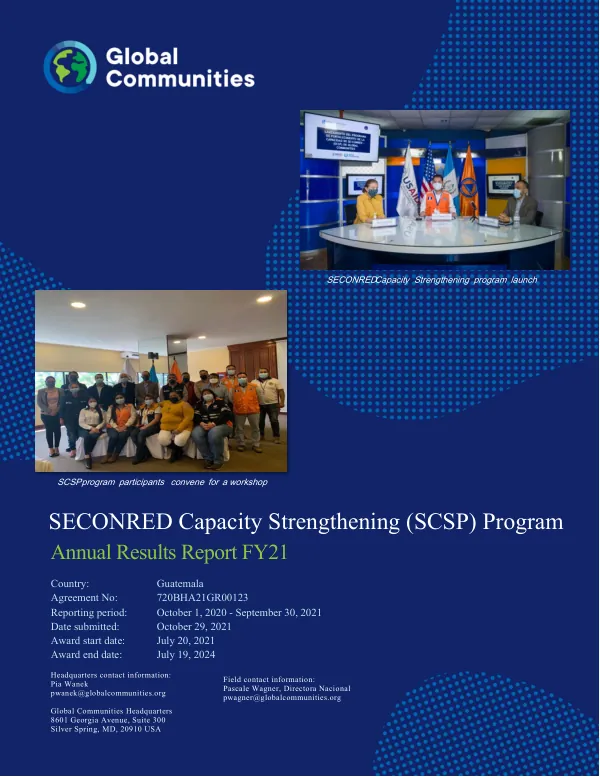
The SECONRED Capacity Strengthening (SCSP) Program is a 36-month initiative launched on July 20, 2021, with a budget of $1.14 million.
2021 · 6 pages
Sign in to readA free account is required to download.
Abstract
The program aims to enhance the capacity of the Executive Secretariat of the National Coordinator for Disaster Reduction (SECONRED) to reduce disaster risk and improve emergency preparedness. The target areas of the program include Region 1, which comprises Guatemala, Santa Rosa, Jalapa, Jutiapa, and Region 3, which includes Quetzaltenango, Sololá, Quiché, Huehuetenango, Totonicapán, and San Marcos. These regions cover a total of 1,743,449 individuals, or 337,175 families, who will benefit indirectly from the capacity strengthening of SECONRED. The program's beneficiary breakdown is as follows: Quetzaltenango (200,140 individuals), Sololá (55,019 individuals), Quiché (114,141 individuals), Huehuetenango (29,925 individuals), Totonicapán (132,601 individuals), San Marcos (126,221 individuals), Guatemala (589,156 individuals), Santa Rosa (99,635 individuals), Jalapa (221,748 individuals), and Jutiapa (174,863 individuals). During the reporting period, Global Communities (GC) focused on program start-up activities, including hiring personnel and finalizing an implementation plan with a timeline and details of the baseline activities. GC held 7 meetings and 5 workshops with SECONRED and its 6 directorates, resulting in full buy-in from the institution. The program team identified 36 primary topics to cover during the first two years of the project and presented the SCSP project activities to institutions such as INSIVUMEH, INE, MICIVI, the Municipality of Guatemala City, and MGCS to inform them about the scope of the proposal and to build partnerships with potential program participants and stakeholders. GC's program staff received training from the USAID office in Guatemala to adapt the USAID CLA Maturity Tool, which will be used for the baseline study. The tool has been adapted with six identified priority areas: the program cycle component, internal collaboration and technical evidence base, learning and M&E, enabling conditions, networks and relationships, knowledge management, and decision making. The program team created the first training session materials in preparation for the baseline study, which is scheduled to start in the next reporting period. The program's goals for the initial phase included preparing and presenting Memorandums of Understanding (MoUs) to SECONRED's director and finalizing an implementation plan for project start-up. These goals were achieved successfully in various meetings and workshops. The program team also started designing and adapting the CLA tools and methodology for the baseline study, which will be conducted in the next reporting period. The SCSP program is expected to strengthen the capacity of SECONRED to reduce disaster risk and improve emergency preparedness, ultimately benefiting the target population of 1,743,449 individuals. The program's implementation plan includes training topics and activities that will be adjusted based on baseline results and diagnostics. The program team will continue to work with SECONRED and its national and municipal partners to systematize, adapt, and scale up the tools and strategies designed by the project.