FLORIDA INTERNATIONAL UNIVERSITY
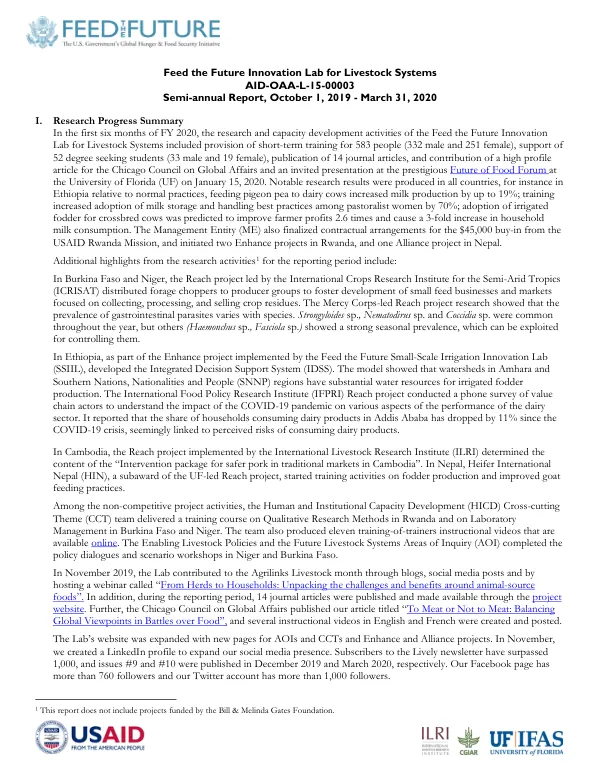
Semi-Annual Report Format for Feed the Future Innovation Labs
The Chickpea Innovation Lab for Climate Resilient Chickpea is a research initiative focused on improving the resilience of chickpea crops to climate change.
2015 · 7 pages
Sign in to readA free account is required to download.
Abstract
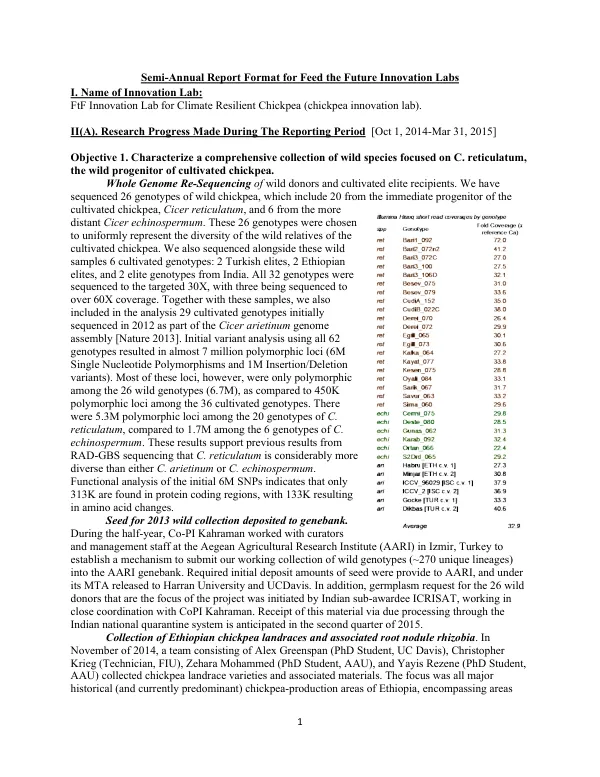
The lab's research progress during the reporting period from October 1, 2014, to March 31, 2015, is centered around several key objectives. Objective 1 aims to characterize a comprehensive collection of wild species focused on C. reticulatum, the wild progenitor of cultivated chickpea. Whole Genome Re-Sequencing of wild donors and cultivated elite recipients has been completed, resulting in the sequencing of 26 genotypes of wild chickpea and 6 cultivated genotypes. The analysis of these sequences has identified almost 7 million polymorphic loci, with most of these loci being polymorphic among the 26 wild genotypes. Functional analysis of the initial 6 million SNPs indicates that only 313,000 are found in protein-coding regions, with 133,000 resulting in amino acid changes. Seed for the 2013 wild collection has been deposited to the genebank at the Aegean Agricultural Research Institute in Turkey. A mechanism has been established to submit the working collection of wild genotypes to the genebank, and germplasm requests for the 26 wild donors have been initiated by the Indian sub-awardee ICRISAT. Objective 2 focuses on creating reverse-introgression and advanced backcross introgression. Introgression crosses have been conducted in Turkey, Ethiopia, and the United States. In Turkey, crossing blocks were planted in November 2014, and crosses to the Turkish elite cultivar Gokce are scheduled for spring and summer quarters 2015. In Ethiopia, seed was sent from UCDavis, and DZARC trialed growing wild donor panels in screenhouse conditions. However, the wild donor plants fared poorly due to exposure to ambient climate and/or use of unamended native soil. UCDavis served as the primary site for crossing in this growing cycle. In the United States, staggered planting of wild donor panels and recipient elites was done in greenhouses beginning in October 2014. As plants flowered, crosses of wild donors into cultivated lines were done, and crossing activities were completed in late January 2015. F1 plants from introgression crosses made in summer 2014 were also harvested and threshed at the University of Saskatchewan. Objective 5 focuses on resource and data management and public-facing bioinformatics. High-quality draft genomes for chickpea are being developed, and detailed knowledge of the genome structures of wild donors and cultivated recipients is critical to the accuracy and precision of association mapping activities. In concert with the concurrently running NSF-PGRP project, representative single genotypes of C. reticulatum and C. echinospermum have been selected to serve as focal genotypes to describe their genome organization. Genotypes from the Besevler (C. reticulatum) and S2Drd (C. echinospermum) sites have been selected to anchor the two wild species. Work has been initiated on GenomeBrowser, which will provide project data in an online format and provide visualization tools for genotyping to guide association mapping activities. The Chickpea Innovation Lab for Climate Resilient Chickpea has made significant progress in its research objectives, with a focus on improving the resilience of chickpea crops to climate change. The lab's research has the potential to contribute to the development of climate-resilient chickpea varieties that can improve food security and livelihoods of smallholder farmers in developing countries.