USAID DEC
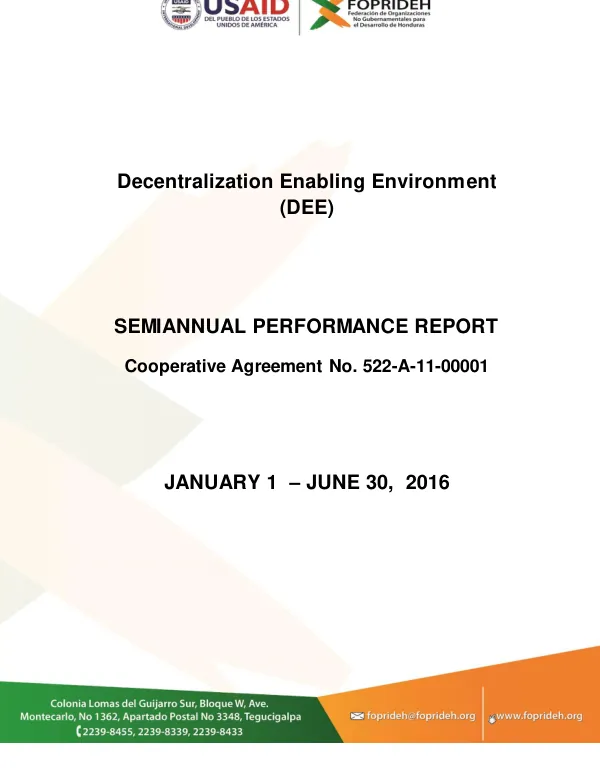
Semi-Annual Report January 1 – June 30 2016: Decentralization Enabling Environment Program
Sign inUSAID
Semi-Annual Report January 1 – June 30 2016: Decentralization Enabling Environment Program
The Decentralization Enabling Environment (DEE) program in Honduras aims to strengthen national institutions, local governments, and civil society's capacities to promote, ratify, and apply legislative reforms that support decentralization.
2016 · 13 pages
Sign in to readA free account is required to download.
Abstract
The program is implemented by the Federation of Non-Governmental Organizations for Honduran Development (FOPRIDEH) under a Cooperative Agreement with the United States Agency for International Development (USAID). The general objective of the DEE project is to achieve a legal framework for decentralization through the approval of new and/or reformed public policies and laws. The specific objectives include making complementary activities to reach the target of Result 1 of the Regulatory Framework for decentralization and performing sub-grants to Municipal Associations in the projects' intervention and the USAID/NEXOS program. The Performance Monitoring Plan (PMP) results indicate that the program has made progress in achieving its objectives. In terms of Result 1, the National Congress approved the transfer of L 4,200,006,000.00 million lempiras to municipalities, representing 3.14% of the total public resources. However, over 60 municipalities have not received authorization for fourth-quarter payments due to lack of accountability reports. Regarding Indicator 1.2, the First Draft of the Municipal Law has been completed by consensus of the Interinstitutional Commission for Honduran Decentralization State (CIDEH), but it has not been socialized among local authorities and civil society due to priority being given to the Decentralization Law, its regulations, and Local Finance Law. The National Congress has approved 22 articles of 32 representing 68% of the Decentralization Law, and the Commission (CIDEH) has completed the Draft of the Regulations under the Decentralization Law. In terms of Result 4, the Municipal Grant Challenge, the program has exceeded its target of providing grants to Municipal Associations. Nine out of 10 grants have been provided, and youth participation in the process for project prioritization aimed at violence prevention has reached 80%, exceeding the target of 20%. The program has also made progress in implementing the Municipal Administrative Career Law (LCAM). Advocacy actions with the SDHJGD have contributed to the approval of the CAM Law Regulation, and the position of the SCGG has not significantly impacted the implementation of the Law. The program has faced some challenges, including the lack of accountability reports from municipalities, which has resulted in delayed payments. However, the program has made significant progress in achieving its objectives, and the results indicate that the program is on track to meet its targets. The DEE program has also made progress in promoting the Municipal Administrative Career Law (LCAM). The program has contributed to the approval of the CAM Law Regulation, and the implementation of the Law is underway. The program has also promoted the use of sub-grant funds for the implementation of projects with a cross-cutting focus in citizen security, improving the livelihood of the inhabitants of the benefited municipalities. The program has also made progress in promoting the participation of youth in the process for project prioritization aimed at violence prevention. The program has exceeded its target of 20% youth participation, and the participation of women has reached 60%. The program has also made progress in promoting the use of sub-grant funds for the implementation of projects with a cross-cutting focus in citizen security, improving the livelihood of the inhabitants of the benefited municipalities. Overall, the DEE program has made significant progress in achieving its objectives, and the results indicate that the program is on track to meet its targets. The program has faced some challenges, but the progress made so far is a positive indication of the program's effectiveness in promoting decentralization in Honduras.