USAID DEC
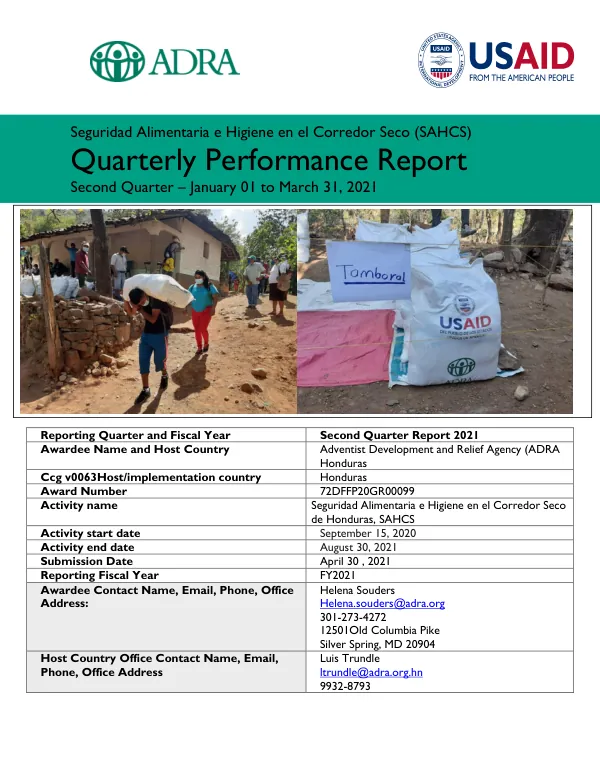
Seguridad Alimentaria e Higiene en el Corredor Seco (SAHCS) Quarterly Performance Report Second Quarter – January 01 to March 31, 2021
Sign inADVENTIST DEVELOPMENT AND RELIEF AGENCY INTERNATIONAL
Seguridad Alimentaria e Higiene en el Corredor Seco (SAHCS) Quarterly Performance Report Second Quarter – January 01 to March 31, 2021
The Seguridad Alimentaria e Higiene en el Corredor Seco (SAHCS) project in Honduras aimed to improve food security and hygiene in the dry corridor region.
2021 · 11 pages
Sign in to readA free account is required to download.
Abstract
The project, implemented by the Adventist Development and Relief Agency (ADRA) Honduras, received funding from the United States Agency for International Development (USAID) under the award number 72DFFP20GR00099. The project's main objective was to provide food assistance and hygiene promotion to vulnerable households in the six intervention municipalities. The project's key indicators included food security, unconditional food assistance, and hygiene promotion. The project's targets were based on a baseline study conducted in 2020, which identified 22% of households with inadequate Food Consumption Score (FCS) conditions. During the second quarter of 2021, the project achieved significant results. The project delivered food sacks to 4,774 beneficiary households, with each household receiving a total of 4,774 rations. The distributions were carried out at strategic points in the communities, such as schools, soccer fields, and community centers. The project also trained 220 WASH volunteers in February, who began their hygiene promotion awareness visits in the same month. The volunteers reached 4,474 vulnerable families and helped to disseminate key messages on WASH topics through radio spots. The project's programming performance was evaluated based on the results of the baseline study and the third Post Distribution Monitoring (PDM) study. The results showed that 22% of households had inadequate FCS conditions before the project began, but after receiving food assistance, all beneficiary families were in the adequate FCS condition. The project also reported significant improvements in food security, with 100% of households achieving adequate FCS conditions. The project's hygiene promotion activities included the establishment of handwashing stations and the dissemination of key messages on COVID-19 and access to safe water. The project also installed 12 complaint/recommendation boxes at strategic points in the communities, which were checked once a month by the monitoring team. The project's food assistance sector achieved significant results, with 100% of households receiving food assistance. The project also reported significant improvements in food security, with 100% of households achieving adequate FCS conditions. The project's hygiene promotion activities also reported significant improvements, with 100% of households adopting good hygiene habits. The project's overall performance was evaluated based on the results of the baseline study and the third PDM study. The results showed that the project achieved significant improvements in food security and hygiene, with 100% of households achieving adequate FCS conditions and adopting good hygiene habits. The project's programming performance was also evaluated based on the results of the third PDM study, which showed that the project achieved significant improvements in food security and hygiene. The project's implementation was carried out in partnership with local communities, with the empowerment of local selection committees and their participation in the distribution process. The project's distribution plan was constantly updated together with the local selection committees, and improvements were made to the distribution routes and processes during deliveries. The project's health volunteers also made themselves known in their communities, disseminating key messages on COVID-19, hygiene promotion, and breastfeeding. The project's overall impact was significant, with 100% of households achieving adequate FCS conditions and adopting good hygiene habits. The project's food assistance sector achieved significant results, with 100% of households receiving food assistance. The project's hygiene promotion activities also reported significant improvements, with 100% of households adopting good hygiene habits. The project's overall performance was evaluated based on the results of the baseline study and the third PDM study, which showed that the project achieved significant improvements in food security and hygiene.