USAID DEC
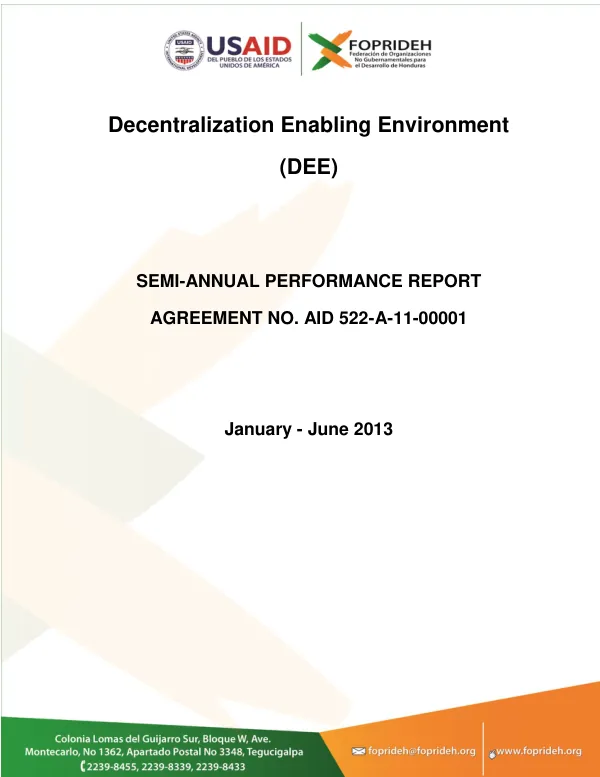
Semi-Annual Performance Report January-June 2013: Decentralization Enabling Environment (DEE) Project
Sign inUSAID
Semi-Annual Performance Report January-June 2013: Decentralization Enabling Environment (DEE) Project
The Decentralization Enabling Environment (DEE) project in Honduras aims to promote an enabling environment for government services decentralization, encouraging local development, municipal autonomy, and consensus building.
2013 · 40 pages
Sign in to readA free account is required to download.
Abstract
The project is implemented by the Honduran Federation of Non-Governmental Organizations for Development (FOPRIDEH) in partnership with the United States Agency for International Development (USAID). The project's general objective is to strengthen national institutions, local governments, and civil society organizations' abilities to advocate, enact, and implement legal decentralization framework and its implementation, including fiscal, legal, and administrative reforms. The project's goal is to achieve more responsive governance, with improved local-provided services in response to citizen needs. During the January-June 2013 reporting period, the project implemented several activities to achieve its objectives. These included the National Forums for Decentralization, where discussions were held with project partners to collect feedback and incorporate observations on drafted laws into the Commitment Act. Members of the National Forum agreed to proceed in drafting two laws and presenting them to the National Congress. The Municipal Law and the Decentralization Law were passed to the National Congress in May 2013, and the project advocated for the decree 135-2012, the Municipal Service Law, which was entered again in a state of vacatio legis for political reasons in August 2012. The project also provided advocacy to reform the Environmental Law for environmental licensing decentralization. The DEE project reviewed and updated the Transition and Handover of Municipal Government Handbook for local government, which was approved by the Association of Municipalities (AMHON) Board of Directors and conveyed to the Secretary of the Interior and Population (SEIP). The Social Observatory for Decentralization (OSD) platform was launched, containing visual plug-ins, a video database, updated documents, and news. In terms of fiscal autonomy, the project provided technical assistance to municipalities in setting and implementing the Tributary and Financial Administration System (SAFT). The average Financial Autonomy (FAI) is 29.50%, surpassing the 14.63% target. However, only the Mancomunidad of Municipalities Martyrs from the Sierra of Agalta (MAMSA), MANVASEN, and AMVAS surpassed the indicator in relation to the first semester of 2012. The project also discussed the draft Municipal Financial Administration Law and oriented the implementation of laws that favor fiscal autonomy. The technical assistance provided by the project employees and Financial Unit Mancomunadas (UFIM) staff resulted in the successful implementation of SAFT by Inter-municipal Technical Units (UTI) and the water committee from San Nicolás, Santa Bárbara. The project's progress in implementing project results is evident in the increased cross-cutting actions of civil society participation in the decentralization processes. The project has reviewed and updated the Transition and Handover of Municipal Government Handbook for local government, launched the Social Observatory for Decentralization (OSD) platform, and provided technical assistance to municipalities in setting and implementing the Tributary and Financial Administration System (SAFT). The project's impact is also evident in the increased municipal autonomy, with the Municipal Law and the Decentralization Law being passed to the National Congress. The project's advocacy for the decree 135-2012, the Municipal Service Law, and the reform of the Environmental Law for environmental licensing decentralization also demonstrate the project's commitment to promoting an enabling environment for government services decentralization. The project's gender focus is evident in the increased participation of women in the decentralization processes. The project's training activities also demonstrate its commitment to building the capacity of local governments and civil society organizations to implement decentralization reforms. The project's constraints include the political reasons that led to the entry of the Municipal Service Law in a state of vacatio legis in August 2012. However, the project's recommendations for improvement during the next period include continuing to provide technical assistance to municipalities in setting and implementing the Tributary and Financial Administration System (SAFT) and orienting the implementation of laws that favor fiscal autonomy. The project's projections for the next period include continuing to promote an enabling environment for government services decentralization, encouraging local development, municipal autonomy, and consensus building. The project will also continue to provide technical assistance to municipalities in setting and implementing the Tributary and Financial Administration System (SAFT) and orienting the implementation of laws that favor fiscal autonomy.