USAID DEC
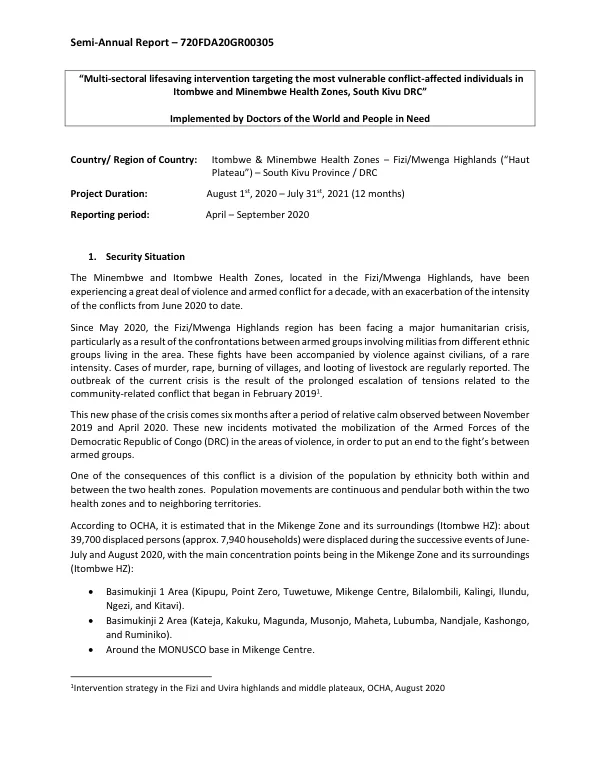
Semi-Annual Report – Multi-sectoral lifesaving intervention targeting the most vulnerable conflict-affected individuals in Itombwe and Minembwe Health Zones, South Kivu DRC
Sign inUSAID DEC
Semi-Annual Report – Multi-sectoral lifesaving intervention targeting the most vulnerable conflict-affected individuals in Itombwe and Minembwe Health Zones, South Kivu DRC
The multi-sectoral lifesaving intervention targeting the most vulnerable conflict-affected individuals in Itombwe and Minembwe Health Zones, South Kivu DRC, was implemented by Doctors of the World and People in Need.
2020 · 5 pages
Sign in to readA free account is required to download.
Abstract
The project duration was from August 1st, 2020, to July 31st, 2021, with a reporting period of April to September 2020. The project aimed to provide assistance in health, water, sanitation, hygiene, protection, and nutrition to the affected populations. The Minembwe and Itombwe Health Zones have been experiencing a decade of violence and armed conflict, with an exacerbation of the intensity of the conflicts from June 2020 to date. The region has been facing a major humanitarian crisis, particularly due to confrontations between armed groups involving militias from different ethnic groups. The violence has resulted in cases of murder, rape, burning of villages, and looting of livestock. The population has been divided by ethnicity, and population movements are continuous and pendular within and between the two health zones. According to OCHA, approximately 39,700 displaced persons were displaced in the Mikenge Zone and its surroundings in Itombwe Health Zone, with the main concentration points being in Basimukinji 1 and 2 Areas, around the MONUSCO base in Mikenge Centre, and around the locality of Kalingi in Minembwe Health Zone. In Minembwe Zone and surroundings, approximately 29,500 displaced persons were displaced, with the main areas of concentration being South Basimunyaka Area and South Basimukuma Area. The project launch was delayed due to physical and security access restrictions to the two intervention zones. The project activities will start on November 1, 2020, with the first patients being received on that date. The project staff are being gradually deployed to the two bases, and medications are on their way to Itombwe. The project will try to make up for the time lost due to the delay in the coming months, and a no-cost extension could be envisaged two months before the end of the project if necessary. Despite the delay in launching the project, several activities were carried out during the reporting period. These include the recruitment of staff, including a project manager, logisticians, health manager, pharmacist, medical supervisors, nurses, midwives, and administrative assistants. Two missions to reassess needs, particularly logistical and security needs, were carried out in the two health zones. A proposal to readjust the intervention strategy to adapt it to the reality on the ground was also carried out, with a new targeting of the intervention zones. The health areas initially planned were revised based on the evaluation carried out in the two health zones, with the newly targeted health areas being Kipupu, Mikenge, Malanda, Mikalati, and Aleba in Itombwe Health Zone, and Minembwe, Kalingi, Kihunga, Ibumba, and Kahwela in Minembwe Health Zone.