INTERNATIONAL ALERT
Programming Effectively Against Conflict and Extremism (PEACE) IQC
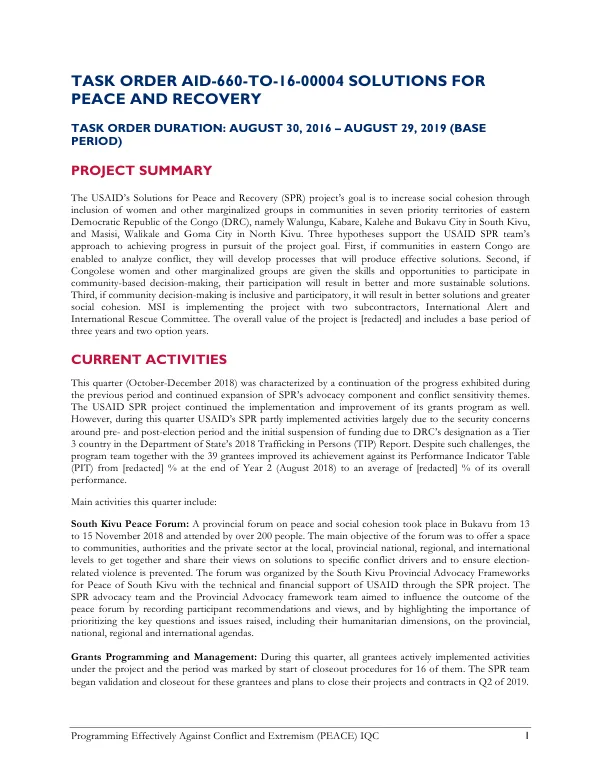
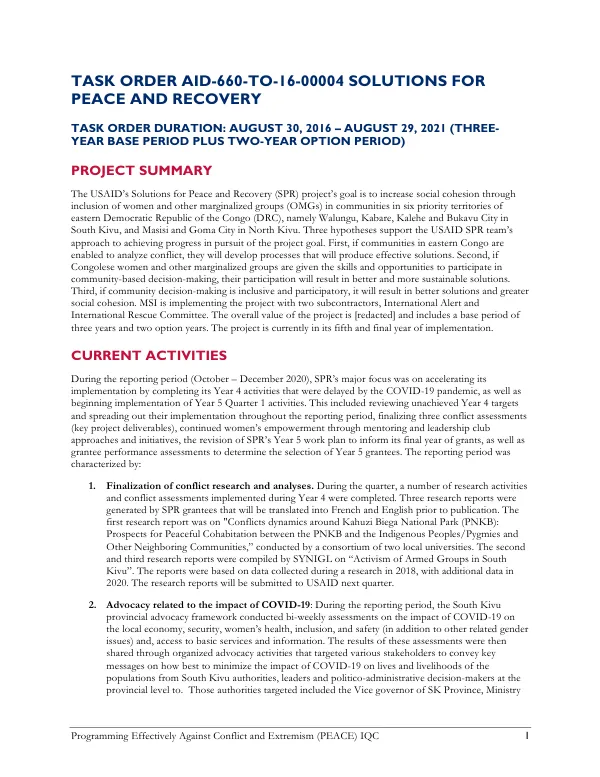
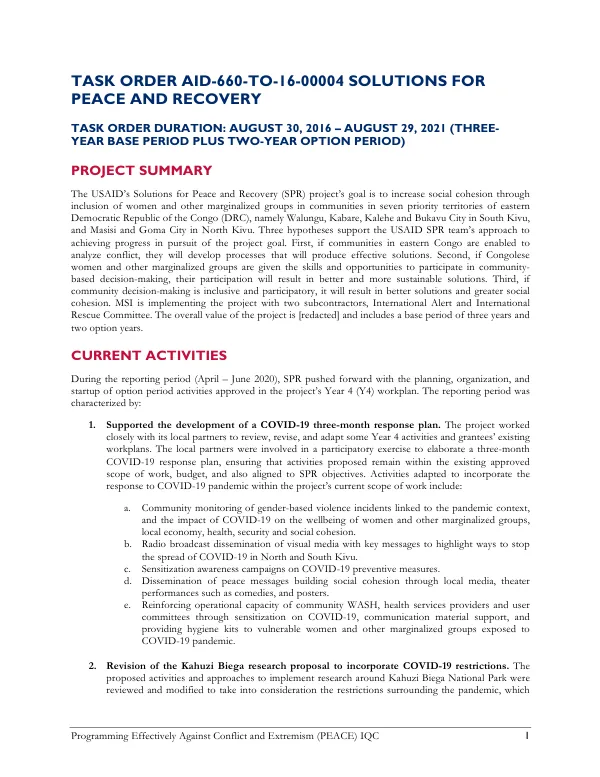
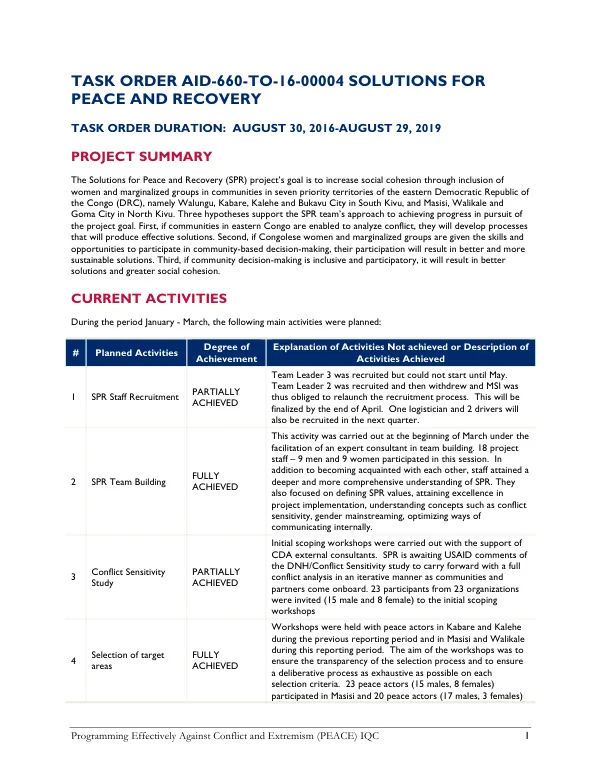
The Solutions for Peace and Recovery (SPR) project in the Democratic Republic of the Congo (DRC) aims to increase social cohesion through the inclusion of women and other marginalized groups in communities in seven priority territories of eastern DRC.
2020 · 3 pages
Sign in to readA free account is required to download.
Abstract
The project is implemented by Management Systems International (MSI) with two subcontractors, International Alert and International Rescue Committee, and has a total value of [redacted] over a three-year base period and two-year option period. The project's goal is supported by three hypotheses: communities in eastern Congo can develop effective solutions to conflict through analysis and process development; Congolese women and other marginalized groups can contribute to better and more sustainable solutions through participation in community-based decision-making; and inclusive and participatory community decision-making can lead to better solutions and greater social cohesion. The project's overall objective is to increase social cohesion through the inclusion of women and other marginalized groups in communities in seven priority territories of eastern DRC. During the reporting period (January – March 2020), the SPR project pushed forward with the planning, organization, and startup of option period activities approved in the project's workplan. Key activities included the finalization and submission to USAID for approval of the Year 4 (Y4) Workplan and option period Monitoring, Evaluation, and Learning (MEL) plans and targets; the finalization and submission to USAID for approval of application packages for nine local grantees selected to support option period implementation; and the onboarding of local grantees, including orientation and refresher trainings on gender & inclusion, conflict sensitivity, indicators, targets, planning and reporting tools, grants processes and financial management, budget monitoring, compliance, ethics, and protection against sexual harassment and abuse. The project achieved 89% of its overall project achievement against its revised life-of-project (LOP) performance indicator table (PIT) at the end of the reporting period. Progress towards achieving targets was at 96% for Objective 1, 102% for Objective 2, and 69% for Objective 3. The project also faced various challenges, including a delay in implementation of project activities and onboarding of new staff due to uncertainty with the option period's funding, and a difficult relationship with the North Kivu Provincial Advocacy Framework (CPP-NK). However, the project team worked on solutions to address these challenges and developed strategic approaches to maximize opportunities in favor of SPR's objectives. The project took several actions to address these challenges, including organizing an all-staff detailed planning workshop for the remainder of Y4 to ensure the acceleration of activities and achievement of Y4 targets; continuing a recruitment process to fill vacancies for key positions; and accelerating the finalization and submission for approval of local grantees' application packages. The project also worked with USAID to manage a difficult relationship with the CPP-NK, including traveling to the Kivus to discuss directly with project leadership, staff, and CPP-NK members, and agreeing to continue to support capacity building of the CPP-NK through non-direct financial means. The project also faced the emerging threat of COVID-19, which required the project to temporarily change its strategy for the implementation of direct and partner activities in the final weeks of the period. The project took several actions to address this challenge, including beginning preparation of the SPR COVID-19 Continuity of Operations Plan (COOP); working with SPR Consortium Members to take immediate precautionary actions and authorized all-staff remote working to ensure their health and safety; and maintaining regular communications with local partners to ensure they were following COVID-19 preventative measures and did not conduct activities or disburse funds outside of essential operations. The project achieved several key quarterly results, including the approval of the Y4 Workplan and option period; the approval and full execution of 9 local grant awards; the onboarding of 9 local grant partners; and the provision of Protect and Respect training for all staff. The project also assisted consensus-building peace and social cohesion processes, resulting in an agreement in seven conflicts supported by the project's Local Peace and Development Committees (LPDCs) in South Kivu.