INTERNATIONAL COMMITTEE FOR THE RED CROSS
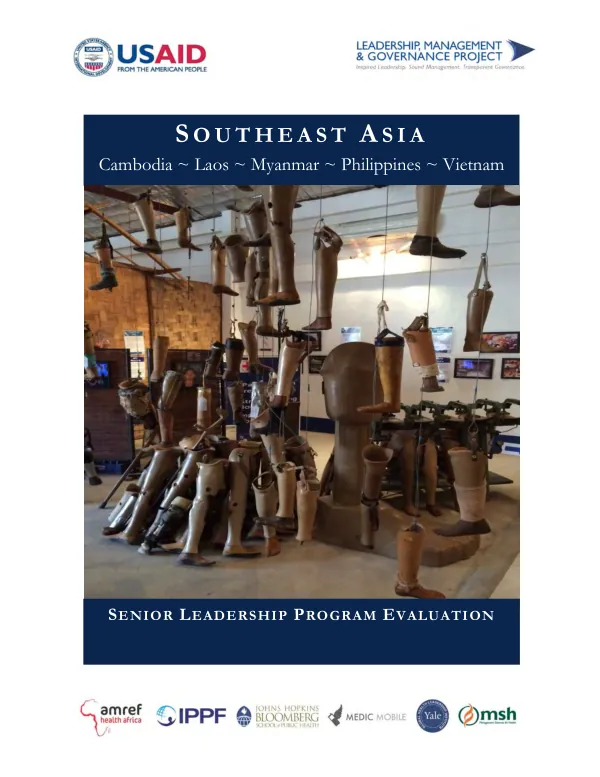
Senior Leadership Program Evaluation: Southeast Asia
The Southeast Asia Senior Leadership Program (SLP) was a leadership development initiative implemented in Cambodia, Laos, Myanmar, the Philippines, and Vietnam from March to November 2015.
2017 · 45 pages
Sign in to readA free account is required to download.
Abstract
The program was designed to equip senior decision makers with the skills to address key challenges in their fields, with a focus on physical rehabilitation and disability rights. The program was supported by the Leadership, Management, and Governance (LMG) Project, which aimed to improve service delivery and strengthen health systems. The SLP was a collaborative effort between the International Committee of the Red Cross (ICRC) Physical Rehabilitation Programme (PRP) and the Special Fund for the Disabled (SFD), with funding from the United States Agency for International Development (USAID) and the Leahy War Victims Fund. The program included three workshops in Phnom Penh, Cambodia, and involved senior leaders from the public sector and civil society organizations. A total of 38 participants completed the program, which consisted of a mixed-methods approach that included a survey, participant interviews, field project assessments, and team focus groups. The evaluation aimed to assess the progress and outcomes of country team field projects and participant capacity and professional performance in leadership, management, and governance. The evaluation found that participants incorporated strategic problem-solving methodology into their daily work and employed new governance skills and practices in their workplace. Participants also internalized a new understanding of disability rights and integrated aspects of the United Nations Convention on the Rights of People with Disabilities (UNCRPD) into their work. The evaluation highlighted the importance of teamwork and the exchange of ideas and experiences among participants from different countries. The evaluation found a significant change in self-reported confidence levels from pre-evaluation to follow-up regarding leadership, management, and governance practices and strategic problem-solving content. Participants reported a marked increase in confidence in identifying and engaging stakeholders, conducting root-cause analyses, and implementing strategic work plans. The program's success was attributed to the collaborative effort between the ICRC, SFD, and other stakeholders, as well as the commitment of the participants to apply the skills and knowledge gained during the program. The evaluation recommended that future trainings should build on the successes of the SLP and continue to focus on leadership, management, and governance practices, as well as strategic problem-solving and teamwork. The Southeast Asia SLP demonstrated the importance of investing in leadership development and capacity building in the field of physical rehabilitation and disability rights. The program's impact was evident in the increased confidence and skills of the participants, as well as the improved outcomes of their field projects. The evaluation provided valuable insights into the effectiveness of the program and highlighted the need for continued support and investment in leadership development initiatives in the region. The program's geographic focus was on Southeast Asia, with a specific emphasis on Cambodia, Laos, Myanmar, the Philippines, and Vietnam. The program's context was shaped by the region's unique cultural, social, and economic characteristics, as well as the challenges and opportunities related to physical rehabilitation and disability rights. The program's timeframes were from March to November 2015, with three workshops held in Phnom Penh, Cambodia. The program's implementation details were managed by the ICRC, SFD, and other stakeholders, with the support of USAID and the Leahy War Victims Fund. The program's recommendations for future trainings emphasized the importance of building on the successes of the SLP and continuing to focus on leadership, management, and governance practices, as well as strategic problem-solving and teamwork. The evaluation highlighted the need for continued support and investment in leadership development initiatives in the region, with a focus on improving service delivery and strengthening health systems.
Related documents