OFDA
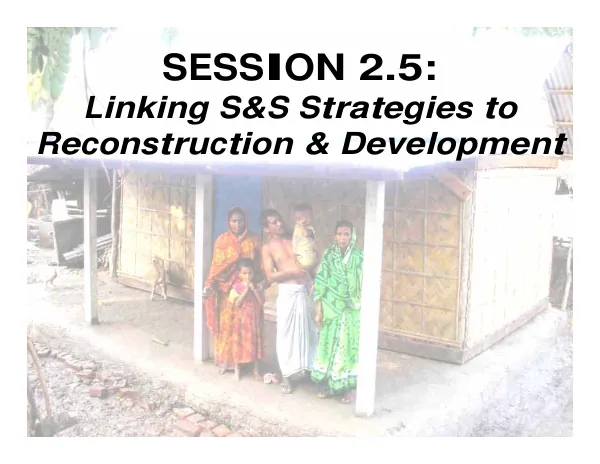
Session 2.5 - Linking S&S Strategies to Reconstruction and Development
The humanitarian and development sectors have traditionally operated in distinct arenas, with the former focused on emergency response and the latter on long-term development.
2009 · 11 pages
Sign in to readA free account is required to download.
Abstract
However, conditions in settlements are increasingly complex, and vulnerabilities are rising. This shift in context necessitates a reevaluation of the sectors' approaches and interactions. Development policy itself has become a significant hazard that requires risk reduction. Mainstreaming disaster risk reduction (DRR) into development policy may be necessary but is insufficient. The sectors must transition from a relief phase and reconstruction phase to a process of transition from relief to reconstruction, with donor and institutional support shifting accordingly. To facilitate this shift, new alliances must be formed within the humanitarian community and between the humanitarian and development communities. Sectors actors must interact with reconstruction and development officials, specifically those in planning, housing, services, and social agencies, to promote humanitarian objectives. This interaction is best done prior to the onset of disasters and crises, allowing all actors to identify and understand issues and make needed changes in existing protocols. Rapid changes in the reconstruction and development sector are causing planning time frames to shorten, requiring policies to be responsive and relevant. Conversely, the longer-term view of humanitarian actors may result in greater overlaps of time frames and perspectives, enhancing both communities. Key objectives for both humanitarian and development actors will likely include jointly identifying areas of high risk, creating mechanisms to reduce or prevent occupancy of these areas, reducing risk for those unable to move out, and responding to disasters and crises in a creative and cost-effective manner that reduces risk over time. The sectors must adapt to these changing conditions and work together to address the complex challenges facing settlements. By forming new alliances and interacting with reconstruction and development officials, humanitarian and development actors can promote humanitarian objectives and reduce risk for vulnerable populations. This collaborative approach will be essential in addressing the increasingly complex needs of settlements and promoting sustainable development.