USAID
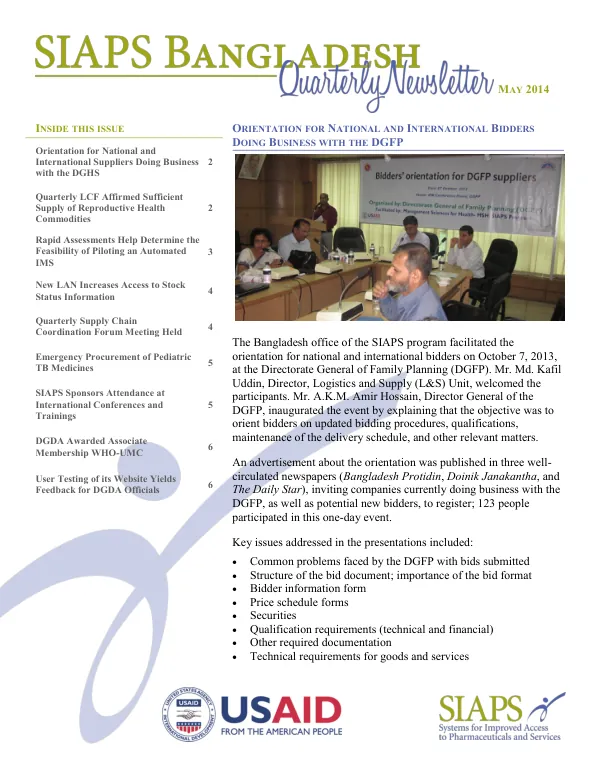
SIAPS Bangladesh Quarterly Newsletter, January 2014
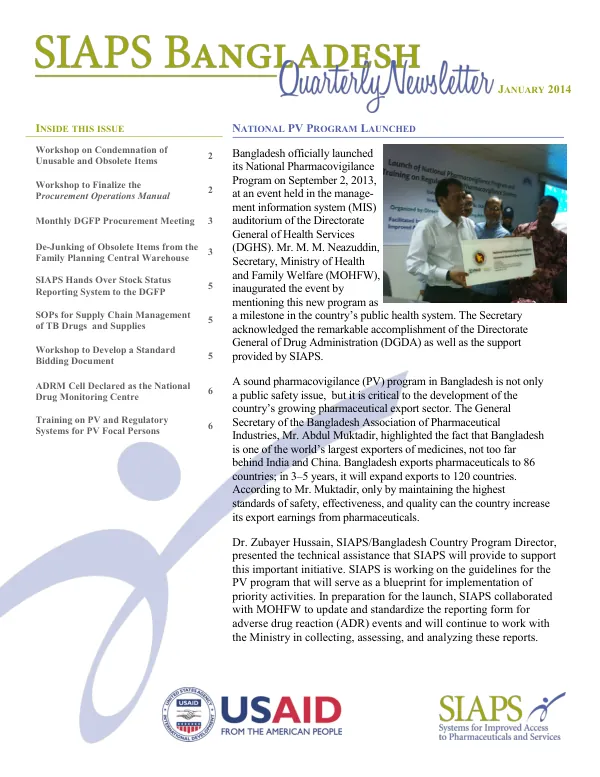
The National Pharmacovigilance Program in Bangladesh was officially launched on September 2, 2013, at an event held in the management information system (MIS) auditorium of the Directorate General of Health Services (DGHS).
2014 · 7 pages
Sign in to readA free account is required to download.
Abstract
The program was inaugurated by Mr. M. M. Neazuddin, Secretary, Ministry of Health and Family Welfare (MOHFW), who mentioned this new program as a milestone in the country's public health system. The Secretary acknowledged the remarkable accomplishment of the Directorate General of Drug Administration (DGDA) as well as the support provided by SIAPS. A sound pharmacovigilance (PV) program in Bangladesh is not only a public safety issue, but it is critical to the development of the country's growing pharmaceutical export sector. Bangladesh is one of the world's largest exporters of medicines, not too far behind India and China. The country exports pharmaceuticals to 86 countries, and in 3-5 years, it will expand exports to 120 countries. According to Mr. Abdul Muktadir, General Secretary of the Bangladesh Association of Pharmaceutical Industries, only by maintaining the highest standards of safety, effectiveness, and quality can the country increase its export earnings from pharmaceuticals. SIAPS is working on the guidelines for the PV program that will serve as a blueprint for implementation of priority activities. In preparation for the launch, SIAPS collaborated with MOHFW to update and standardize the reporting form for adverse drug reaction (ADR) events and will continue to work with the Ministry in collecting, assessing, and analyzing these reports. Speaking on behalf of USAID, Mr. Gregory Adams, Director (Acting), Office of the Population, Health, Nutrition and Education, USAID/Bangladesh, pledged continued support of the SIAPS Program in promoting PV. The launching ceremony was also attended by the members of the ADR Advisory Committee (ADRAC), PV focal persons from different government hospitals, officials from the DGDA, and other USAID partners. The National PV Program aims to ensure the safety of medicines in Bangladesh and to promote the country's pharmaceutical export sector. A three-day workshop was held at the Nazimgarh resort in Sylhet, September 12-14, 2013, to finalize the Procurement Operations Manual (POM). The workshop was sponsored by the USAID-funded SIAPS Program. The Additional Secretary, MOHFW, chaired the workshop, which was attended by officials and desk officers from the different procurement entities in MOHFW, including the Central Medical Store Depot, Health Engineering Department, Directorate General of Family Planning (DGFP), and other line directors' offices of the DGHS. The workshop aimed to finalize the POM, which will be used by all offices in MOHFW that undertake procurement. The document is currently being vetted by the World Bank (WB) and the Central Procurement Technical Unit in the Ministry of Planning. Once comments and suggestions from these reviewers are incorporated, the POM will be finalized and used by all offices in MOHFW that undertake procurement. The monthly procurement meeting of the Logistics and Supply (L&S) Unit was held in its conference room at the DGFP on August 26, 2013. The meeting was facilitated by the L&S director and the senior technical advisor-procurement, SIAPS/Bangladesh. The L&S Unit provided a briefing on the DGFP procurement system to orient the new WB delegation. L&S Unit staff stated that the procurement it manages, for itself and for all other units of the DGFP, is working well. The Unit gave an update on the status of fiscal year (FY) 2012-13 procurement. On average, shipments financed by the WB-funded International Development Association, the reimbursable project aid credit, and Government of Bangladesh-funded procurement have been received in 18-34 weeks, much less time than the required 58 weeks stipulated by MOHFW. This significant reduction in total procurement time has helped to assure the availability of stocks of contraceptives and other essential commodities. The Family Planning Central Warehouse (CW) was built in 1979. It has approximately 18,000 square feet of floor space and 4,000 square feet for vehicle parking. A couple of years later, a two-story repacking unit was built. However, the CW has not taken any steps over the last 34 years to condemn and destroy unusable or obsolete items, including old vehicles. Rather, many unlisted obsolete items were stored, thereby reducing the available storage space for usable products. Since 2010, SIAPS/Bangladesh repeatedly raised this issue, stating that the routine condemnation of unusable and obsolete items is one of the key components of the logistics management system. The system has four levels: the Central Warehouse, regional warehouses, upazila FP stores, and stores at service delivery points. All logistics management systems rely on a well-functioning supply chain system to deliver reproductive health (RH) commodities and other essential medicines to the end user. Poor warehousing and distribution results in