CHEMONICS
Formative Assessment Results Report, Sindh Province, Summary
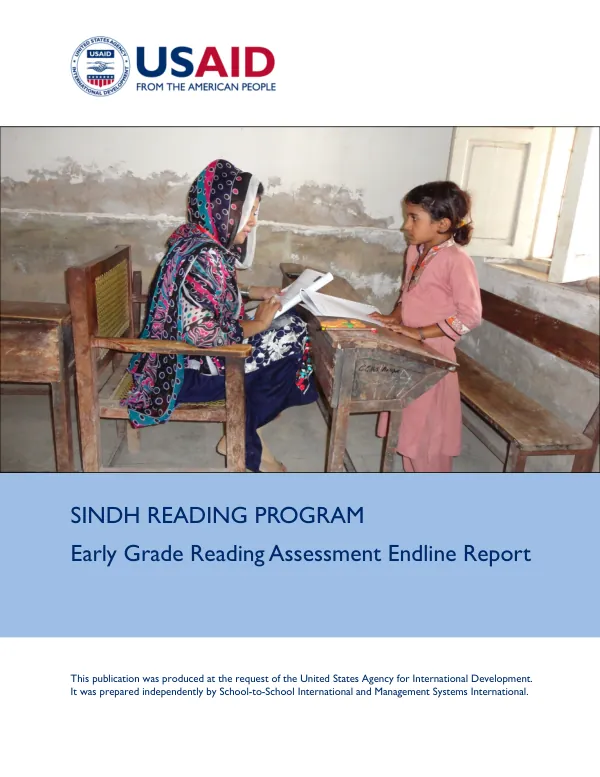
The Sindh Reading Program (SRP) in Pakistan aimed to improve reading skills among Grade 2 students in Sindh Province.
2016 · 31 pages
Sign in to readA free account is required to download.
Abstract
The program's formative assessment results report for February-March 2016 provides insights into the progress of students who were initially assessed in October 2015. A total of 21,203 Grade 2 students were evaluated in October 2015 on three tasks: non-word reading, oral reading fluency, and comprehension. In February-March 2016, a sub-sample of 13,280 students was reassessed using the same tasks. The results indicate that students in Grade 2 appear to be improving in their reading abilities. The average oral reading fluency rates improved for common students, with rates ranging from 23 to 52 Correct Words Per Minute (CWPM) in Sindhi and 48 to 51 CWPM in Urdu. Readers also showed improvements in pre-reading skills, such as decoding, and comprehension of a passage they had read. However, the average number of comprehension questions they were able to answer correctly remained below the 80% threshold. Non-readers in Grade 2 also made improvements in pre-reading skills and in reading. They attempted and correctly decoded more non-words in February 2016 than in October 2015. Some non-readers are becoming readers, with the number of common students who were reading at least 20 CWPM on the oral reading passage in February 2016 ranging from 61 students in Karachi to 373 students in Kamber district. The proportion of non-readers who remained non-readers varied by district. For the Sindhi test, Jacobabad and Sukkur had the highest proportion of students who remained non-readers, while Kamber and Karachi had the lowest proportion. On the Urdu test, half of non-readers in Karachi remained non-readers in February. The average fluency rate among the sub-sample of non-readers who were tested in February suggests that almost three-quarters of non-readers were able to read at least one word of the oral reading passage in February 2016. The results of the formative assessment indicate that the SRP is making progress in improving reading skills among Grade 2 students in Sindh Province. However, the program still faces challenges in certain districts, particularly in terms of the proportion of non-readers who remain non-readers. Further analysis and evaluation are needed to identify the factors contributing to these challenges and to inform program improvements. The SRP's focus on improving reading skills among Grade 2 students is critical for the long-term success of the program. Reading proficiency is a key indicator of academic achievement, and improving reading skills can have a positive impact on students' future academic and professional prospects. The SRP's efforts to improve reading skills among Grade 2 students are likely to have a lasting impact on the education system in Sindh Province and contribute to the overall development of the region. The SRP's use of formative assessments to monitor student progress and inform program improvements is a key aspect of the program's success. The assessments provide valuable insights into the strengths and weaknesses of the program and enable program managers to make data-driven decisions about program improvements. The SRP's commitment to using data to inform program decisions is likely to contribute to the program's long-term success and impact. The SRP's focus on improving reading skills among Grade 2 students is also critical for addressing the broader educational challenges facing Sindh Province. The province has a high rate of out-of-school children, and improving reading skills among Grade 2 students is essential for ensuring that these children have the skills they need to succeed in school and beyond. The SRP's efforts to improve reading skills among Grade 2 students are likely to have a positive impact on the overall education system in Sindh Province and contribute to the development of the region.
Related documents
Documents in this collection
 2015
2015USAID DEC
USAID SINDH READING PROGRAM EARLY GRADE READING AND MATHEMATICS ASSESSMENT BASELINE REPORT SINDH PROVINCE, KAMBAR SHAHDADKOT DISTRICT
Open record 2015
2015USAID DEC
USAID SINDH READING PROGRAM EARLY GRADE READING AND MATHEMATICS ASSESSMENT BASELINE REPORT SINDH PROVINCE, SUKKUR DISTRICT
Open record