USAID DEC
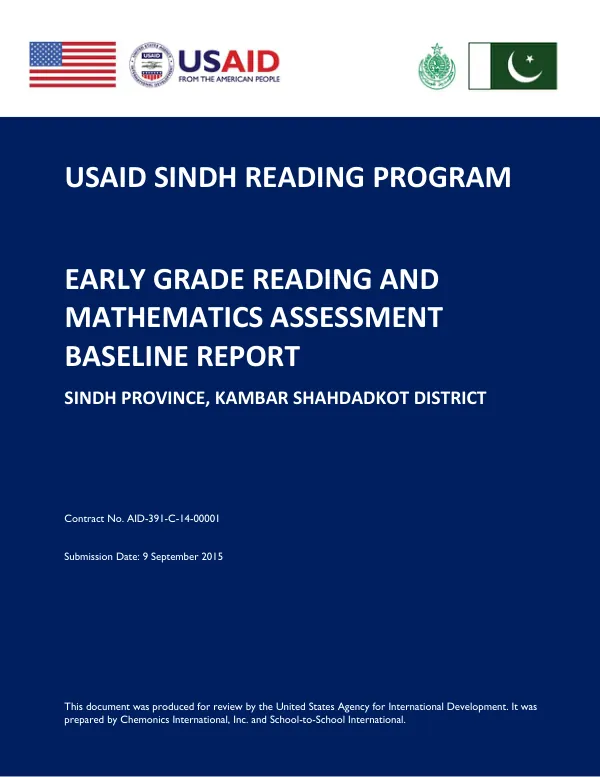
USAID SINDH READING PROGRAM EARLY GRADE READING AND MATHEMATICS ASSESSMENT BASELINE REPORT SINDH PROVINCE, KAMBAR SHAHDADKOT DISTRICT
Sign inCHEMONICS
USAID SINDH READING PROGRAM EARLY GRADE READING AND MATHEMATICS ASSESSMENT BASELINE REPORT SINDH PROVINCE, KAMBAR SHAHDADKOT DISTRICT
The Early Grade Reading and Mathematics Assessment Baseline Report for Sindh Province, Kambar Shahdadkot District, was conducted in September 2015.
2015 · 82 pages
Sign in to readA free account is required to download.
Abstract
The report presents the findings of the assessment, which aimed to establish a baseline for the USAID Sindh Reading Program. The assessment was conducted in 120 schools, with 1,200 students in Grade 3 and 1,200 students in Grade 5 participating. The Early Grade Reading Assessment (EGRA) and Early Grade Mathematics Assessment (EGMA) were administered to students in both grades. The EGRA test structure consisted of 12 tasks, including phonics, reading fluency, and comprehension. The EGMA test structure consisted of 12 tasks, including mathematics fluency and computation. The assessments were designed to measure students' reading and mathematics skills, as well as their ability to apply these skills in real-world contexts. The results of the EGRA and EGMA assessments showed that students in both grades performed below the expected levels. In Grade 3, the average phonics and reading fluency scores were 40% and 30%, respectively. In Grade 5, the average phonics and reading fluency scores were 50% and 40%, respectively. The results also showed that students who spoke a language other than Urdu at home performed lower on the assessments than students who spoke Urdu at home. The EGMA results showed that students in both grades performed below the expected levels in mathematics fluency and computation. In Grade 3, the average mathematics fluency score was 30%, and the average computation score was 40%. In Grade 5, the average mathematics fluency score was 50%, and the average computation score was 60%. The report also presents the results of the contextual variables assessment, which aimed to identify factors that may be associated with students' reading and mathematics performance. The results showed that students who reported practicing reading at home, reading stories aloud to someone, and studying or completing classwork with classmates performed higher on the assessments than students who did not report these activities. The report concludes that the baseline assessment provides a critical foundation for the USAID Sindh Reading Program. The findings highlight the need for targeted interventions to improve students' reading and mathematics skills, particularly in areas such as phonics, reading fluency, and mathematics fluency. The report recommends that the program focus on developing teacher capacity, improving instructional materials, and increasing access to reading and mathematics resources for students. The assessment results also highlight the importance of considering contextual variables when designing interventions. The report recommends that the program take into account the language spoken at home, the availability of reading materials, and the frequency of reading practice when developing interventions. Overall, the Early Grade Reading and Mathematics Assessment Baseline Report provides a comprehensive overview of the reading and mathematics skills of students in Sindh Province, Kambar Shahdadkot District. The report highlights the need for targeted interventions to improve students' skills and provides recommendations for the USAID Sindh Reading Program.