THE CLOUDBURST GROUP
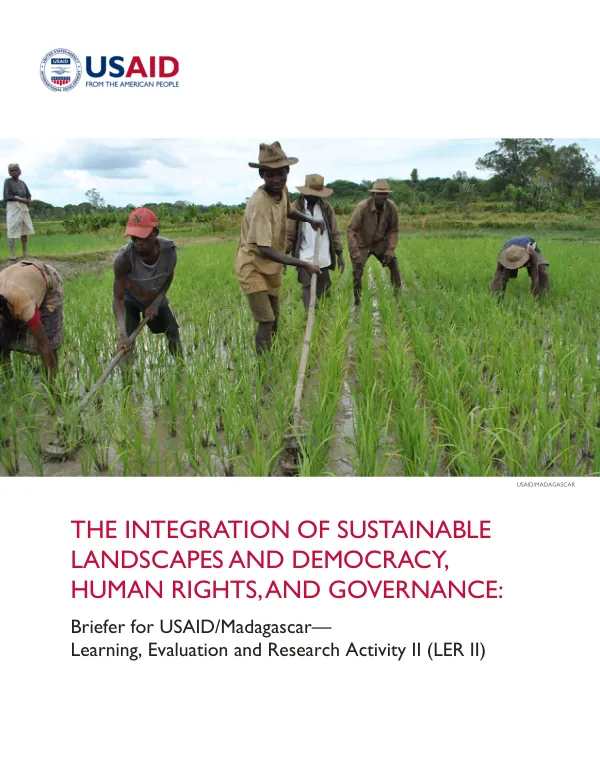
SL-DRG Integration: Briefer for USAID/Madagascar
The link between Democracy, Human Rights, and Governance (DRG) and Sustainable Landscapes (SL) in Madagascar is profound.
2021 · 16 pages
Sign in to readA free account is required to download.
Abstract
Strength of governing institutions combined with a lack of transparency and accountability has led to short-term, self-enriching land use and management approaches by competing political and economic elites. This inability to break the cycle has resulted in continued environmental degradation, including significant loss of forests and marine areas, which threatens the existence of several wildlife species. The United States Agency for International Development (USAID) has been active in Madagascar for more than three decades, providing assistance and relief in areas of health, food security, and natural disaster response. USAID/Madagascar's health initiatives address maternal and child mortality, access to potable water and sanitation, malaria prevention, family planning, and community health. The agency works with Madagascar's government to improve farm productivity and profitability and access to markets, while cooperation with the private sector seeks to increase investment and risk-sharing and contribute to Madagascar's economic growth. Environmental programs focus on protecting ecosystems and species, while creating jobs and increasing local management and ownership of natural resources. USAID is also involved in the largest relief efforts in the country for communities affected by droughts and other disasters. The Mission has encouraged programmatic integration across sectors, including using a common approach to engage with local partners in government, civil society, and the private sector. USAID's Conservation and Communities Project (CCP) supports the protection of Madagascar's natural capital through conservation of biodiversity, promotion of resilient livelihoods, and concrete actions to secure effective local management and ownership. Through CCP, USAID has partnered with the United States Forest Service to provide support to Madagascar's Reducing Emissions from Deforestation and Forest Degradation (REDD+) efforts by assisting with their Camphor Forest Inventory and Carbon Quantification projects. USAID is also helping coastal communities measure carbon stocks in mangroves and increase their ability to manage key natural resources. Two new environment activities, Mikajy and Hay Tao, have been developed using the Nature, Wealth, and Wealth (NWP) framework, which is featured in the USAID SL-DRG Guide. These activities have incorporated thinking on how governance, markets, livelihoods, and natural resource use intersect. USAID/Madagascar is currently drafting a new Country Development Cooperation Strategy (CDCS) that aims to strengthen governance, promote economic growth, and reinforce human capacity to improve Malagasy well-being and resilience. The 2019 Tropical Forestry and Biodiversity Analysis (FAA 118-119) is an excellent resource for guiding the integration of SL and DRG as the Mission moves forward with programming. Findings and recommendations from the FAA 118-119 are incorporated below, and an excerpt from the document containing key recommendations that pertain to SL and governance is presented as an annex to this primer. Key issues for SL-DRG integration include building staff capacity to integrate Political Economy Analysis (PEA) and Thinking and Working Politically (TWP) into SL and all programming. Given the importance of political and power relations in shaping natural resource outcomes at all levels, it is imperative to think through how proposed programs will be influenced by these relations. Strengthening land rights and tenure is also crucial, as weak land tenure for farmers and dwellers creates incentives to deforest in order to claim land. SL-DRG integration recommendations include supporting civil society to advocate for strengthened tenure, including education programming on land rights and tenure in the context of land and forest preservation. A user-friendly guide on land access and tenure would help USAID and non-governmental organization (NGO) partners in this regard. Reviewing the 2019 trip report by USAID's land team, which contains sound recommendations for tenure reform, is also recommended. Note that there are risks of conflict associated with land reform and strengthening tenure, and sound stakeholder analysis, monitoring, and safeguards should complement any programming in this area. Improving land planning processes to address overlapping and conflicting land uses is also essential. SL-DRG integration recommendations include considering local research organizations and civil society to reduce "data asymmetry" to advocate for transparency and access to data. Creating a public unified map of all land uses and other approaches to promote collaboration among ministries and other government entities at the national and local levels is also recommended. Spatial planning should align with development policies and strategies and comply with regulations, and using PITA principles for stakeholder analysis, monitoring, and safeguards is needed. Addressing decentralization is also crucial, as weak law enforcement, lack of services, and growth of the "informal sector" hinder sustainable development. SL-DRG integration recommendations include reviewing DRG analyses of decentralization and the case of USAID/Uganda's Strengthening Decentralization for Sustainability (SDS) activity, which supported decentralization processes in several sectors but was centered on DRG. This approach could be used in Madagascar with local government units. In the case of Madagascar, however, decentralization requires not just supporting districts, but setting up a financial
Related documents