USAID. MISSION TO GUATEMALA
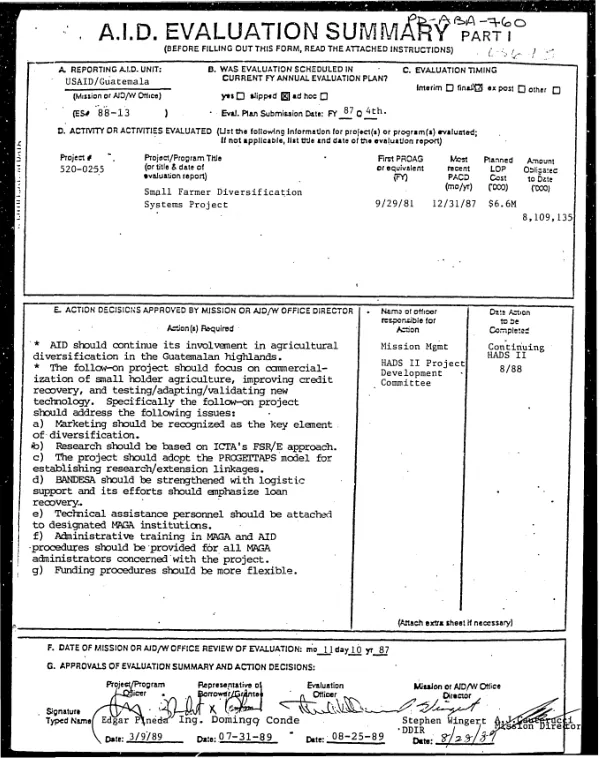
Small farmer diversification systems
PES of a mid-term evaluation (unattached) of project to help the Government of Guatemala (GOG) to promote agricultural diversification among small farmers in the Altiplano.
Trujillo, Audon · 1986
Sign in to readA free account is required to download.
Abstract
Evaluation covered the period 4/81-6/85 and was based on document review, site visits, and interviews with personnel of participating agencies and with farmers. The project is behind schedule (only 30% of funds have been utilized). Major problems have been: lack of coordination among the four, traditionally competitive Guatemalan implementing units; lack of GOG contributions; failure to concentrate resources within the selected Diversified District of Region I; slowness in contracting TA (several long- and short-term positions are still vacant); and tardiness in developing and implementing annual workplans. External factors affecting implementation have included guerilla activity, which caused project sites to be changed several times during 1982-85, and an economic decline which has increased the cost of production inputs and thus may make it difficult to reach the planned 5,000 farmers. Progress in applied research and technology adaptation has been slow. The project design assumed that ICTA (the Ministry of Agriculture"s research arm) possessed enough technological information to initiate diversified farm programs involving vegetables, deciduous fruit, and livestock. In fact, ICTA has had little experience in this area and has been reluctant to provide production recommendations. Research also needs to be refocused from on-station to model farms. Training is on target, but curriculum packages have not yet been developed. Progress in providing credit has been noteworthy. Extension to farm wives has been deemphasized in favor of activities more directly abetting production and should be stepped up. It appears that the marketing infrastructure being developed under a complementary project will be inadequate to absorb the production increases that are expected to be generated. Despite these problems, project purpose and objectives remain valid and the work on model farms, although only recently begun, represents significant preparation for technology diffusion. A 2-3 year extension has been recommended, along with an expanded training program to reach all key participants. Lessons learned are: (1) in projects involving several agencies, designers should carefully assess the capacities and TA needs of each and should designate a lead agency; (2) projects to strengthen public agricultural agencies should specify a timetable for developing curriculum and conducting training so that local counterparts can assume these activities at project end.
Related documents