USAID. MISSION TO GUATEMALA
Small farmer diversification systems project
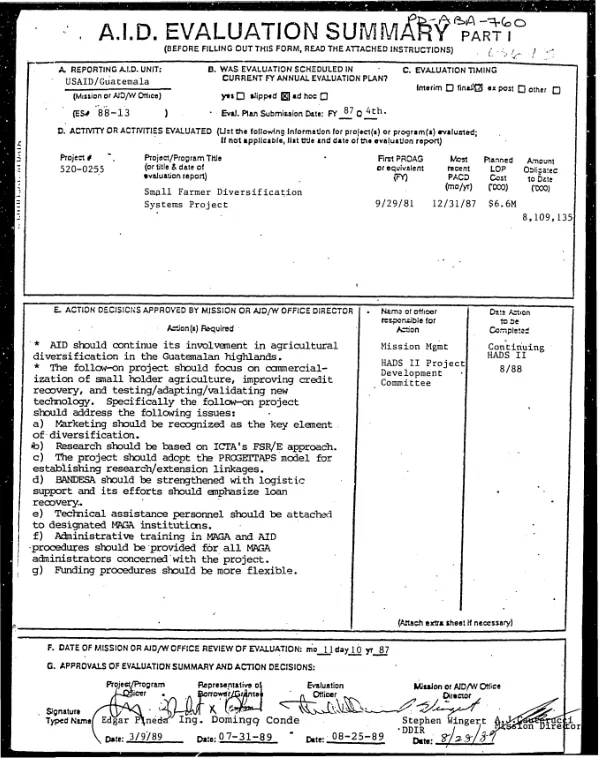
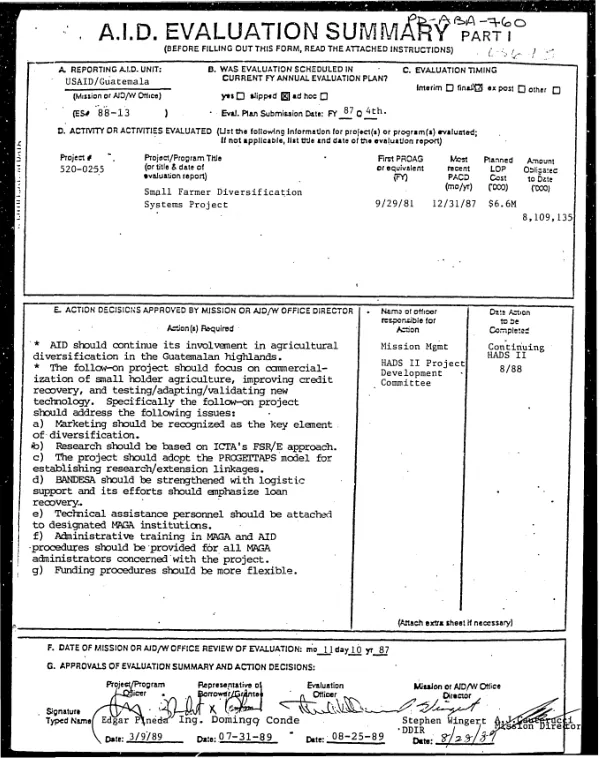
Summarizes final evaluation (XD-ABA-760-A) of a project to help small farmers in Guatemala"s western highlands to diversify and expand production by strengthening four Guatemalan agencies: the Instituto de Ciencia y Tecnologia Agricola (ICTA), the Direccion General de Servicios Pecuarios (DIGESEPE), the Direccion General de Servicios Agricola (DIGESA), and the Banco Nacional de Desarrollo Agricola (BANDESA).
1989
Sign in to readA free account is required to download.
Abstract
The evaluation covered the period 9/81-10/87. The project had a significant positive impact. Beneficiary farms are clearly superior to non-beneficiary farms in terms of on-farm capital investment, available working capital, agricultural investments, volume and variety of commodities produced, diversity of household economic base, and net income. Overall, the project had a 60% weighted achievement rate at the farm level, with a 15% internal rate of return. On the institutional level, research units for livestock, vegetables, and fruit were established in ICTA; DIGESA increased its extension activities in fruit and vegetable production; DIGESEPE"s veterinary program was expanded to include animal production and reoriented towards livestock farm management; and BANDESA"s loan portfolio was expanded to include diversification loans for fruit, vegetables, livestock, soil conservation, and small-scale irrigation. Despite all their faults, the two extension agencies - DIGESA and DIGESEPE - were the strongest components of the diversification effort. These achievements were attained despite many design and implementation problems. Major design flaws included: (1) lack of a marketing component; (2) an emphasis on production targets before the necessary institutional capacity was created and research results were available for extension; (3) the development of a new, complex approach to farming systems research/extension rather than employment of ICTA"s established and well-known approach; (4) insufficient personnel and logistic support for BANDESA, resulting in a projected loan default rate of 35%; (5) poor indicators for institutional development; (6) inadequately defined roles for the TA team; (7) conflicting sets of roles and responsibilities between the coordinating unit and the regional implementing agencies; (8) inadequately funded technology validation and testing activities; and (9) an overly ambitious and inappropriate baseline survey. In reference to implementation, the project started up very slowly and experienced frequent changes in leadership within the Ministry of Agriculture, ICTA, DIGESA, and USAID/G. The coordinating unit"s lack of familiarity with A.I.D. procedures resulted in delays in equipment procurement and in construction of laboratories, a training center, and other infrastructure. Exacerbating these problems were a two-year delay in providing a Spanish translation of the project paper to regional authorities and the failure to adjust the Quetzal budgets following devaluation, which led to underfunding of some project items and incomplete disbursement of loan funds.
Related documents