USAID DEC
Small-Scale Irrigation Applications for Smallholder Farmers in Ethiopia Ex Ante Analysis of Options
Sign inINTERNATIONAL FOOD AND POLICY RESEARCH INSTITUTE
Small-Scale Irrigation Applications for Smallholder Farmers in Ethiopia Ex Ante Analysis of Options
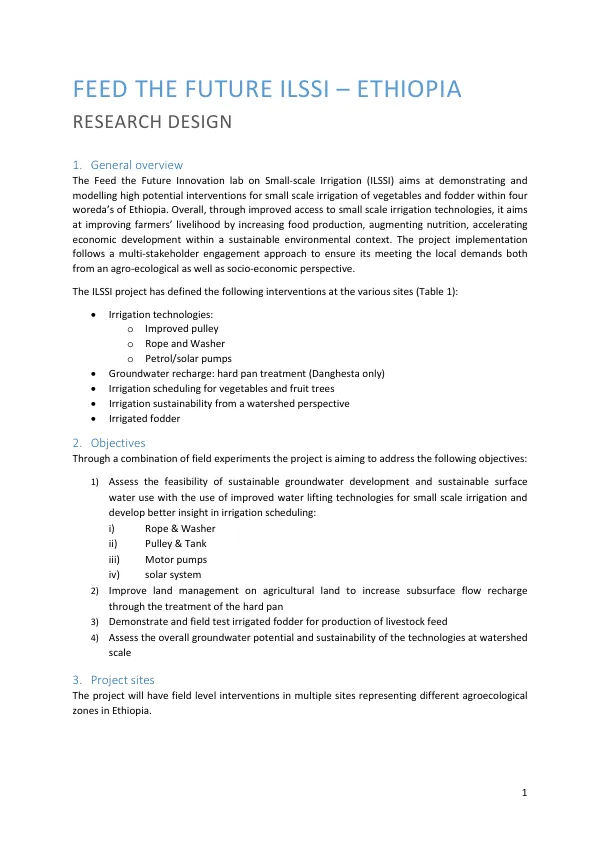
The USAID Feed the Future Innovation Laboratory for Small-Scale Irrigation (ILSSI) conducted an ex ante analysis of small-scale irrigation (SSI) options in Ethiopia.
2016 · 16 pages
Sign in to readA free account is required to download.
Abstract
The research aimed to increase food production, improve nutrition, accelerate economic development, and protect the environment in rural Ethiopia. ILSSI integrated natural resources, agricultural, and socioeconomic data with input from local farm families, local agronomic research, and powerful natural resource, agronomic, and farm-scale economic models. ILSSI combines the expertise of the International Water Management Institute (IWMI), the International Livestock Research Institute (ILRI), North Carolina A&T State University (NCAT), the International Food Policy Research Institute (IFPRI), and Texas A&M University (TAMU). The project involves close interaction with international, national, and local agriculture and rural development professionals, local farm families, and university faculty and students engaged in agricultural and rural development research in the target regions. The ILSSI research focuses on three major components: field studies evaluating selected SSI methods, household surveys to assess and evaluate gender, nutrition, and economic consequences of SSI interventions, and the application of a suite of integrated models to quantitatively estimate the impact of SSI on production, environmental, and economic outcomes. The Integrated Decision Support System (IDSS) is a key component of ILSSI, using a suite of previously validated, interacting, and spatially explicit agroecosystem models to predict short and long-term changes in crop and livestock production, farm economies, and environmental services. ILSSI analyzed proposed SSI interventions in watersheds located in four different woredas in Ethiopia: Bahir Dar Zuria (BDZ) and Dangila, both in the Amhara region; Adami Tulu, in the Oromia region; and Lemo, in the Southern Nations, Nationalities and Peoples (SNNP) region. The research evaluated maximizing the use of SSI to produce high-value crops during the dry season, simulating the use of shallow groundwater for SSI and comparing five alternative water-lifting technologies. For each site, all three ILSSI component models were used in an interactive and integrated fashion. The Soil and Water Assessment Tool (SWAT) simulated watershed-scale hydrology and soil erosion, while the Agricultural Policy Environmental Extender (APEX) analyzed the impacts of the proposed SSI interventions on crop yields and soil erosion at the field scale. The Farm Scale Nutrition and Economic Risk Assessment Model (FARMSIM) determined the effects of the proposed SSI interventions on farm family livelihoods and nutrition. Simulations with the integrated and interactive IDSS models allowed ILSSI to evaluate the land appropriate for SSI of dry-season crops at each of the four sites, the amount of irrigation water required for the proposed SSI interventions, and the complete hydrology of each watershed with and without the proposed SSI interventions. The research also evaluated the impacts of various farming practices on crop yields, watershed hydrology, and farm economies when implemented in conjunction with the proposed SSI interventions. The results of the IDSS ex ante analyses of proposed SSI interventions in Ethiopia indicate large potential for increased SSI in BDZ, Dangila, and Lemo, with simulations showing that the proposed SSI interventions could be sustained by shallow groundwater recharge without affecting long-term groundwater storage. However, simulations of watershed-scale hydrology in Adami Tulu indicated that groundwater recharge rates might be inadequate to support extensive SSI.