USAID DEC
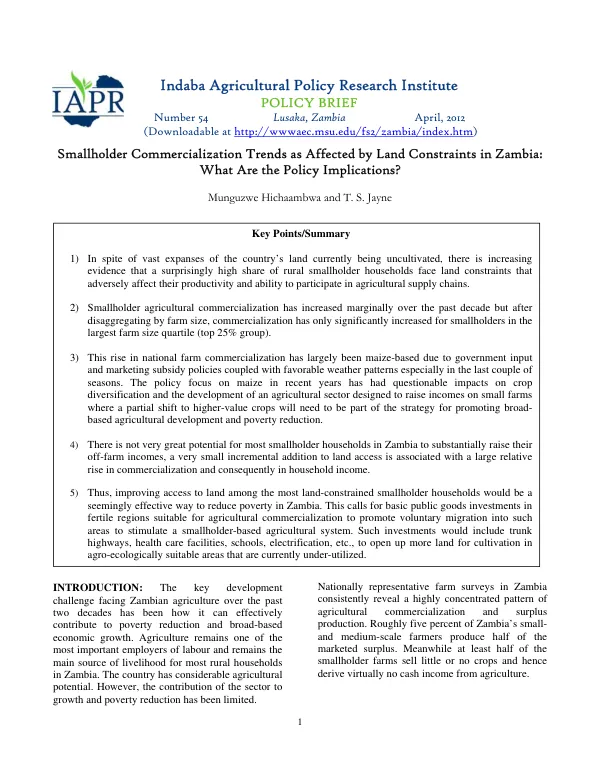
Smallholder Commercialization Trends as Affected by Land Constraints in Zambia: What Are the Policy Implications?
Sign inMACEDONIAN MINISTRY OF AGRICULTURE, FORESTRY AND WATER ECONOMY
Smallholder Commercialization Trends as Affected by Land Constraints in Zambia: What Are the Policy Implications?
The agricultural sector in Zambia has been a key employer of labor and main source of livelihood for most rural households over the past two decades.
2012 · 5 pages
Sign in to readA free account is required to download.
Abstract
However, the sector's contribution to growth and poverty reduction has been limited. Nationally representative farm surveys consistently reveal a highly concentrated pattern of agricultural commercialization and surplus production, with roughly five percent of Zambia's small- and medium-scale farmers producing half of the marketed surplus. Smallholder agricultural commercialization has increased marginally over the past decade, but after disaggregating by farm size, commercialization has only significantly increased for smallholders in the largest farm size quartile, which represents the top 25% of households. This rise in national farm commercialization has largely been maize-based due to government input and marketing subsidy policies, as well as favorable weather patterns in recent years. The policy focus on maize has had questionable impacts on crop diversification and the development of an agricultural sector designed to raise incomes on small farms. Empirical investigation of the importance of inadequate access to land in constraining smallholder commercialization and farm incomes in Zambia is still lacking. However, analysis of nationally representative data for the 2010/11 agricultural season shows that 54% of smallholder households in Zambia cultivated all the land they owned, while only 41% cultivated less land than they owned, and 5% cultivated more land than they owned through renting or borrowing land. This gives rise to the paradox of smallholder rural households facing land constraints in the midst of apparent land abundance. Smallholder commercialization has marginally increased over the past decade, with smallholder mean crop sales per household, proportion of households selling, and the Household Commercialization Index (HCI) fluctuating in the last eleven seasons but showing a general increase, especially in the last two seasons. This increase is attributed mostly to an increase in maize sales as a result of favorable weather facilitating production, and government input and marketing subsidy programs making maize production and marketing more attractive to smallholders. Commercialization has only significantly increased for smallholders with relatively larger farm sizes, while crops sales among households in the least farm size quartile have remained more or less the same. Commercialization has largely been maize-based, achieved at the expense of crop diversification, which negates the policy of diversification of the economy and the agricultural sector up to the crop subsector levels. Only a minority of smallholder households in Zambia account for most of the maize sales, with the proportion of smallholder households accounting for the top 50% of the value of maize sales ranging from 1.3% to 8.6% over the period 2000/1 to 2010/11.
Related documents