USAID DEC
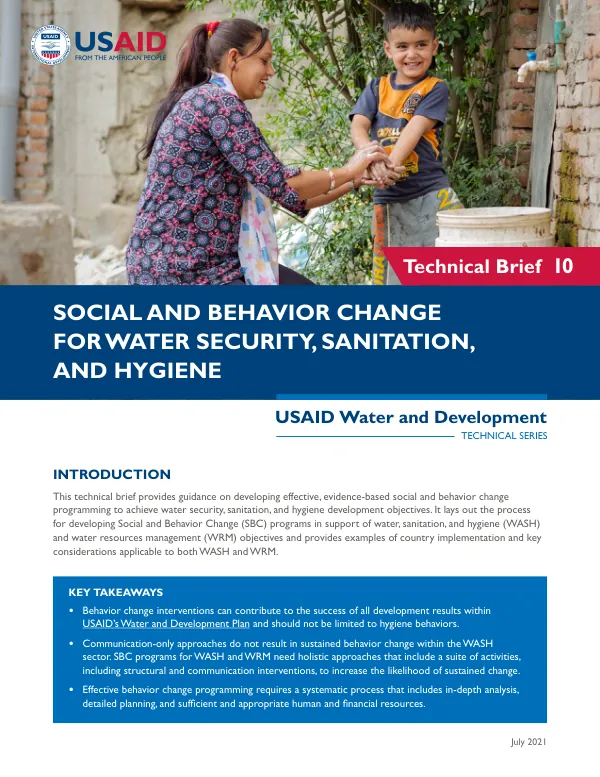
Social and Behavior Change for Water Security, Sanitation, and Hygiene Technical Brief 10
Sign inUSAID
Social and Behavior Change for Water Security, Sanitation, and Hygiene Technical Brief 10
Social and Behavior Change for Water Security, Sanitation, and Hygiene, and Water Resources Management is a critical component of development programs.
2021 · 13 pages
Sign in to readA free account is required to download.
Abstract
Behavior change interventions can contribute to the success of all development results within USAID's Water and Development Plan and should not be limited to hygiene behaviors. Communication-only approaches do not result in sustained behavior change within the WASH sector. SBC programs for WASH and WRM need holistic approaches that include a suite of activities, including structural and communication interventions, to increase the likelihood of sustained change. The WASH sector faces significant challenges, including up to 30 percent of water points being nonfunctional at any time within Africa, communities reverting back to open defecation, and unsustainable water abstraction creating 'day zero' scenarios. Human behavior is fundamental to the success of all development programs, and the WASH and WRM sectors have historically prioritized finding technical solutions over the exploration of behavioral solutions. However, the success of Community Led Total Sanitation (CLTS) in certain contexts illustrates that a focus on behavior is as important as the technical and infrastructure choices in achieving program objectives. The evolution of behavior change approaches has moved beyond a focus on increasing knowledge and awareness, to addressing beliefs, attitudes, and other individual factors. Social and Behavior Change Communication (SBCC) emerged as a more holistic approach, focusing on the use of communication and persuasion as the main vehicle for triggering change. However, recent research on behavioral economics and habit formation has highlighted the need for interventions that address the environmental barriers to support correct, consistent use of the desired behaviors. USAID recommends using SBC, which is the most expansive approach to behavior change. SBC interventions aim to affect key behaviors and social norms by addressing their individual, social, and structural determinants. SBC is grounded in several disciplines, including systems thinking, strategic communication, marketing, psychology, anthropology, and behavioral economics. Within the WASH sector, several studies have shown that environmental interventions such as use of visual nudges can trigger behavior change, particularly for handwashing. Strategic and effective behavior change programming requires a systematic process in the design, implementation, and monitoring of the intervention(s). The SBC process model includes four stages: Define, Understand, Build and Test, and Learn and Adapt. Stage one, Define, involves identifying and prioritizing key behaviors and target audiences. The primary outcome of this stage is a clear definition of the behaviors that contribute to the overall objectives of the program, as well as the target audiences for each behavior. The first step in this stage is to identify and prioritize the key behavior(s). Desired behaviors are the objective of stage one, which is to identify which behavior(s) need to be improved and by whom. This process begins with a thorough analysis of the program's objectives and the behaviors that contribute to achieving those objectives. The target audience for each behavior is also identified, including key influencers and community structures that can block or facilitate change. The next step in stage one is to conduct a thorough analysis of the target audience, including their demographics, behaviors, and motivations. This analysis is critical in understanding the factors that influence the target audience's behavior and identifying the most effective strategies for changing those behaviors. The analysis should also consider the social and environmental determinants of behavior, including access to resources, social norms, and environmental factors. Once the target audience and desired behaviors have been identified, the next step is to develop a clear and concise definition of the behaviors that need to be improved. This definition should be specific, measurable, achievable, relevant, and time-bound (SMART). The definition should also be aligned with the program's overall objectives and the target audience's needs and motivations. The final step in stage one is to prioritize the key behaviors and target audiences. This involves ranking the behaviors and audiences based on their importance and feasibility. The prioritization should be based on a thorough analysis of the program's objectives, the target audience's needs and motivations, and the resources available for the program. The outcome of stage one is a clear definition of the behaviors that contribute to the overall objectives of the program, as well as the target audiences for each behavior. This definition provides a foundation for the next stage of the SBC process, which involves understanding the context in which the behaviors will be changed.
Related documents