USAID
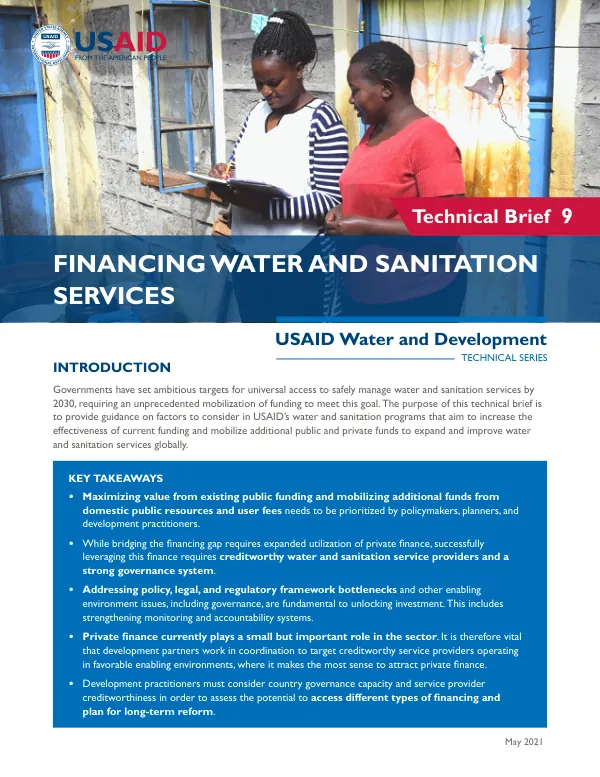
FINANCING WATER AND SANITATION SERVICES
Governments have set ambitious targets for universal access to safely manage water and sanitation services by 2030, requiring an unprecedented mobilization of funding to meet this goal.
2021 · 14 pages
Sign in to readA free account is required to download.
Abstract
The World Bank estimates that $114 billion of capital investment per year is needed to meet universal access to safely managed water, sanitation, and hygiene (WASH) services by 2030. This represents about three times the current estimated global investment and comprises only the capital costs of new infrastructure, not the associated costs of ongoing operations and maintenance. The costs of delivering services must include both the initial costs of infrastructure and ongoing costs, which are sometimes overlooked or underestimated. These costs can be classified under the following categories: Capital Expenditure (CapEx) and Operations and Minor Maintenance Expenditure (OpEx). CapEx includes the capital invested in constructing fixed assets, largely infrastructure, while OpEx includes the recurrent costs for operating water and sanitation systems. The costs of CapEx and OpEx can be further broken down into various categories, including fixed assets, procurement of meters and equipment, salaries of operators and staff, fuel and chemicals, and continued training and monitoring. To meet the costs of providing WASH services, there are three sources of funding: user fees, taxes, and foreign assistance. User fees are fees paid by households, businesses, and public institutions to service providers, as well as household investment in self-supply solutions. Taxes are funds originating from domestic taxes that are channeled to the sector by central, regional, and local governments. Foreign assistance includes funds from international donors and charitable foundations. In general, more resources are needed from all of these sources to meet the funding requirements of the sector. Repayable finance refers to sources of financing that require repayment, such as bonds, commercial loans, concessional loans, or equity. It should be used to finance capital expenditures or replace infrastructure and not used to fill the gap in operating costs. Repayable finance is not considered as a separate source of funding because it depends upon revenue generation from tariffs or government tax revenue to service the debt. The types of repayable finance include bonds, commercial loans, concessional finance, and equity. Each of these types of finance has its own characteristics and requirements, and they can be used in different contexts to fill the finance gap and achieve universal, sustainable WASH services. Maximizing the value of existing public funding and mobilizing additional funds from domestic public resources and user payments are critical to addressing the sector finance gap. This can be achieved by increasing the effectiveness of existing non-repayable finance and potentially mobilizing more. Non-repayable sources of funding include taxes and user fees. The following section outlines key opportunities to increase the effectiveness of existing non-repayable finance and potentially mobilize more. This includes addressing policy, legal, and regulatory framework bottlenecks and other enabling environment issues, including governance, to unlock investment and attract non-traditional financing.